If you’ve recently seen earbuds that don’t go inside your ears and wondered how they even work, you’re not alone.
The idea of open-ear earbuds sounds a bit strange at first. We are used to earbuds that sit inside the ear canal and block outside noise. But these new designs do the exact opposite. They keep your ears open while still playing music.
So the big question is: Are open-ear earbuds actually better than normal earbuds? Or are they just another trend?
In this guide, I’ll break everything down in a simple way. You’ll understand what open-ear earbuds are, how they work, their pros and cons, and who should actually consider buying them.
What Are Open-Ear Earbuds?
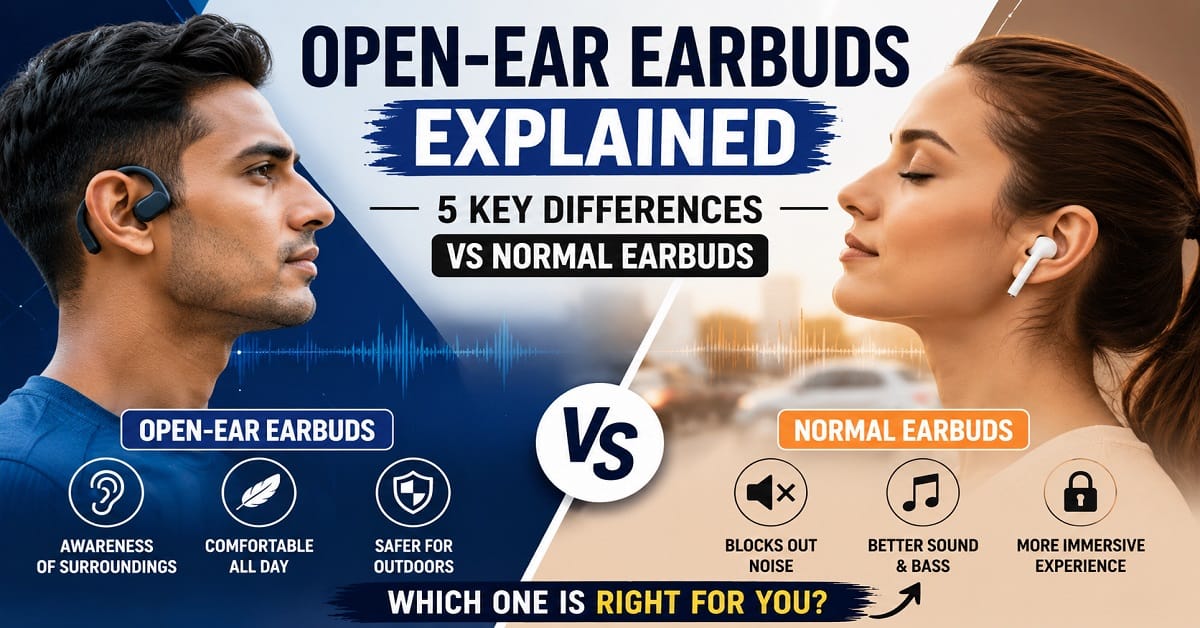
Open-ear buds are a type of earphone that sits outside or just near your ear instead of going inside your ear canal.
In simple terms:
- Normal earbuds = go inside your ears
- Open-ear earbuds = sit outside your ears
Because of this design, your ears stay open. You can hear your surroundings while listening to music or taking calls.
Think of it like this:
It’s similar to playing music on a small speaker that’s very close to your ear, instead of sealing the sound inside your ear.
This is the biggest difference and also the main reason why people are getting interested in open-ear earbuds.
Recommended for you: How to Choose TWS Earbuds: A Complete Beginner’s Guide
How Do Open-Ear Earbuds Work?
Now let’s understand how open-ear buds actually deliver sound without being inside your ear.
There are mainly two technologies used:
1. Air Conduction (Most Common)
This is what most modern open-ear earbuds use.
- Small speakers are placed near your ear
- Sound travels through air into your ear canal
- Your ear remains physically open
So instead of pushing sound directly inside your ear, it “floats” into your ear naturally.
2. Bone Conduction (Less Common)
Some open-ear earbuds use bone conduction.
- They sit on your cheekbones
- Sound travels as vibrations through bones
- Your eardrum is bypassed
This technology is more common in sports headphones.
Simple Analogy
Imagine two situations:
- Normal earbuds: Like closing a door and playing music inside a room
- Open-ear earbuds: Like keeping the door open and playing music near it
You still hear the music, but you also hear everything around you.
Types of Open-Ear Earbuds
Not all open-ear earbuds are the same. Here are the main types:
1. Clip-On Style
- Clips gently onto your ear
- Lightweight and minimal design
- Good for casual use
2. Ear Hook Design
- Wraps around your ear like sports headphones
- More stable fit
- Best for running and workouts
3. Bone Conduction Style
- Rests near cheekbones
- Used mainly by fitness enthusiasts
- Slightly different sound experience
Each type of open-ear earbuds focuses on comfort and awareness rather than isolation.
Advantages of Open-Ear Earbuds
Let’s look at why people are choosing open-ear earbuds.
1. You Stay Aware of Your Surroundings
This is the biggest advantage.
- You can hear traffic while walking or cycling
- You won’t miss announcements at stations
- Safer for outdoor use
Example:
If you are jogging on a road, normal earbuds can block car sounds. Open-ear earbuds keep you aware.
2. More Comfortable for Long Use
Since nothing goes inside your ear:
- No ear pain
- No pressure buildup
- No irritation after long hours
Great for people who don’t like in-ear tips.
3. Better for Calls in Some Situations
Because your ears are open:
- Your own voice sounds natural to you
- You don’t feel “blocked” while talking
This can feel more comfortable during long calls.
4. Hygienic and Sweat-Friendly
- Less earwax buildup
- Easier to clean
- Good for gym and outdoor use
You Might Also Like: Do Expensive TWS Earbuds Really Sound Better?
Limitations of Open-Ear Earbuds
Now let’s be honest. Open-ear earbuds are not perfect.
1. Weak Bass and Sound Quality
Because sound is not sealed:
- Bass feels lighter
- Sound is less immersive
- Not ideal for music lovers who want deep sound
Example:
If you love heavy bass songs, you might feel disappointed.
2. Sound Leakage
People around you might hear your audio, especially at high volume.
- Not ideal for quiet places like libraries
- Can disturb others nearby
3. Not Good in Noisy Environments
Since your ears are open:
- Outside noise mixes with your music
- Difficult to enjoy audio in crowded areas
Example:
In a busy bus or market, you may struggle to hear clearly.
4. Limited Noise Isolation
Unlike normal earbuds:
- No passive noise cancellation
- No proper ANC experience
Open-Ear Earbuds vs Normal Earbuds
Let’s compare clearly so you can decide.
| Feature | Open-Ear Earbuds | Normal Earbuds |
|---|---|---|
| Fit | Outside ear | Inside ear |
| Awareness | High | Low |
| Sound Quality | Moderate | Better |
| Bass | Low | Strong |
| Comfort | Very high | Depends |
| Noise Isolation | None | Good |
| Safety Outdoors | High | Lower |
Simple Conclusion:
- Choose open-ear earbuds → if safety and comfort matter
- Choose normal earbuds → if sound quality matters
Practical Use Cases
Here’s where open-ear earbuds actually make sense.
1. Running and Cycling
You stay aware of vehicles and surroundings.
2. Office Work
You can listen to music and still hear colleagues.
3. Online Meetings
You can hear your own voice naturally while talking.
4. Walking in Public Places
Safer compared to fully isolating earbuds.
Keep Reading: Are TWS Earbuds Safe for Health? Myths vs Facts Explained Simply
Are Open-Ear Earbuds Better Than Normal Earbuds?
This depends on your usage.
They are better if you:
- Care about safety outdoors
- Want all-day comfort
- Don’t like in-ear designs
They are not better if you:
- Want powerful bass
- Need immersive sound
- Travel in noisy environments
So it’s not about better or worse. It’s about what suits your lifestyle.
FAQs About Open-Ear Earbuds
1. Are open-ear earbuds safe for ears?
Yes, they are generally safe. In fact, they can be safer because they don’t block your ears completely and often encourage lower volume usage.
2. Do open-ear earbuds have bass?
They do have bass, but it is much lighter compared to normal earbuds. Don’t expect deep or punchy bass.
3. Can people hear my music?
Yes, at higher volumes there can be sound leakage. It’s noticeable in quiet environments.
4. Are open-ear earbuds good for calls?
They can be good for calls in quiet environments. But in noisy places, background noise may affect call quality.
5. Are open-ear earbuds worth buying?
They are worth it if your priority is comfort, safety, and awareness. For pure sound quality, normal earbuds are still better.
Final Thoughts
Open-ear earbuds are not just a trend. They solve a real problem that many users face with traditional earbuds.
If you often feel uncomfortable with in-ear designs or want to stay aware while listening to audio, open-ear buds can be a great option.
But if your main goal is enjoying music with strong bass and immersive sound, normal earbuds are still the better choice.
Simple Advice:
- Go for open-ear buds → for outdoor use, comfort, and safety
- Go for normal earbuds → for music, movies, and deep sound
If possible, try both types once. You’ll quickly understand which one fits your lifestyle better.

About the Author
Hari Prasad is the editor of AudioPick.in and a lifelong audio enthusiast. He writes detailed, honest reviews and guides to help everyday users pick the right gear without tech jargon. His personal interest in Bluetooth audio, neckbands, and codecs comes from testing dozens of devices over the past few years.