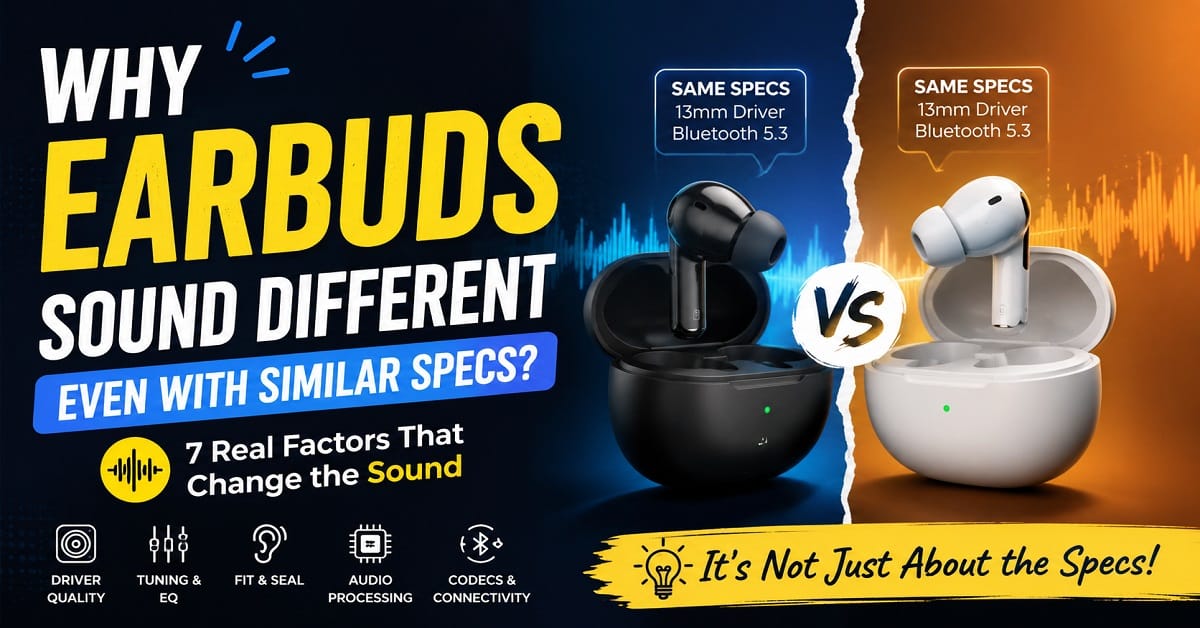
If you’ve ever compared two earbuds that both claim to have “13mm drivers,” “Bluetooth 5.3,” or “deep bass,” but one sounds amazing while the other feels dull or harsh, you’re not imagining things.
Many people assume that earbuds with similar specifications should sound almost the same. But in real life, that rarely happens. Two earbuds can look nearly identical on paper and still deliver completely different listening experiences.
That’s because audio quality is influenced by many hidden factors that brands don’t fully explain in spec sheets.
In this article, we’ll break down why earbuds sound different even with similar specs in the simplest way possible. You’ll learn what actually affects sound quality, why tuning matters more than numbers sometimes, and how to choose earbuds more wisely without getting confused by marketing terms.
Why Earbuds Sound Different Even with Similar Specs: Simple Explanation
The short answer is this:
Specifications only tell a small part of the story.
Think about it like cooking. Two people may use the same ingredients, same stove, and same recipe, but the final taste can still be very different because of technique, balance, and quality of preparation.
Earbuds work the same way.
Even if two earbuds use similar drivers or Bluetooth versions, brands may tune them differently, use different materials, or process audio differently.
That is the main reason why earbuds sound different even with similar specs.
Latest Post: Open-Ear Earbuds Explained: Are They Better Than Normal Earbuds?
What Actually Affects Earbud Sound Quality?
Let’s break down the real factors that influence how earbuds sound.
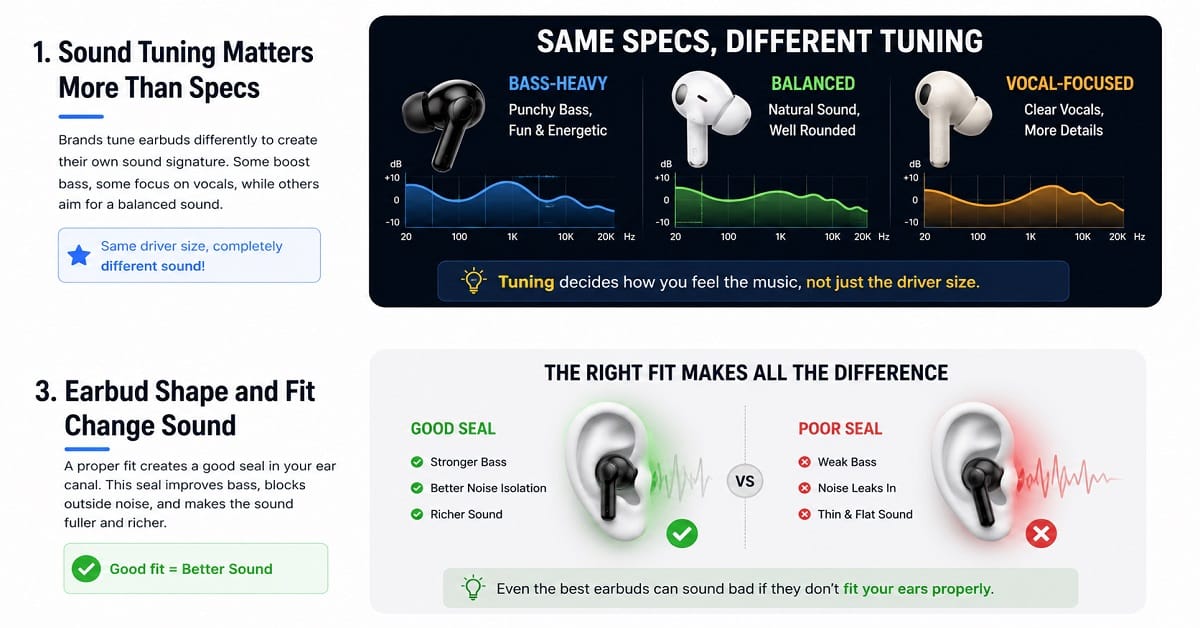
1. Sound Tuning Matters More Than Specs
This is probably the biggest reason.
“Sound tuning” means how the manufacturer adjusts the audio output.
Some brands tune earbuds for:
- Heavy bass
- Clear vocals
- Balanced sound
- Sharp treble
- Gaming footsteps
- Movie watching
For example:
- boAt earbuds often focus on strong bass.
- Soundcore usually aims for a cleaner and more balanced sound.
- Sony earbuds often try to provide richer detail and depth.
Even if all three use similar 10mm or 13mm drivers, the tuning completely changes the listening experience.
This is one of the biggest reasons why earbuds sound different even with similar specs.
Real-Life Example
Imagine two earbuds:
- Earbud A boosts bass heavily
- Earbud B keeps bass controlled and highlights vocals
If you love EDM or hip-hop, you may prefer Earbud A.
If you watch podcasts or listen to old songs, Earbud B may sound better to you.
Neither is “wrong.” They are simply tuned differently.
2. Driver Quality Is More Important Than Driver Size
Many brands advertise:
- 10mm drivers
- 12mm drivers
- 13mm drivers
People often think larger drivers automatically mean better sound.
That’s not true.
A well-made 10mm driver can sound far better than a cheap 13mm driver.
What Is a Driver?
A driver is the tiny speaker inside your earbuds that produces sound.
But size alone doesn’t decide quality.
Other things matter too:
- Driver material
- Magnet quality
- Vibration control
- Engineering
- Airflow design
This is another major reason why earbuds sound different even with similar specs.
Simple Analogy
Think of two cars with the same engine size.
One may feel smooth and powerful, while the other feels noisy and weak because build quality and tuning are different.
Drivers work similarly.
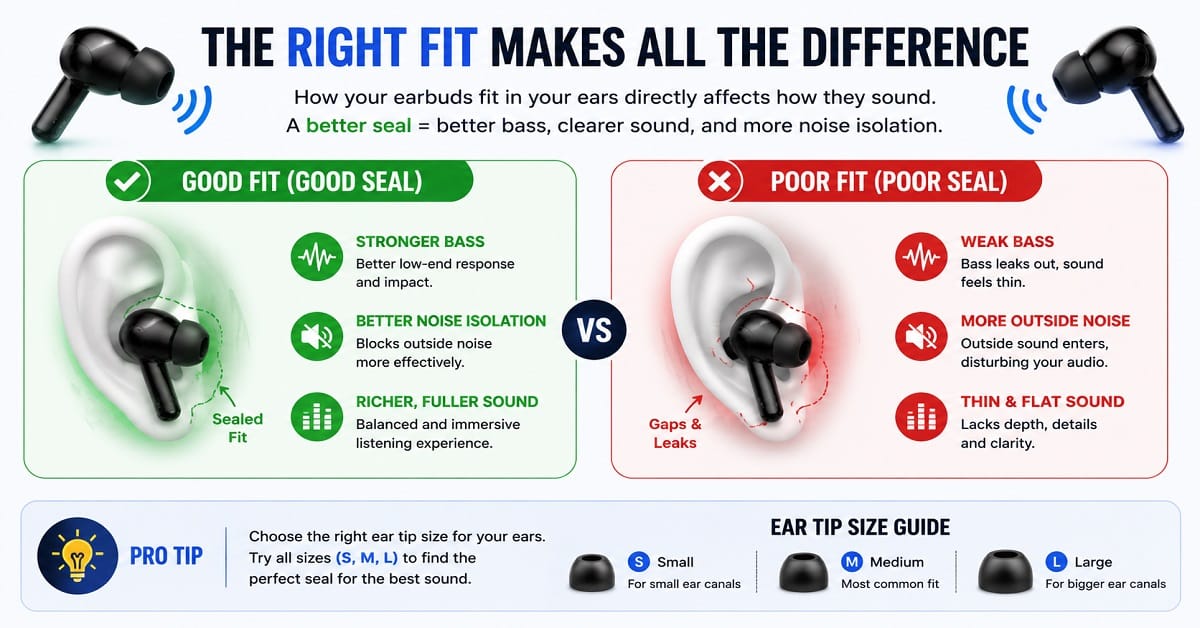
3. Earbud Shape and Fit Change Sound
Many people ignore this factor, but it has a huge impact.
If earbuds don’t fit properly:
- Bass becomes weak
- Outside noise enters
- Audio feels thin
Even expensive earbuds can sound bad with poor fitting ear tips.
Why Fit Matters
Earbuds create a seal inside your ears.
A better seal:
- Improves bass
- Enhances noise isolation
- Makes audio fuller
This is another hidden reason why earbuds sound different even with similar specs.
Example
You may notice this yourself:
- Push earbuds slightly deeper into your ears
- Suddenly bass becomes stronger
That happens because the seal improved.
Recommended for you: Troubleshooting Poor Call Quality on Neckbands: ENC Not Working? (Complete Guide)
4. Audio Processing Software Plays a Huge Role
Modern earbuds don’t just play raw sound.
They use software processing called:
- DSP (Digital Signal Processing)
- EQ tuning
- Audio enhancement algorithms
This software changes:
- Bass strength
- Vocal clarity
- Loudness
- Soundstage
- Treble sharpness
Two earbuds with the same hardware may still sound different because their software processing is different.
This is another important answer to why earbuds sound different even with similar specs.
5. Bluetooth Codecs Affect Sound Quality
You may see terms like:
- SBC
- AAC
- aptX
- LDAC
These are Bluetooth audio codecs.
They control how audio travels wirelessly from your phone to earbuds.
Simple Explanation
Think of codecs like video quality settings:
- Lower codec = more compression
- Better codec = more detail retained
Common Codecs
| Codec | Quality | Common Usage |
|---|---|---|
| SBC | Basic | Budget earbuds |
| AAC | Better clarity | iPhones |
| aptX | Lower latency + cleaner sound | Android |
| LDAC | High-resolution audio | Premium earbuds |
Even if two earbuds have similar drivers, codec support can still change how they sound.
6. Build Quality and Internal Design Matter
This is something spec sheets rarely reveal.
Inside earbuds:
- Air chambers
- Acoustic vents
- Internal wiring
- Material quality
- Shell design
all influence sound.
Premium brands spend more time optimizing these details.
Budget earbuds may use similar advertised specs but cut corners internally.
That’s another reason why earbuds sound different even with similar specs.
7. Your Personal Hearing Preferences Matter Too
Audio is subjective.
Some people love:
- Deep bass
- Sharp treble
- Loud sound
Others prefer:
- Balanced sound
- Soft vocals
- Natural audio
This means the “best sounding earbuds” are different for different people.
Two people can listen to the same earbuds and have completely opposite opinions.
That’s normal.
Why Spec Sheets Can Be Misleading
Most brands highlight:
- Driver size
- Battery life
- Bluetooth version
But they rarely explain:
- Actual tuning style
- Sound balance
- Vocal quality
- Imaging
- Instrument separation
That’s why relying only on specs is risky.
When understanding why earbuds sound different even with similar specs, remember this:
Good sound cannot be fully measured by numbers alone.
Different Sound Signatures Explained
Here are the common sound styles brands use.
Bass-Heavy Sound
- Strong punchy bass
- Fun for EDM and movies
- Sometimes vocals become less clear
Popular in many budget earbuds.
Balanced Sound
- Bass, mids, and treble stay controlled
- Better for mixed music genres
- More natural listening experience
Preferred by many audiophiles.
V-Shaped Sound
- Boosted bass and treble
- Exciting sound
- Vocals slightly pushed back
Very common in consumer earbuds.
Vocal-Focused Sound
- Clear voices
- Great for podcasts and calls
- Bass may feel lighter
Real-Life Situations Where Sound Differences Become Noticeable
While Watching Movies
Some earbuds create:
- Better surround feeling
- Clearer dialogue
- More cinematic audio
Others may sound flat.
During Gaming
Good tuning helps:
- Hear footsteps clearly
- Improve directional awareness
- Reduce audio delay
During Calls
Some earbuds make voices sound natural.
Others sound muffled even with similar mic specs.
While Listening to Music
Bass-heavy earbuds may feel exciting initially but tiring after long listening.
Balanced earbuds often feel more comfortable for longer sessions.
Should You Ignore Specs Completely?
No. Specs still matter.
But they should not be your only buying factor.
Use Specs as a Starting Point
Good indicators include:
- Codec support
- Battery life
- Bluetooth version
- ANC support
But for sound quality:
- Reviews matter more
- Real usage feedback matters more
- Tuning matters more
This is the smartest way to understand why earbuds sound different even with similar specs.
How to Choose Better Sounding Earbuds
Here are some practical tips.
1. Read Real Reviews
Look for:
- Vocal clarity
- Bass control
- Comfort
- Call quality
- Long-term listening experience
Not just star ratings.
2. Understand Your Preference
Ask yourself:
- Do you like bass-heavy sound?
- Do you prefer vocals?
- Are you buying for gaming?
- Mostly for calls?
- Movies?
Choose accordingly.
3. Don’t Fall for Driver Size Marketing
Bigger drivers do not always mean better sound.
4. Check Codec Support
Especially if:
- You use Android
- Stream high-quality music
- Watch many videos
5. Focus on Comfort Too
Even great sounding earbuds become annoying if they hurt your ears after 30 minutes.
Explore Next: What Are the Disadvantages of Noise-Cancelling Headphones? (Complete Guide)
FAQs
1. Why earbuds sound different even with similar specs?
Because sound quality depends on many factors beyond specs, including tuning, driver quality, fit, software processing, codecs, and internal design.
2. Does bigger driver size mean better sound?
No. A well-tuned smaller driver can sound much better than a poorly tuned larger driver.
3. Why do expensive earbuds usually sound better?
Premium brands often use:
Better materials
Advanced tuning
Better software processing
Improved internal acoustic design
That improves overall sound quality.
4. Can ear tips affect sound quality?
Yes, a lot.
A proper seal improves:
Bass
Noise isolation
Audio fullness
Wrong ear tips can make earbuds sound weak.
5. Are Bluetooth codecs important?
Yes.
Better codecs can improve:
Audio detail
Clarity
Latency
Especially on compatible phones.
6. Why do online reviews for the same earbuds differ so much?
Because sound preference is personal.
Some people love bass-heavy tuning while others prefer balanced audio.
7. Should I buy earbuds based only on specs?
No.
Specs are useful, but real-world reviews and tuning matter more for actual sound quality.
Final Thoughts
Now you know why earbuds sound different even with similar specs.
Two earbuds may advertise the same driver size, Bluetooth version, or battery life, but the actual listening experience can still be completely different because of:
- Tuning
- Driver quality
- Fit
- Software processing
- Codec support
- Internal engineering
This is why smart buyers don’t depend only on spec sheets anymore.
If you mainly enjoy bass-heavy music and casual listening, you may prefer fun-sounding earbuds. But if you care about vocals, detail, or long listening comfort, balanced tuning may suit you better.
The best approach is simple:
- Understand your listening style
- Read real-world reviews
- Ignore marketing hype
- Focus on actual experience, not just numbers
That way, you’ll choose earbuds that truly sound good to you, not just on paper.

About the Author
Hari Prasad is the editor of AudioPick.in and a lifelong audio enthusiast. He writes detailed, honest reviews and guides to help everyday users pick the right gear without tech jargon. His personal interest in Bluetooth audio, neckbands, and codecs comes from testing dozens of devices over the past few years.