
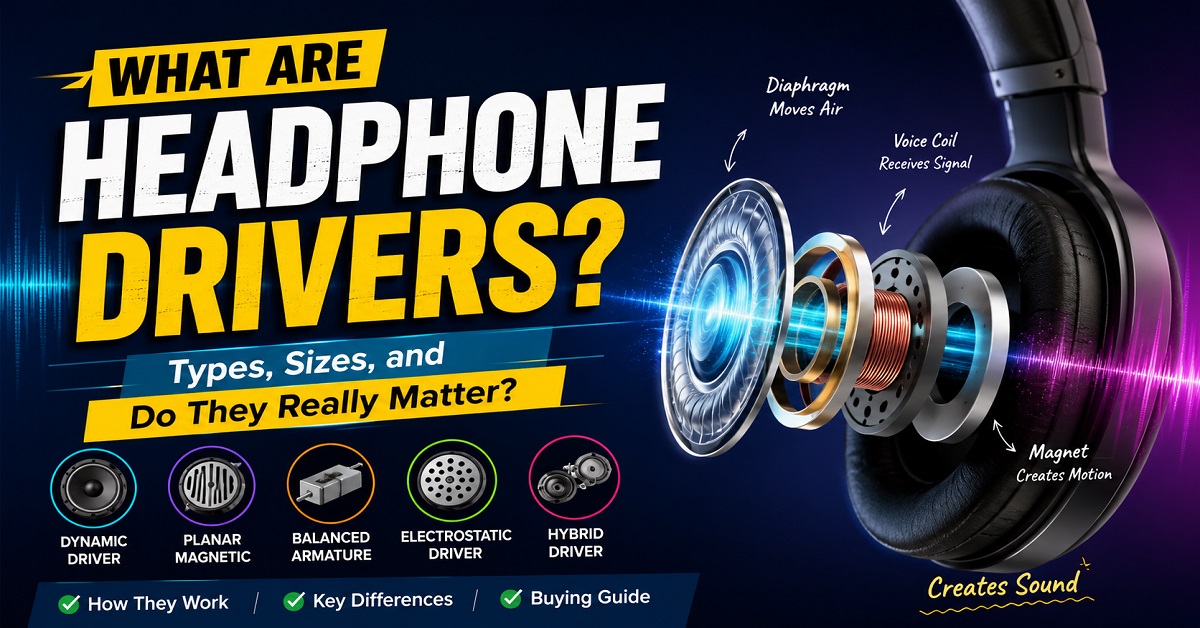
If you’ve ever looked at the specifications of a pair of headphones, you’ve probably come across terms like 40mm drivers, 50mm drivers, dynamic drivers, or planar magnetic drivers. For many people, these technical terms can be confusing. You might even wonder whether a larger driver automatically means better sound quality.
The short answer is not always.
Understanding headphone drivers can help you make a smarter buying decision instead of relying on marketing claims alone. After all, the driver is the part of the headphone that actually creates the sound you hear. It’s often called the “heart” of a headphone because every song, movie, podcast, or phone call depends on how well the driver performs.
In this guide, we’ll explain what headphone drivers are, how they work, the different types available, whether driver size really matters, and what you should actually pay attention to when buying your next pair of headphones. By the end, you’ll be able to read headphone specifications with confidence and know which features truly affect sound quality.
📌 At a Glance
| What is a headphone driver? | A headphone driver is the component inside your headphones that converts electrical signals into sound by vibrating and moving air. |
| Do bigger drivers sound better? | Not always. Larger drivers can produce deeper bass, but sound quality depends more on tuning, materials, and engineering. |
| Best driver type for most people | Dynamic drivers offer the best balance of sound quality, bass performance, efficiency, and affordability. |
| Do multiple drivers improve sound? | Not necessarily. Proper tuning and overall engineering matter more than simply adding more drivers. |
| Buying Tip | Don’t judge headphones by driver size alone. Consider sound tuning, comfort, battery life, features, and trusted reviews before buying. |
What Are Headphone Drivers?
A headphone driver is a small component inside each earcup that converts electrical signals into sound waves. In simple terms, it’s the tiny speaker responsible for producing everything you hear through your headphones.
Think of it like this:
Imagine you’re at a live concert. The singer’s voice travels through large speakers before reaching your ears. Inside your headphones, the driver performs a similar job, but on a much smaller scale. It takes the audio signal from your phone, laptop, or music player and turns it into vibrations that create sound.
Without a driver, your headphones wouldn’t produce any sound at all.
A Simple Example
Suppose you’re listening to your favorite song on your smartphone.
Here’s what happens behind the scenes:
- Your phone stores or streams the music as digital data.
- The phone converts that data into an electrical audio signal.
- The signal travels to your headphones through a cable or Bluetooth connection.
- The headphone driver receives the signal.
- The driver vibrates very quickly, pushing air toward your ears.
- Those tiny air movements become the music, voices, and instruments you hear.
This entire process happens thousands of times every second, creating smooth and detailed audio without you noticing the complex technology involved.
Why Is It Called a “Driver”?
The name “driver” comes from its role in driving or moving air. As the driver vibrates, it pushes and pulls air molecules, creating sound waves that travel into your ears.
The better the driver can control these vibrations, the more accurate and enjoyable the sound becomes.
Every Headphone Has Drivers
Whether you’re using:
- budget wired headphones,
- wireless Bluetooth headphones,
- gaming headsets,
- premium noise-cancelling headphones, or
- studio monitoring headphones,
they all rely on headphone drivers to produce sound. The main difference is the type of driver used, the materials it’s made from, and how well it’s engineered.
This is why two headphones with the same driver size can sound completely different. The driver’s design, tuning, build quality, and the overall acoustic engineering all play a significant role in the final listening experience.
Quick Answer: A headphone driver is the component inside a headphone that converts electrical signals into sound by vibrating and moving air. It acts like a miniature speaker and is the most important part responsible for the audio you hear.
Recent Post: Best Wireless Headphones Under ₹10000 in India (2026)
Check Boat Rockerz 512 ANC with 40 mm drivers
How Do Headphone Drivers Work?
Now that you know what a headphone driver is, let’s understand how it actually produces sound.
Don’t worry, you don’t need an engineering degree to understand it. The basic idea is surprisingly simple.
Imagine placing your hand in a bowl of water and gently moving it back and forth. You’ll notice ripples spreading across the water.
A headphone driver works in a similar way. Instead of creating ripples in water, it creates tiny waves in the air. Those air waves travel into your ears, and your brain recognizes them as music, voices, or other sounds.
Although the process happens thousands of times every second, it can be broken down into a few simple steps.
Step 1: The Audio Signal Reaches the Driver
When you play music on your smartphone, laptop, TV, or gaming console, the device converts the digital music file into an electrical audio signal.
This signal is then sent to your headphones through either:
- A wired connection
- Bluetooth (for wireless headphones)
The driver receives this signal almost instantly.
Step 2: The Voice Coil Creates a Magnetic Field
Inside most headphones is a tiny coil of copper wire called the voice coil.
As electricity flows through the coil, it creates a magnetic field.
You can think of this like turning on a small electromagnet.
Step 3: The Magnet and Voice Coil Move the Diaphragm
Next to the voice coil is a permanent magnet.
The magnetic field from the voice coil interacts with the permanent magnet, causing the coil to move forward and backward very quickly.
Since the coil is attached to a thin membrane called the diaphragm, it also moves back and forth.
The diaphragm is the part that actually pushes air.
Step 4: Air Vibrates and Creates Sound
As the diaphragm moves, it pushes and pulls the surrounding air.
These rapid movements create sound waves.
When those sound waves reach your ears, your brain interprets them as:
- Singing
- Dialogue
- Bass
- Guitar
- Drums
- Movie sound effects
- Game audio
Everything you hear comes from these tiny air vibrations.
A Simple Analogy
Imagine holding a small hand fan.
If you wave it slowly, you’ll feel a gentle breeze.
Wave it faster, and the airflow becomes stronger.
A headphone driver works in a similar way, except it’s moving incredibly fast and with extreme precision.
Instead of producing wind, it’s producing carefully controlled sound waves.
Why Driver Quality Matters More Than Just Driver Size
Many people assume that all drivers work the same.
In reality, manufacturers spend years improving:
- Diaphragm materials
- Magnet strength
- Driver tuning
- Precision engineering
- Airflow management
This is why two headphones with 40mm drivers can sound completely different.
One may have deep, controlled bass and detailed vocals, while another may sound muddy or overly sharp.
The quality of engineering matters far more than simply making the driver larger.
Types of Headphone Drivers
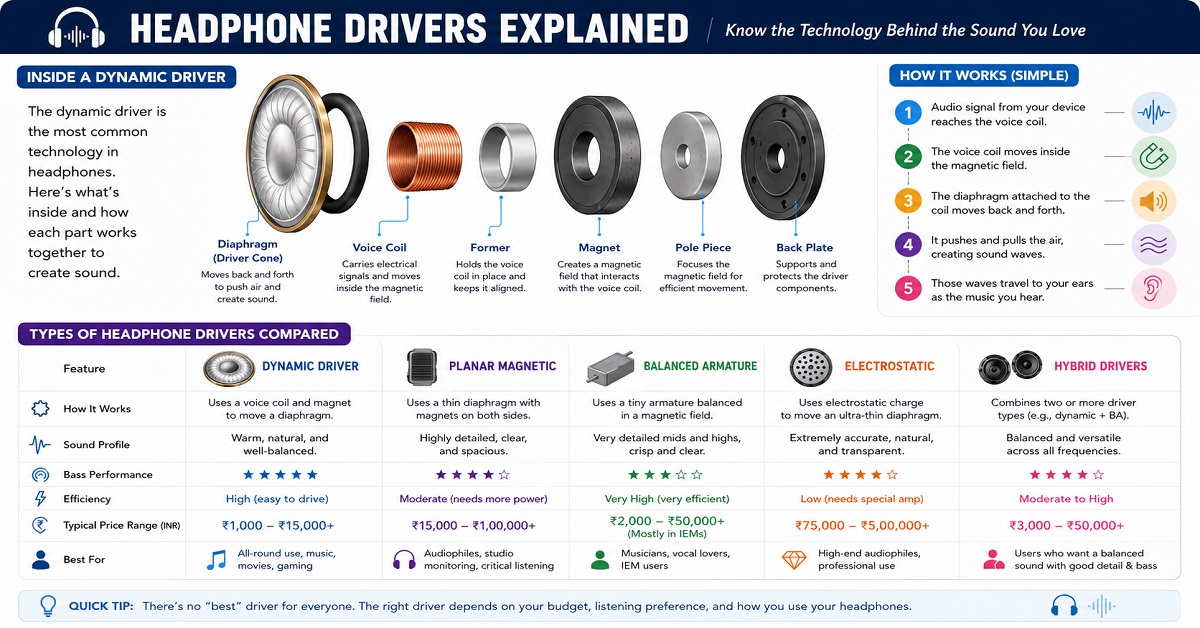
Not all headphone drivers are built the same.
Different driver technologies produce sound in different ways. Some focus on powerful bass, while others prioritize detail, speed, or accuracy.
Let’s look at the most common types you’ll come across.
1. Dynamic Drivers
Dynamic drivers are the most common type found in headphones today.
In fact, if you’ve ever owned a pair of affordable wired headphones, Bluetooth headphones, gaming headsets, or wireless earbuds, chances are they use dynamic drivers.
How They Work
A dynamic driver uses:
- A permanent magnet
- A voice coil
- A diaphragm
As electricity flows through the voice coil, it moves the diaphragm back and forth to create sound.
This is the technology we explained earlier.
Advantages
- Strong bass performance
- Affordable to manufacture
- Durable
- Energy efficient
- Suitable for almost every music genre
Limitations
- May not reproduce extremely fine details as accurately as premium driver technologies.
- Lower-quality dynamic drivers can sometimes sound less refined.
Best For
- Everyday music listening
- Movies
- Gaming
- Office work
- Budget and mid-range headphones
You’ll find dynamic drivers in the majority of headphones sold today.
2. Planar Magnetic Drivers
Planar magnetic drivers are becoming increasingly popular in premium headphones.
Instead of using a traditional cone-shaped diaphragm, they use an ultra-thin flat diaphragm suspended between powerful magnets.
This allows the entire surface of the diaphragm to move more evenly.
Advantages
- Excellent detail
- Very accurate sound
- Wide soundstage
- Fast response
- Tight bass
Limitations
- Usually more expensive
- Larger and heavier
- Require more power to perform at their best
Best For
- Audiophiles
- Professional music production
- Critical listening
If you’re someone who enjoys hearing every tiny detail in your music, planar magnetic headphones can be very rewarding.
3. Balanced Armature Drivers
Balanced armature drivers are commonly used in premium in-ear monitors (IEMs) rather than over-ear headphones.
These drivers are extremely small, making them ideal for compact earbuds.
Instead of producing powerful bass, they excel at reproducing fine details.
Advantages
- Highly detailed sound
- Compact size
- Excellent vocal clarity
- Efficient power consumption
Limitations
- Bass output is usually weaker than dynamic drivers.
- More expensive to manufacture.
Best For
- Musicians
- Audio professionals
- People who prioritize clarity over bass
4. Electrostatic Drivers
Electrostatic drivers are considered among the most advanced headphone technologies available.
Instead of using traditional magnets, they move an incredibly thin diaphragm using an electrostatic field.
The result is exceptionally clean and natural sound reproduction.
Advantages
- Outstanding detail
- Extremely low distortion
- Natural sound
- Exceptional clarity
Limitations
- Very expensive
- Require a dedicated amplifier
- Not designed for everyday users
Best For
- Serious audiophiles
- High-end home listening setups
For most people, electrostatic headphones are more of a luxury than a practical purchase.
5. Hybrid Drivers
Some premium headphones and earbuds combine multiple driver technologies.
For example, a product might include:
- One dynamic driver for bass
- One balanced armature driver for vocals and treble
This is known as a hybrid driver setup.
The idea is simple.
Instead of asking one driver to reproduce every frequency, different drivers handle different parts of the sound.
When implemented well, hybrid designs can offer excellent balance across bass, mids, and highs.
| Driver Type | Overall Detail | Bass Performance | Typical Price Range | Pros | Cons | Best For |
|---|---|---|---|---|---|---|
| Dynamic Driver | Warm, balanced, and natural sound | ★★★★★ | ₹1,000 – ₹15,000+ | Affordable, punchy bass, durable, energy-efficient, widely available | May not offer the same level of detail as premium driver technologies | Everyday music, movies, gaming, and general use |
| Planar Magnetic | Excellent clarity, detail, and soundstage | ★★★★☆ | ₹15,000 – ₹1,00,000+ | Outstanding detail, low distortion, fast response, wide soundstage | Expensive, heavier, often requires more power | Audiophiles, studio work, and critical listening |
| Balanced Armature | Excellent vocal and treble detail | ★★★☆☆ | ₹2,000 – ₹50,000+ (Mostly found in premium IEMs) | Compact, detailed, power-efficient, excellent clarity | Bass is usually less powerful than dynamic drivers | Musicians, IEM users, and vocal lovers |
| Electrostatic | Reference-grade detail and accuracy | ★★★★☆ | ₹75,000 – ₹5,00,000+ | Ultra-low distortion, exceptional clarity, natural sound | Very expensive and requires a dedicated amplifier | Professional audio and high-end audiophile setups |
| Hybrid Drivers | Balanced performance across all frequencies | ★★★★☆ | ₹3,000 – ₹50,000+ | Combines the strengths of multiple driver technologies for a well-rounded sound | Performance depends heavily on tuning and implementation | Users looking for balanced sound across bass, mids, and treble |
Does Driver Size Really Matter?
One of the biggest marketing claims you’ll see is driver size.
Manufacturers often advertise specifications like:
- 30mm drivers
- 40mm drivers
- 50mm drivers
- 53mm drivers
It’s easy to assume that bigger automatically means better.
But that’s only part of the story.
What Does Driver Size Mean?
Driver size refers to the diameter of the diaphragm, measured in millimetres (mm).
Generally speaking:
- Larger drivers can move more air.
- Moving more air makes it easier to reproduce deeper bass frequencies.
However, that doesn’t automatically mean the headphones will sound better overall.
Bigger Drivers Don’t Guarantee Better Sound
Imagine comparing two cars.
One has a larger engine.
The other has a smaller engine but better engineering, suspension, and tuning.
The better-designed car may actually provide the superior driving experience.
Headphones work in much the same way.
A well-engineered 40mm driver can easily outperform a poorly designed 50mm driver.
Several factors influence sound quality, including:
- Driver materials
- Magnet quality
- Diaphragm design
- Acoustic tuning
- Earcup design
- Digital signal processing (DSP)
- Overall build quality
Driver size is just one piece of a much larger puzzle.
Recommended for you: What Is Headphone Impedance and Does It Matter?
Then Why Do Companies Highlight Driver Size?
Because it’s easy to understand.
Most buyers recognize numbers like 40mm or 50mm, even if they don’t fully understand what they mean.
While driver size does matter to some extent, it’s often used as a marketing specification because it’s simple to advertise.
A well-tuned 40mm driver from a reputable brand will almost always sound better than a larger driver with poor tuning.
Do Multiple Drivers Make Headphones Better?
You may have noticed some premium earbuds claiming:
- Dual drivers
- Triple drivers
- Quad drivers
This can make it seem like more drivers automatically mean better sound.
In reality, that’s not always true.
Multiple drivers allow each driver to focus on a specific frequency range. For example, one driver may handle bass while another reproduces vocals and high frequencies.
When engineered correctly, this can improve clarity, separation, and overall balance.
However, simply adding more drivers doesn’t guarantee better performance. If the tuning isn’t done properly, the sound can become inconsistent or unnatural.
For most listeners, the overall sound tuning, build quality, and engineering are far more important than the number of drivers alone.
The best headphone isn’t the one with the biggest or the most drivers. It’s the one where all the components work together to deliver a balanced, enjoyable listening experience.
Advantages and Limitations of Different Headphone Drivers
Every headphone driver has its own strengths and weaknesses. That’s why you’ll find different driver technologies across budget, mid-range, and premium headphones.
The good news is that there isn’t a single “best” driver for everyone. The right choice depends on how you use your headphones and what kind of sound you enjoy.
Advantages of Good Headphone Drivers
Better Sound Quality
A well-designed driver can produce cleaner, richer, and more natural sound. You’ll notice clearer vocals, more detailed instruments, and bass that feels controlled rather than overwhelming.
Improved Instrument Separation
Good drivers make it easier to distinguish different sounds in a song.
For example, instead of hearing everything blend together, you’ll be able to identify the singer’s voice, guitar, drums, and keyboard as separate elements.
More Accurate Bass
Many people think “more bass” means “better sound.”
In reality, quality drivers focus on accurate bass, not just louder bass. The low frequencies should sound deep and punchy without overpowering the vocals.
Less Distortion at High Volume
Cheaper drivers often start to sound harsh or distorted when you increase the volume.
Better drivers maintain clarity even at higher listening levels, making music more enjoyable.
Better Overall Listening Experience
Whether you’re watching movies, gaming, or listening to music, quality drivers create a more immersive experience by reproducing sound more accurately.
Limitations to Keep in Mind
Better Drivers Usually Cost More
Advanced technologies like planar magnetic and electrostatic drivers are more expensive to manufacture, which increases the price of the headphones.
High-End Drivers May Need More Power
Some premium headphones require a dedicated amplifier or high-quality audio source to perform at their best.
Using them with a basic smartphone may not unlock their full potential.
Driver Quality Isn’t Everything
Even an excellent driver can’t compensate for poor tuning or bad headphone design.
Factors like earcup design, ear cushions, software tuning, and digital signal processing (DSP) all influence the final sound.
This is one reason why reading trusted reviews is just as important as comparing specifications.
When Do Headphone Drivers Really Matter?
You don’t need to be an audiophile to benefit from better drivers.
Here are some everyday situations where driver quality makes a noticeable difference.
Listening to Music
If you spend hours listening to playlists on Spotify, YouTube Music, Apple Music, or other streaming services, better drivers can make your favorite songs sound fuller and more enjoyable.
You’ll hear clearer vocals, cleaner instruments, and bass that feels more natural.
Watching Movies
Movies contain much more than dialogue.
There are background sound effects, music, explosions, footsteps, and ambient sounds.
A good pair of headphones with quality drivers can make movies feel more cinematic by reproducing these details more accurately.
Gaming
Gamers often rely on sound to detect enemy footsteps, gunfire, or approaching vehicles.
Well-tuned drivers improve positional audio, helping you identify where sounds are coming from.
This creates a more immersive gaming experience and can even provide a competitive advantage in certain games.
Online Meetings and Video Calls
Although microphones are more important for speaking, good headphone drivers help you hear voices more clearly during meetings, online classes, and video calls.
Content Creation
If you edit videos, podcasts, or music, accurate drivers help you make better editing decisions because the sound you’re hearing is closer to the original recording.
Common Myths About Headphone Drivers
There are many misconceptions about headphone specifications.
Let’s clear up some of the most common ones.
Myth 1: Bigger Drivers Always Sound Better
Reality: No.
A well-engineered 40mm driver can easily outperform a poorly designed 50mm driver.
Sound quality depends on the overall engineering, not just the driver diameter.
Myth 2: More Drivers Mean Better Audio
Reality: Not necessarily.
Multiple drivers can improve sound if they’re properly tuned.
However, a poorly implemented dual-driver setup may sound worse than a well-tuned single dynamic driver.
Myth 3: Expensive Drivers Guarantee Great Sound
Reality: Price alone doesn’t determine sound quality.
Many affordable headphones deliver excellent performance because they’re carefully tuned.
Myth 4: Driver Type Is the Only Thing That Matters
Reality: Driver technology is important, but it’s only one part of the equation.
Other factors include:
- Acoustic tuning
- Build quality
- Earcup design
- Ear cushions
- Noise cancellation
- Bluetooth codec support
- Equalizer (EQ) tuning
All of these contribute to the overall listening experience.
How to Choose Headphones Beyond Driver Specifications
Instead of buying headphones based only on driver size or technology, consider the complete package.
Here are a few things to look for:
Sound Signature
Think about the type of sound you enjoy.
- Love powerful bass? Look for headphones with a bass-forward tuning.
- Prefer balanced audio? Choose headphones with a neutral sound signature.
- Enjoy podcasts and vocals? Focus on models known for clear mids.
Comfort
Even the best-sounding headphones won’t be enjoyable if they’re uncomfortable after 30 minutes.
Look for:
- Soft ear cushions
- Adjustable headband
- Lightweight design
Battery Life
If you’re buying wireless headphones, battery life can be just as important as sound quality.
Noise Cancellation
Frequent travelers and commuters may benefit more from effective Active Noise Cancellation (ANC) than from a slightly larger driver.
Trusted Reviews
Specifications tell only part of the story.
Reading detailed reviews can help you understand how headphones perform in real-world situations.
That’s why we test and explain products in simple language here on Audiopick, helping you choose headphones based on actual performance rather than marketing claims.
Keep Reading: Best Headphones for Calling and Meetings in India (2026): Top Picks for Clear Voice Calls
Frequently Asked Questions (FAQs)
1. What is the best type of headphone driver?
There isn’t a single best driver for everyone.
Dynamic drivers are excellent for most users because they offer a good balance of sound quality, bass, efficiency, and affordability. Audiophiles may prefer planar magnetic or electrostatic drivers for their exceptional detail, but these are usually much more expensive.
2. Do bigger headphone drivers sound better?
Not always.
Larger drivers can move more air, which may help produce deeper bass. However, overall sound quality depends on driver design, tuning, materials, and engineering. A well-made 40mm driver can sound better than a poorly designed 50mm driver.
3. Are dynamic drivers good for music?
Yes.
Dynamic drivers are the most popular choice because they deliver strong bass, natural vocals, and enjoyable sound across many music genres. Most consumer headphones use dynamic drivers for this reason.
4. What is the difference between dynamic and planar magnetic drivers?
Dynamic drivers use a voice coil and magnet to move a diaphragm, while planar magnetic drivers use an ultra-thin diaphragm placed between magnets.
Planar magnetic drivers generally offer better detail and accuracy, while dynamic drivers are more affordable, efficient, and widely available.
5. Does having two drivers make headphones better?
Not necessarily.
Dual-driver headphones can improve sound when they’re properly engineered, but the overall tuning matters more than simply adding extra drivers.
6. Can I hear the difference between different driver types?
For casual listening, many people may not notice a significant difference.
However, if you listen carefully, especially with high-quality recordings, you may hear improvements in clarity, instrument separation, bass control, and overall detail with better driver technologies.
7. Which driver size is best for headphones?
There isn’t a universally “best” driver size.
Driver sizes between 40mm and 50mm are common in over-ear headphones and can deliver excellent sound when properly tuned. Instead of focusing only on the size, consider the headphone’s overall design, tuning, and real-world performance.
Final Thoughts
Understanding headphone drivers helps you look beyond flashy marketing claims and make a more informed buying decision.
While driver size and driver type are important, they are only part of what determines how a pair of headphones sounds. The quality of the engineering, acoustic tuning, materials, and overall design all play equally important roles.
For most people, a well-tuned pair of headphones with quality dynamic drivers will provide an excellent listening experience for music, movies, gaming, and everyday use. If you’re an audiophile or professional, advanced technologies like planar magnetic or electrostatic drivers may be worth exploring, but they usually come at a much higher price.
The next time you compare headphones, don’t assume that a bigger driver or a higher driver count automatically means better sound. Instead, consider the complete package, including comfort, features, battery life, and trusted reviews.
A little knowledge about headphone drivers can go a long way in helping you choose headphones that truly match your listening needs.

About the Author
Hari Prasad is the editor of AudioPick.in and a lifelong audio enthusiast. He writes detailed, honest reviews and guides to help everyday users pick the right gear without tech jargon. His personal interest in Bluetooth audio, neckbands, and codecs comes from testing dozens of devices over the past few years.