
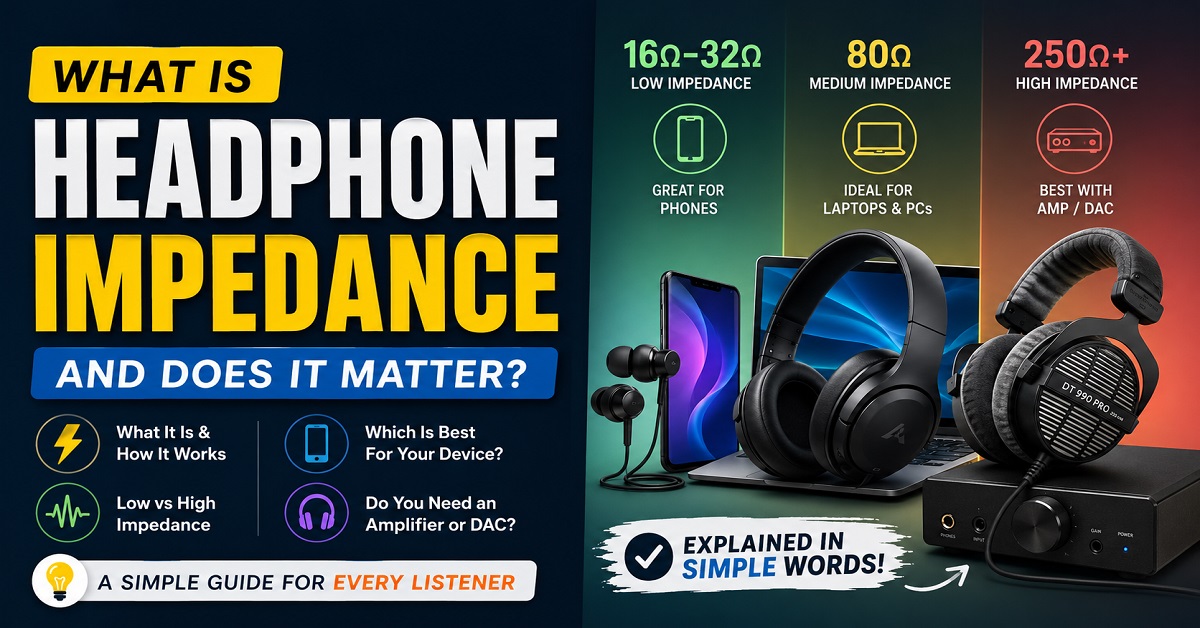
If you’ve ever looked at the specifications of a pair of headphones, you may have noticed numbers like 16Ω, 32Ω, 80Ω, or 250Ω. At first glance, they don’t seem to mean much. Many people simply ignore them and focus on features like sound quality, battery life, or noise cancellation.
But these small numbers actually represent something called headphone impedance, and they can affect how your headphones perform with different devices.
So, what is headphone impedance, and should you care about it before buying your next pair of headphones?
The good news is that the concept is much simpler than it sounds. You don’t need to be an audio engineer to understand it.
In this guide, you’ll learn:
- What headphone impedance actually means
- Why headphones have different impedance ratings
- How impedance affects sound and volume
- Whether you need a headphone amplifier
- Which impedance is best for phones, laptops, gaming, and music
- Whether impedance should influence your buying decision
By the end of this article, you’ll know exactly what those “Ohm (Ω)” numbers mean and whether they matter for the way you listen to music.
What Is Headphone Impedance?
In simple terms, headphone impedance is the amount of electrical resistance that a pair of headphones offers to the audio signal coming from your device.
It is measured in Ohms (Ω).
Don’t let the word “resistance” confuse you.
Imagine electricity as water flowing through a pipe.
- Electricity = Water
- Headphones = Pipe
- Impedance = The narrowness of the pipe
A wide pipe allows water to flow easily.
A narrow pipe makes it harder for water to flow.
Similarly, headphones with higher impedance make it more difficult for electrical signals to pass through, meaning they need more power to produce the same volume.
Headphones with lower impedance allow electricity to flow more easily, so they can reach high volumes even with less powerful devices like smartphones.
Simply put:
- Low impedance = Needs less power
- High impedance = Needs more power
That’s the easiest way to understand what headphone impedance means.
What Does the Ω (Ohm) Symbol Mean?
The symbol Ω stands for Ohm, the unit used to measure electrical resistance.
When you see specifications like:
- 16Ω
- 24Ω
- 32Ω
- 64Ω
- 80Ω
- 250Ω
- 300Ω
The number tells you how much resistance the headphones provide to the electrical signal.
A common misconception is that a higher Ohm number automatically means better sound quality.
That isn’t true.
Impedance doesn’t directly determine how good headphones sound.
Instead, it tells you how much power the headphones require to perform properly.
Think of it like driving different vehicles.
A small scooter needs very little fuel to travel.
A heavy truck needs much more fuel for the same distance.
Both can reach the destination, but their power requirements are different.
Headphones work in a similar way.
How Does Headphone Impedance Work?
Now that you know the definition, let’s see what actually happens when you play music.
Step 1: Your device generates an audio signal.
Whether you’re using a smartphone, laptop, gaming console, or music player, the device sends an electrical signal to the headphones.
Step 2: The signal reaches the headphone drivers.
Inside every headphone are tiny speaker units called drivers.
These drivers convert electrical signals into sound waves that you hear.
Step 3: Impedance affects how much power reaches the drivers.
Here’s where impedance comes into play.
If the headphones have low impedance, the electrical signal flows easily.
If the headphones have high impedance, the signal faces greater resistance and needs more power to move the drivers effectively.
Step 4: You hear the sound.
If your device can supply enough power, the headphones perform as intended.
If not, the headphones may sound quieter than expected.
This is why some professional studio headphones sound surprisingly quiet when connected directly to a smartphone.
The headphones aren’t faulty.
The phone simply isn’t powerful enough to drive them efficiently.
Why Do Headphones Have Different Impedance Ratings?
You might wonder why manufacturers don’t simply make every headphone 32Ω.
The answer is that different headphones are designed for different users.
For example:
Everyday headphones
These are made for smartphones, tablets, laptops, and Bluetooth devices.
They usually have lower impedance because these devices don’t produce a lot of output power.
Typical range:
- 16Ω to 32Ω
Gaming headphones
Gaming headsets also tend to have low impedance.
This allows them to work well with gaming consoles, PCs, and controllers without requiring additional equipment.
Typical range:
- 24Ω to 50Ω
Studio headphones
Professional studio headphones are often built with higher impedance.
Recording equipment, audio interfaces, and studio amplifiers provide much more power, making high-impedance headphones a suitable choice.
Typical range:
- 80Ω to 300Ω
Audiophile headphones
Premium wired headphones designed for serious music enthusiasts may have even higher impedance.
These headphones are usually intended to be paired with dedicated headphone amplifiers for the best listening experience.
Low Impedance vs High Impedance Headphones
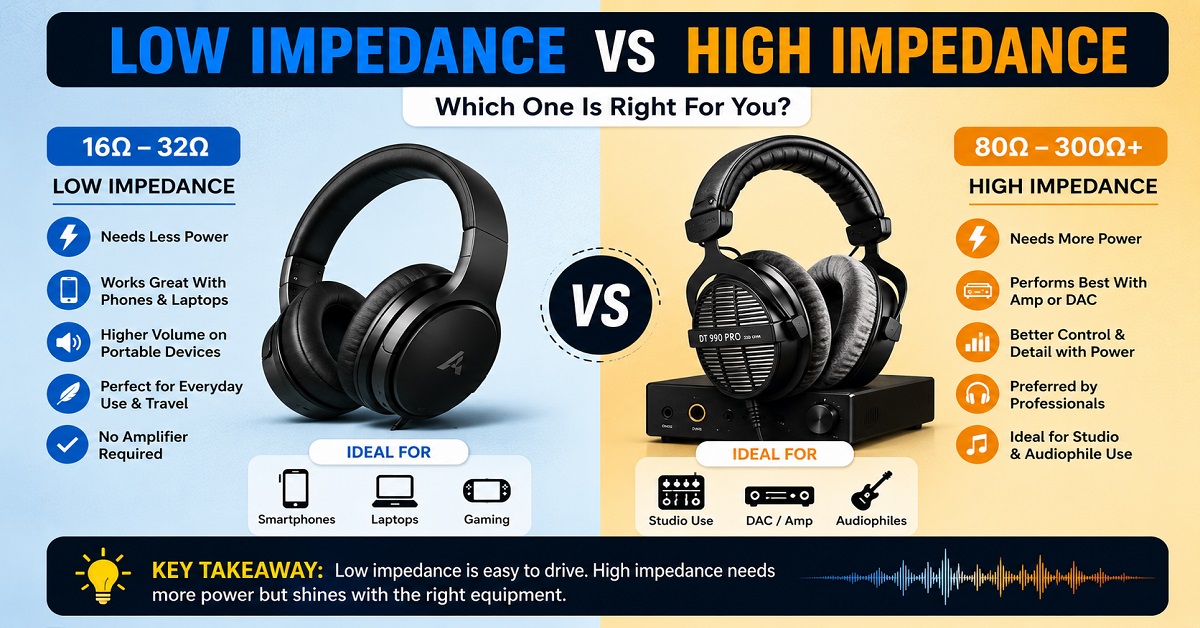
Understanding the difference between low and high impedance headphones is much easier than it sounds.
Low Impedance Headphones (16Ω–32Ω)
These are the headphones most people use every day.
They are designed to work well with:
- Smartphones
- Tablets
- Laptops
- Bluetooth adapters
- Portable music players
Advantages
- Easy to drive
- Louder with phones
- No amplifier required
- Great for everyday listening
- Ideal for travel and commuting
Possible drawback
Because they are more sensitive to electrical noise, very cheap devices may sometimes introduce a slight background hiss, although this is uncommon with modern smartphones.
High Impedance Headphones (80Ω–300Ω)
These headphones require more power to reach their full potential.
They are commonly used in:
- Recording studios
- Audio production
- Music mixing
- Home Hi-Fi systems
- Dedicated headphone amplifiers
Advantages
- Can handle more powerful audio equipment
- Often preferred by audio professionals
- Better suited for studio environments
Possible drawbacks
- Lower volume when connected directly to a smartphone
- May require a DAC or headphone amplifier
- Less practical for portable use
It’s important to remember that high impedance does not automatically mean better sound quality.
A well-made 32Ω headphone can easily outperform a poorly designed 250Ω headphone.
Sound quality depends on many factors, including:
- Driver quality
- Tuning
- Frequency response
- Build quality
- Comfort
- Engineering
Impedance is just one piece of the overall picture.
A Simple Real-Life Example
Imagine two bicycles.
One is designed for riding comfortably around your neighborhood.
The other is built for competitive mountain racing.
The racing bike offers excellent performance, but it also demands more effort and skill to use effectively.
Similarly, high-impedance headphones are often designed for powerful audio equipment, while low-impedance headphones are optimized for everyday devices like smartphones and laptops.
Neither is universally better.
The right choice depends on where and how you plan to use your headphones.
Does Headphone Impedance Affect Sound Quality?
This is one of the biggest misconceptions among headphone buyers.
The short answer is:
No, headphone impedance by itself does not determine sound quality.
Many people assume that a 250Ω headphone must sound better than a 32Ω headphone simply because the number is higher. In reality, that’s not how headphones work.
Think of it like cars.
A sports car with a larger engine isn’t automatically more comfortable or practical than a well-designed family car. Each is built for a different purpose.
Similarly, a headphone’s sound quality depends on several factors, such as:
- Driver quality
- Driver size
- Tuning by the manufacturer
- Frequency response
- Audio codecs (for wireless headphones)
- Build quality
- Ear cup design
- Comfort and fit
Impedance only tells you how much power the headphones need to perform properly.
For example:
A high-quality 32Ω headphone from Sony, Sennheiser, or Audio-Technica may sound much better than a poorly tuned 250Ω headphone from an unknown brand.
So, don’t judge headphones based on impedance alone.
Does Higher Impedance Mean Better Sound?
Not necessarily.
High-impedance headphones are often associated with professional or audiophile equipment because they’re commonly used in recording studios and home audio systems.
However, the higher impedance itself isn’t what makes them sound good.
Instead, manufacturers of premium headphones often choose higher impedance because these headphones are expected to be paired with powerful audio equipment.
Think of it this way:
It’s similar to high-performance racing tires.
They perform exceptionally well on a race track, but they don’t automatically make every car faster.
The overall vehicle matters much more.
Likewise, great headphone design matters far more than impedance.
What Happens If You Use High-Impedance Headphones with a Smartphone?
This is a very common question.
Let’s imagine you buy a pair of 250Ω studio headphones and connect them directly to your phone.
Here’s what you may notice:
- Lower maximum volume
- Less dynamic sound
- Reduced bass impact
- Music may feel less energetic
This doesn’t mean the headphones are bad.
It simply means your smartphone doesn’t have enough power to drive them efficiently.
It’s like trying to tow a heavy trailer using a small hatchback.
The vehicle moves, but it’s working much harder than it was designed to.
If you connect the same headphones to a dedicated headphone amplifier or a good DAC, they’ll usually perform much closer to their intended potential.
What Happens If You Use Low-Impedance Headphones?
Low-impedance headphones are much easier to power.
That’s why almost every modern device supports them without any issues.
Whether you use:
- An Android phone
- An iPhone
- A laptop
- A tablet
- A Nintendo Switch
- A PlayStation controller
Low-impedance headphones usually work perfectly.
You’ll get:
- Plenty of volume
- Good overall performance
- No need for additional accessories
This is one reason why most consumer headphones have an impedance between 16Ω and 32Ω.
Manufacturers know that most people listen through portable devices.
Do You Need a Headphone Amplifier?
Not always.
In fact, most people do not need one.
A headphone amplifier simply provides more power to drive headphones.
Think of it like this:
Your phone is like a small water pump.
A headphone amplifier is like a larger water pump that can move much more water through bigger pipes.
If your headphones only need a small amount of power, your phone is already doing the job perfectly.
If your headphones require much more power, an amplifier helps them reach their full performance.
You probably DON’T need an amplifier if:
- Your headphones are 16Ω
- Your headphones are 24Ω
- Your headphones are 32Ω
- You mainly use a smartphone or laptop
- You already get enough volume
You may benefit from an amplifier if:
- Your headphones are 80Ω or higher
- Your headphones sound too quiet
- You’re using professional studio headphones
- You enjoy high-resolution wired audio
- You have a dedicated listening setup at home
For most AudioPick readers, a headphone amplifier is not essential.
What Is a DAC, and Is It the Same as an Amplifier?
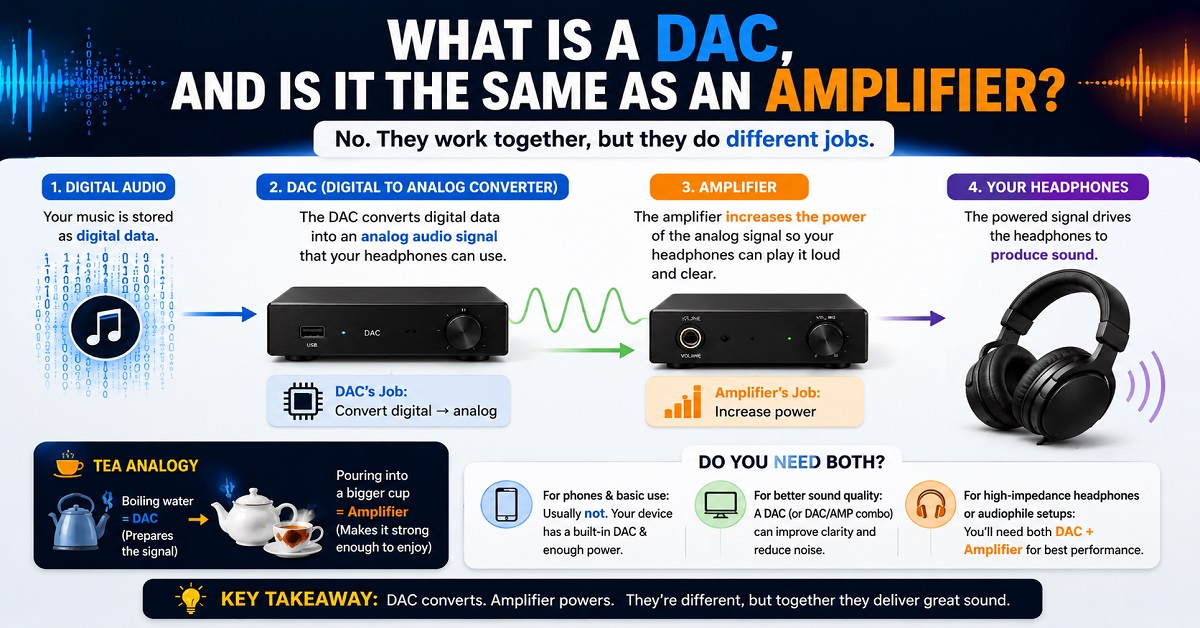
Many beginners confuse these two devices.
Although they often come together in one product, they do different jobs.
A DAC (Digital-to-Analog Converter) converts digital music into an analog audio signal that headphones can reproduce.
An amplifier increases the power of that signal.
Think of preparing tea.
The DAC is like boiling the water.
The amplifier is like pouring the tea into a larger cup so there’s enough for everyone.
Some devices include both a DAC and an amplifier in one compact unit.
You don’t necessarily need either one unless your headphones demand more power or you’re aiming for a high-end listening experience.
Best Headphone Impedance for Different Devices
One of the most practical ways to understand what is headphone impedance is by matching it to the device you use.
For Smartphones
Recommended impedance:
16Ω–32Ω
This is the ideal range for Android phones and iPhones.
You’ll get good volume without draining extra battery or needing additional equipment.
For Laptops
Recommended impedance:
16Ω–80Ω
Most laptops can comfortably power headphones within this range.
Some premium laptops may even handle slightly higher impedance models.
For Gaming
Recommended impedance:
24Ω–50Ω
Gaming headsets are designed to work with:
- PCs
- PlayStation
- Xbox
- Nintendo Switch
Lower impedance ensures louder sound and better compatibility.
For Music Production
Recommended impedance:
80Ω–250Ω
Professional studios often use higher-impedance headphones because they’re connected to audio interfaces and dedicated headphone amplifiers.
These setups provide enough power for accurate monitoring.
For Audiophiles
Recommended impedance:
80Ω–300Ω (or higher)
Many audiophiles pair high-impedance headphones with quality DACs and amplifiers to get the best possible listening experience.
However, this isn’t necessary for casual listeners.
Advantages of Low-Impedance Headphones
If you mostly listen to music on your phone or laptop, low-impedance headphones offer several benefits.
Easy to Drive
Almost any device can power them properly.
Portable
Perfect for travel, commuting, and everyday use.
No Extra Equipment Needed
No amplifier or DAC is required in most cases.
Better Compatibility
They work well with nearly every smartphone, tablet, and laptop.
Advantages of High-Impedance Headphones
Although they’re not suitable for everyone, high-impedance headphones have their own strengths.
Excellent for Studio Equipment
Professional audio interfaces provide enough power for them.
Handle Powerful Signals Well
They can perform consistently with dedicated audio gear.
Popular Among Professionals
Many recording engineers and audio enthusiasts prefer them for critical listening and studio work.
Limitations of Low-Impedance Headphones
Nothing is perfect.
Some possible downsides include:
- May reveal background hiss from very noisy audio sources
- Not always designed for professional studio environments
- Build quality varies depending on the manufacturer
These limitations are usually minor for everyday users.
Limitations of High-Impedance Headphones
Before buying high-impedance headphones, keep these drawbacks in mind.
- Require more power
- Often need a headphone amplifier
- Can sound quieter on phones
- Less convenient for travel
- Usually intended for home or studio use
Unless you specifically need professional headphones, these limitations often outweigh the benefits for casual listening.
Common Myths About Headphone Impedance
Let’s clear up a few myths that confuse many buyers.
Myth 1: Higher impedance always means better sound.
False.
Sound quality depends on the overall design of the headphones, not just the impedance rating.
Myth 2: Every headphone needs an amplifier.
False.
Most headphones sold today work perfectly with smartphones and laptops.
Myth 3: Low-impedance headphones are cheap.
False.
Many premium flagship headphones use low impedance because they’re designed for portable devices.
Myth 4: More Ohms means louder sound.
False.
In many cases, higher-impedance headphones actually sound quieter unless powered by an amplifier.
Should Headphone Impedance Influence Your Buying Decision?
Yes—but only to a certain extent.
Instead of asking,
“Which impedance is best?”
Ask yourself,
“What device will I use these headphones with?”
If you’re buying headphones for:
- Daily commuting
- Watching YouTube
- Listening to Spotify
- Online meetings
- Casual gaming
Choose headphones with 16Ω to 32Ω impedance.
If you’re producing music, mixing tracks, or building a dedicated home audio setup, higher-impedance headphones may be a better choice.
For most people, impedance should be one specification among many, not the deciding factor.
Always consider sound quality, comfort, microphone performance, build quality, battery life (for wireless models), and your intended use before making a purchase.
Low vs High Impedance Headphones: Quick Comparison
If you’re still unsure which type is right for you, here’s a simple comparison.
| Feature | Low Impedance (16Ω–32Ω) | High Impedance (80Ω–300Ω+) |
|---|---|---|
| Power Required | Low | High |
| Best For | Smartphones, tablets, laptops | Studio equipment, DACs, amplifiers |
| Needs Headphone Amplifier? | Usually No | Often Yes |
| Maximum Volume on a Phone | Higher | Usually Lower |
| Portability | Excellent | Limited |
| Ideal Users | Everyday listeners, commuters, gamers | Audio professionals, musicians, audiophiles |
As you can see, neither option is universally better. The right choice depends on the device you’ll use and your listening needs.
Which Headphone Impedance Should You Choose?
If you’re still wondering which impedance is right for you, here’s a quick guide.
Choose 16Ω–32Ω if you:
- Listen to music on your smartphone
- Watch YouTube or Netflix
- Attend online meetings
- Play games casually
- Travel frequently
- Don’t want to buy extra equipment
This is the best choice for most people.
Choose 64Ω–80Ω if you:
- Mostly use a desktop computer
- Own a good laptop with a powerful headphone jack
- Want slightly more flexibility for home listening
Choose 80Ω–300Ω if you:
- Produce music
- Record vocals
- Mix or master audio
- Already own a headphone amplifier or DAC
- Are building a dedicated home audio setup
Unless you fall into one of these categories, high-impedance headphones may not offer any practical advantage.
Does Impedance Matter for Wireless Headphones?
This is another question many buyers have.
The answer is:
Usually, no.
Wireless headphones have a built-in amplifier powered by their own battery.
When you’re using Bluetooth, your phone doesn’t directly power the headphone drivers. Instead, the headphones receive digital audio wirelessly and use their internal electronics to process and amplify the sound.
That’s why manufacturers rarely advertise impedance for Bluetooth headphones.
If you’re buying wireless headphones or true wireless earbuds, features like these are usually far more important than impedance:
- Sound tuning
- ANC performance
- Microphone quality
- Battery life
- Bluetooth version
- Codec support
- Comfort
- Build quality
In other words, don’t let impedance influence your decision when buying Bluetooth headphones unless you also plan to use them in wired mode and the manufacturer provides those specifications.
Frequently Asked Questions (FAQs)
1. What is headphone impedance in simple words?
Headphone impedance is the amount of electrical resistance a pair of headphones offers to the audio signal. It’s measured in Ohms (Ω) and determines how much power the headphones need to produce sound.
2. Does higher impedance mean better sound quality?
No.
Higher impedance doesn’t automatically improve sound quality. Driver quality, tuning, build quality, and engineering have a much greater impact on how headphones sound.
3. Is 32Ω good for headphones?
Yes.
For most people, 32Ω headphones are an excellent choice. They work well with smartphones, laptops, tablets, and gaming consoles without requiring a separate amplifier.
4. Is 80Ω better than 32Ω?
Not necessarily.
An 80Ω headphone isn’t inherently better than a 32Ω model. It’s simply designed to use more power and is often intended for studio equipment or dedicated audio setups.
5. Can I use 250Ω headphones with my phone?
Yes, but there are limitations.
They’ll usually work, but the volume may be lower than expected because most smartphones can’t provide enough power to drive high-impedance headphones effectively.
6. Do I need a headphone amplifier?
Most people don’t.
If your headphones are between 16Ω and 32Ω, your phone or laptop is usually sufficient.
You may benefit from an amplifier if you’re using professional headphones with an impedance of 80Ω or higher.
7. Are low-impedance headphones bad?
Not at all.
Many premium consumer headphones have low impedance because they’re designed for portable devices.
Low impedance doesn’t mean lower quality.
8. Does impedance affect battery life?
Not significantly.
For wired headphones, battery life isn’t a concern because they don’t use a battery.
For wireless headphones, the built-in amplifier handles power internally, so impedance has very little effect on battery performance.
9. What impedance is best for gaming?
Most gaming headsets fall between 24Ω and 50Ω.
This range offers good compatibility with gaming PCs, consoles, and controllers without needing extra equipment.
10. What impedance is best for smartphones?
For smartphones, 16Ω to 32Ω is generally the ideal range.
These headphones are easy to drive, provide good volume, and don’t require a separate amplifier.
11. Should I worry about impedance when buying Bluetooth headphones?
Usually, no.
Bluetooth headphones contain their own amplifier, so impedance is much less important than features like sound quality, battery life, microphone performance, ANC, and comfort.
12. Is headphone impedance important for everyday users?
For most people, it’s only one small part of the buying decision.
As long as you’re choosing headphones designed for smartphones, laptops, or everyday devices, impedance is unlikely to cause any problems.
Final Verdict
So, what is headphone impedance, and does it really matter?
Headphone impedance refers to the electrical resistance of a pair of headphones and indicates how much power they need to perform properly. While it’s an important specification, it shouldn’t be the first thing you look at when buying headphones.
For most people, headphones with an impedance between 16Ω and 32Ω are the best option. They’re easy to power, work well with smartphones and laptops, and don’t require extra equipment.
Higher-impedance headphones certainly have their place, especially in recording studios and high-end audio systems. However, unless you own a headphone amplifier or professional audio gear, they may not provide any noticeable advantage for everyday listening.
The best approach is to choose headphones based on your listening habits and the devices you use, rather than assuming a higher Ohm rating means better performance.
In the end, comfort, sound tuning, microphone quality, durability, and overall value will have a much bigger impact on your listening experience than impedance alone.
Key Takeaways
- Headphone impedance is measured in Ohms (Ω).
- Lower impedance headphones need less power and are ideal for smartphones and laptops.
- Higher impedance headphones require more power and often perform best with amplifiers.
- Higher impedance does not automatically mean better sound quality.
- Most users should choose headphones between 16Ω and 32Ω.
- Studio professionals and audiophiles may benefit from higher-impedance headphones when paired with suitable equipment.
Continue Learning About Headphone Technology
Want to learn more about headphones before making your next purchase? Here are some useful guides that explain important audio technologies and help you choose the right headphones.
- What Is ANC in Headphones and How Does It Work?
- What Is Bluetooth Multipoint Connectivity and How Does It Work?
- Open-Ear Earbuds vs Traditional Earbuds
- Best Headphones for Calling and Meetings in India
- boAt Nirvana Ivy Review: Best ANC Earbuds Under ₹3000?
- Sony WH-1000XM5 vs Bose QuietComfort Ultra

About the Author
Hari Prasad is the editor of AudioPick.in and a lifelong audio enthusiast. He writes detailed, honest reviews and guides to help everyday users pick the right gear without tech jargon. His personal interest in Bluetooth audio, neckbands, and codecs comes from testing dozens of devices over the past few years.