If you are looking for premium wireless earbuds with strong noise cancellation, excellent sound quality and useful smart features, the JBL Tour Pro 3 and Sony WF-1000XM5 are two models that deserve serious attention. But there is an important question: which one is actually better for you?
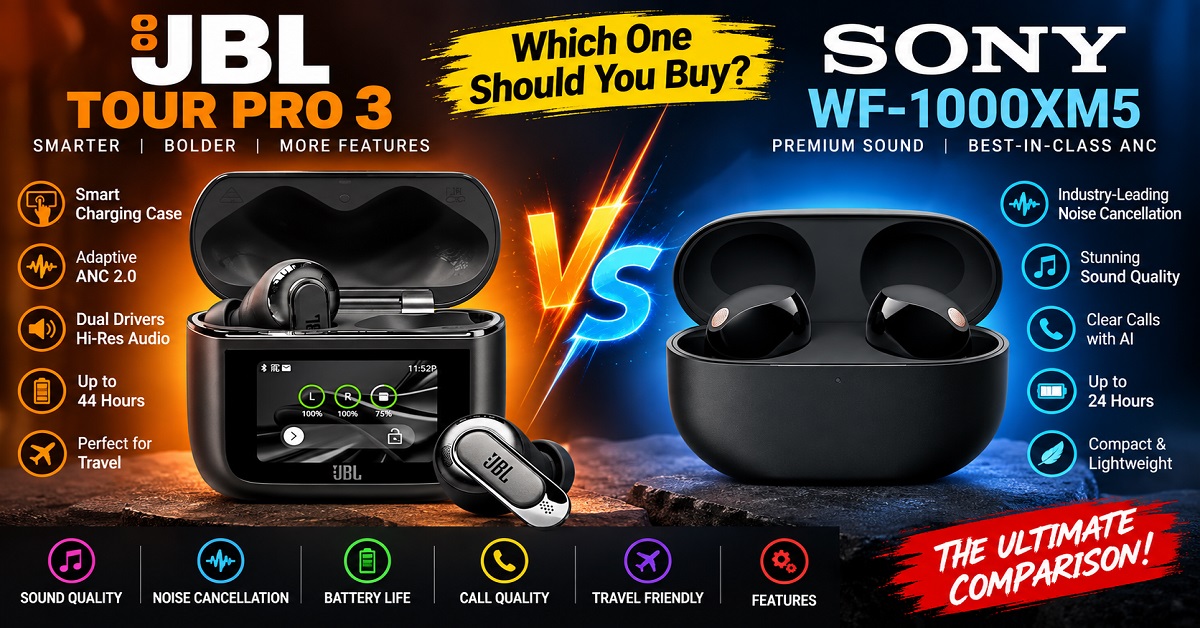
The JBL Tour Pro 3 costs more than the Sony WF-1000XM5 based on the prices we are comparing here. JBL’s model brings some unusual features, including a touchscreen Smart Charging Case, hybrid dual drivers, LDAC, spatial audio with head tracking and an audio transmitter built into the case. Sony, on the other hand, has built the WF-1000XM5 around its strong noise cancellation, sound quality, compact design and excellent app experience. JBL officially lists up to 44 hours of total playback, while Sony rates the WF-1000XM5 for up to 8 hours with noise cancellation enabled.
So, is the JBL Tour Pro 3 worth paying extra for, or is the Sony WF-1000XM5 the smarter buy?
In this JBL Tour Pro 3 vs Sony WF-1000XM5 comparison, we will look beyond the specification sheet. We will compare their sound quality, ANC performance, call quality, battery life, comfort, connectivity, smart features, travel experience and overall value for money. By the end, you should have a much clearer idea of which pair makes more sense for your needs.
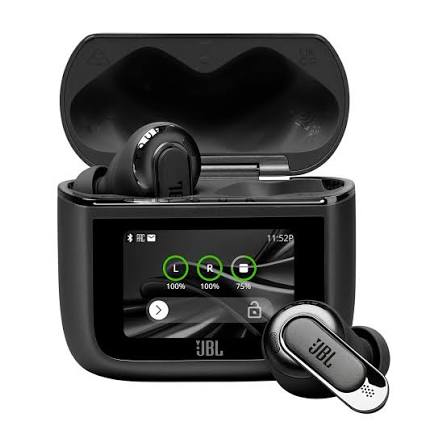
Premium ANC + Smart Charging Case
JBL Tour Pro 3
- Hybrid Dual Drivers with Hi-Res LDAC Audio
- True Adaptive ANC 2.0 + Spatial 360 Head Tracking
- 6-Mic JBL Crystal AI for Calls
- Up to 44 Hours Battery + Smart Touchscreen Case
A premium pair of JBL earbuds for listeners who want high-quality sound, strong adaptive ANC, LDAC, immersive Spatial 360 audio and an unusually capable Smart Charging Case. The Tour Pro 3 is especially interesting for frequent travellers and users who want extensive customization and advanced connectivity features.
Sony WF-1000XM5 Wireless ANC Earbuds
• Industry-leading Active Noise Cancellation
• Rich sound with Dynamic Driver X
• Clear calls with bone conduction sensors
• Multipoint Bluetooth pairing
• Up to 36 hours battery life
• Compact, premium design


JBL Tour Pro 3 vs Sony WF-1000XM5: Quick Verdict
If you want the short answer, the JBL Tour Pro 3 is the more feature-packed pair, while the Sony WF-1000XM5 is the more straightforward premium earbud choice.
The JBL Tour Pro 3 is particularly interesting if you want features that you won’t normally find on a pair of TWS earbuds. Its Smart Charging Case has a touchscreen and can also work as an audio transmitter, allowing you to connect the earbuds to sources such as an airplane entertainment system, TV or other USB-C/AUX audio source. JBL also uses a hybrid driver system and supports LDAC.
The Sony WF-1000XM5 takes a different approach. It is smaller and lighter, supports LDAC and multipoint, and offers Sony’s established noise-cancelling and sound-processing technologies. Sony rates each earbud at approximately 5.9 grams and provides up to 8 hours of continuous music playback with noise cancellation turned on.
Our initial recommendation
Choose the JBL Tour Pro 3 if:
- You want the maximum number of features.
- You like experimenting with EQ and sound customization.
- You want a touchscreen charging case.
- You travel frequently and could use the built-in audio transmitter.
- You want longer overall battery life.
- You want hybrid dual-driver earbuds with LDAC.
- You like spatial audio and head tracking.
Choose the Sony WF-1000XM5 if:
- You want a smaller, lighter premium earbud.
- Noise cancellation is one of your top priorities.
- You want a mature companion app and sound customization.
- You frequently switch between two devices using multipoint.
- You don’t need JBL’s unusual Smart Charging Case features.
- You can get the Sony at a substantially lower price.
The interesting part is that neither pair wins every category. That’s why simply looking at the feature count can lead to the wrong buying decision.
JBL Tour Pro 3 vs Sony WF-1000XM5: At a Glance
| Feature | JBL Tour Pro 3 | Sony WF-1000XM5 |
|---|---|---|
| Type | True wireless earbuds | True wireless earbuds |
| Bluetooth | 5.3 | 5.3 |
| Driver | 10.2 mm dynamic + balanced armature | 8.4 mm dynamic |
| Hi-Res audio | Yes | Yes |
| LDAC | Yes | Yes |
| ANC | True Adaptive ANC 2.0 | Adaptive noise cancellation |
| Spatial audio | JBL Spatial 360 with head tracking | 360 Reality Audio |
| Multipoint | Yes | Yes |
| Microphones | 6 | 6 total |
| Battery with ANC | Up to 8 hours | Up to 8 hours |
| Total battery | Up to 44 hours | Up to 24 hours* |
| Quick charging | 10 minutes for up to 3 hours | 3 minutes for up to 60 minutes |
| Wireless charging | Yes | Yes |
| Water resistance | IP55 | IPX4 |
| Smart case | Yes, touchscreen | No |
| Audio transmitter in case | Yes | No |
| Approx. earbud weight | 5.6 g each | 5.9 g each |
| App | JBL Headphones | Sony Sound Connect |
*Sony’s official specification lists up to 8 hours with ANC and up to 12 hours without ANC per charge, while the case provides additional charging. JBL officially lists up to 8 hours with ANC and 11 hours without ANC, with three additional full charges from the case.
On paper, the JBL looks more impressive because it packs more hardware and features into the package. But that doesn’t automatically make it the better earbud.
For example, if you mainly listen to music, make calls, commute to work and use ANC, you may never use some of the JBL’s extra features.
That is why the rest of this comparison matters.
JBL Tour Pro 3 vs Sony WF-1000XM5: Price Difference
The prices supplied for this comparison put the JBL Tour Pro 3 at ₹19,999, while the Sony WF-1000XM5 is ₹16,989.
That means there is a difference of roughly ₹3,010 between the two.
At this price level, ₹3,000 is not a small difference.
If both earbuds provide the basic things you need, such as good sound, ANC, calls and comfortable wearing, it makes sense to ask whether the JBL’s additional features justify spending that extra money.
This is especially important because premium earbuds are already expensive compared with mainstream TWS models.
The JBL Tour Pro 3 does give you several things for that additional money. Its Smart Charging Case has a 1.57-inch touchscreen, and JBL says the case can also act as an audio transmitter for sources such as USB-C and AUX connections.
Imagine that you are sitting on an airplane and the entertainment system has a standard headphone connection. Instead of using a separate Bluetooth transmitter, you can connect the JBL Smart Charging Case to the source and transmit the audio to the earbuds.
That is a genuinely useful feature for frequent travellers.
But if you rarely travel and normally connect your earbuds directly to your smartphone, laptop or tablet, its usefulness becomes much smaller.
This is one of the main themes of this comparison:
The JBL Tour Pro 3 gives you more, but do you actually need everything it gives you?
Sound Quality: JBL Tour Pro 3 vs Sony WF-1000XM5
Sound quality is probably the most important part of this comparison.
After all, ANC, touch controls, apps and smart cases are secondary if you don’t enjoy listening to music through the earbuds.
The JBL Tour Pro 3 takes an interesting hardware approach. Each earbud combines a 10.2 mm dynamic driver with a balanced-armature driver. JBL says the dynamic driver handles bass and vocals while the balanced-armature driver handles higher frequencies. It also supports LDAC for compatible devices.
Sony uses a different design. The WF-1000XM5 has an 8.4 mm Dynamic Driver X and supports LDAC, along with Sony’s DSEE Extreme processing.
This doesn’t mean that the JBL will automatically sound better simply because it has two drivers.
Driver count alone doesn’t determine sound quality.
Tuning, driver implementation, DSP processing, ear-tip seal and the listener’s personal preference all have a major effect.
JBL Tour Pro 3 sound character
The JBL approach should appeal to listeners who enjoy a lively and detailed presentation.
The hybrid driver setup gives JBL more hardware flexibility to reproduce different parts of the frequency range. Combined with LDAC and JBL’s customization options, the Tour Pro 3 is aimed at people who want to play around with their sound rather than simply use the default tuning.
It also supports JBL’s Personi-Fi system, which lets you personalize the sound based on your hearing preferences.
For someone who listens to Bollywood, Telugu songs, English music, podcasts and movies, this flexibility can be useful because different types of content can benefit from different tuning.
You don’t necessarily want the same sound signature for a bass-heavy song and a dialogue-heavy movie.
Sony WF-1000XM5 sound character
Sony’s strength is refinement.
The WF-1000XM5 uses the company’s Dynamic Driver X along with its sound-processing technologies. Sony also supports LDAC and DSEE Extreme, giving compatible users several options for improving or customizing the listening experience.
The Sony can be particularly appealing if you prefer a more balanced and controlled presentation rather than simply chasing stronger bass.
It is also worth remembering that LDAC requires a compatible source device. Simply buying an LDAC-compatible earbud does not mean every phone will automatically use LDAC.
For Android users with a compatible phone, however, both models offer an important advantage because both support LDAC.
Which sounds better?
This is one area where I would not declare an absolute winner without considering personal preference.
If you prefer an energetic presentation and want the flexibility of a hybrid driver system and extensive customization, the JBL Tour Pro 3 is very attractive.
If you prefer Sony’s more mature sound-processing approach and want a compact premium earbud with LDAC, the WF-1000XM5 remains a strong choice.
And this is exactly why you should not buy either one based only on the words “dual driver” or “LDAC.”
Sound tuning matters more than a specification race.
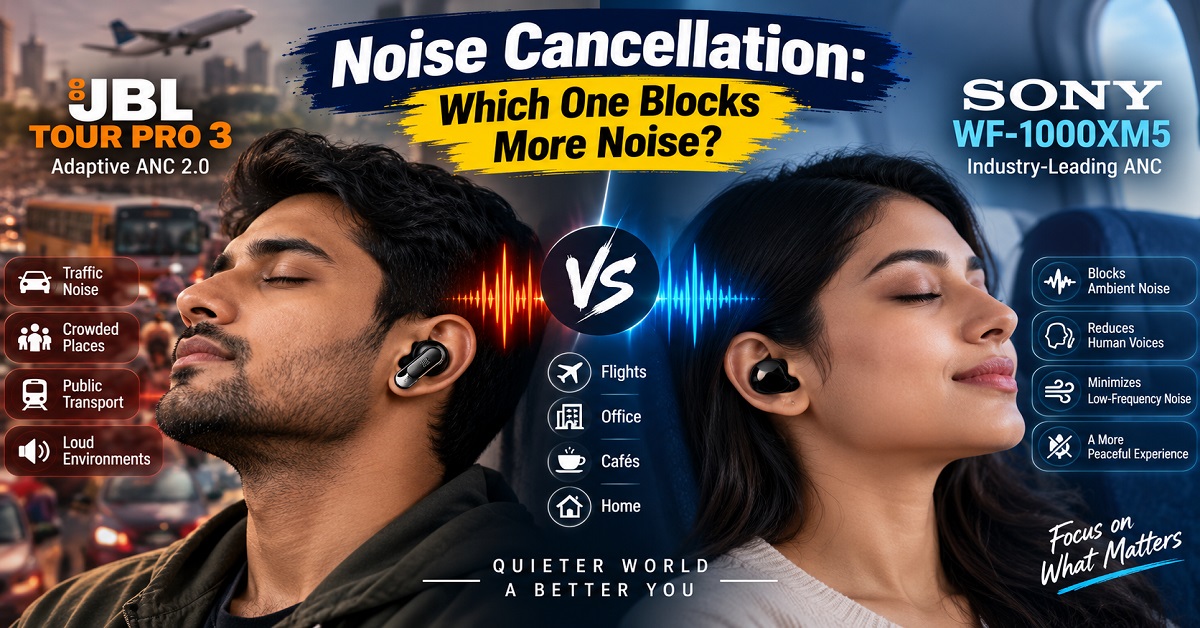
Noise Cancellation: Which One Blocks More Noise?
Both earbuds are designed for people who want strong active noise cancellation, but they approach ANC differently.
The JBL Tour Pro 3 uses True Adaptive Noise Cancelling 2.0. JBL says the system performs real-time calibration and provides customizable control through its software.
Sony uses its own noise-cancelling system, with the WF-1000XM5 combining its Integrated Processor V2 with the HD Noise Cancelling Processor QN2e and multiple microphones. Sony also provides Adaptive Sound Control and an Ambient Sound mode.
For everyday use, both are designed to reduce distractions such as traffic, air-conditioner noise, office sounds and other background noise.
But there is an important point that many comparison articles overlook.
ANC is not only about the processor
The physical fit of an earbud can make a big difference.
Even the most advanced ANC system cannot completely compensate for a poor seal inside your ear.
For example, if an earbud doesn’t fit properly and outside sound is leaking around the ear tip, you may feel that the ANC isn’t working well. Another person using the same earbuds with a better seal may have a completely different experience.
That’s why ear-tip selection is important.
JBL includes multiple ear-tip sizes as well as foam tips with the Tour Pro 3. Sony also includes noise-isolation earbud tips with the WF-1000XM5.
So, when comparing ANC, don’t judge the earbuds only by marketing claims.
Fit + passive isolation + ANC processing all work together.
For a deeper look at how ANC actually works before choosing premium earbuds, you can also link to [What Is Active Noise Cancellation and How Does ANC Work?].
Early ANC verdict
If ANC is your number-one reason for buying premium earbuds, Sony deserves very serious consideration because noise cancellation has long been one of the defining strengths of its premium headphone and earbud lineup.
However, JBL’s adaptive ANC system is also highly capable and gives you extensive control.
The final winner should therefore depend on real-world testing, fit and your listening environment rather than a simple specification claim.
What About Calls?
Call quality is another area where premium earbuds need to justify their price.
The JBL Tour Pro 3 uses six microphones and JBL’s Crystal AI algorithm for calls. JBL specifically positions the system around reducing wind and environmental noise so that your voice can remain clear.
Sony’s WF-1000XM5 also uses multiple microphones along with its Precise Voice Pickup technology and bone-conduction sensors. Sony says its AI-based noise reduction technology is designed to improve voice pickup in noisy environments.
This matters if you regularly use your earbuds for:
- Phone calls
- WhatsApp calls
- Google Meet
- Microsoft Teams
- Zoom
- Outdoor conversations
- Work meetings
However, call quality can change considerably depending on wind, traffic, background voices and the position of the microphones.
So I would avoid saying that one pair will deliver “perfect calls” in every situation.
Both are designed to be serious calling earbuds, but neither can completely eliminate the limitations of tiny microphones operating in a noisy environment.
Battery Life: JBL Tour Pro 3 vs Sony WF-1000XM5
Battery life is another area where the JBL Tour Pro 3 has a clear advantage on paper.
JBL rates the Tour Pro 3 for up to 8 hours of playback with ANC enabled and up to 11 hours with ANC turned off. With the charging case, the total playback time can reach up to 44 hours. JBL also says a 10-minute charge can provide up to 3 hours of playback.
The Sony WF-1000XM5 is rated for up to 8 hours with ANC enabled and up to 12 hours with ANC turned off. Sony lists up to 24 hours of total battery life when using ANC, with the case providing additional charges. A 3-minute quick charge can provide up to 60 minutes of playback.
This gives us an interesting situation.
Earbuds-only battery life
With ANC turned on, both models are rated at around 8 hours.
So if you normally put the earbuds in your ears in the morning, listen during your commute, use them at work and then listen again on your way home, both should comfortably cover a normal day for many users.
Actual battery life will vary depending on factors such as volume, ANC, codec, spatial audio and other features.
For example, using high-quality Bluetooth codecs and more demanding processing features can affect battery consumption.
Total battery life
This is where JBL pulls ahead.
The Tour Pro 3’s advertised total battery life of up to 44 hours is considerably higher than the Sony’s advertised total with ANC.
If you travel frequently or don’t want to charge the case every few days, that extra capacity can be genuinely useful.
Imagine going on a two- or three-day trip. With the JBL, you have considerably more total playback available from the case before you need to find a charger.
Sony’s battery life isn’t poor. In fact, the WF-1000XM5’s 8-hour ANC figure is perfectly respectable.
But if battery endurance is one of your biggest priorities, JBL wins this round.
Quick Charging
Both models support quick charging, but they take different approaches.
JBL says a 10-minute charge gives you up to 3 hours of playback.
Sony says a 3-minute charge provides up to 60 minutes of playback.
In practical terms, neither is likely to leave you stuck without music because you forgot to charge the earbuds.
If you’re leaving home and suddenly notice that the battery is almost empty, a few minutes connected to the charger can give you enough playback for a commute or workout.
Comfort and Fit
Comfort is one of those things that specifications cannot properly describe.
An earbud can have excellent sound and ANC, but if it starts hurting your ears after 30 minutes, you probably won’t enjoy using it.
The Sony WF-1000XM5 was designed to be smaller than its predecessor, and each earbud weighs approximately 5.9 grams. Sony also uses specially designed noise-isolation ear tips intended to provide a secure fit.
The JBL Tour Pro 3 is also lightweight, with each earbud weighing approximately 5.6 grams according to JBL’s specifications.
So the weight difference is very small.
But weight isn’t the only factor.
The shape of the earbud, the nozzle, ear-tip size and how the earbud sits inside your ear can all affect comfort.
Sony’s compact design
One of the Sony WF-1000XM5’s strengths is its relatively compact design.
This can make it a better choice for someone who doesn’t like bulky earbuds sticking out of their ears.
However, Sony’s foam-style tips can feel different from the silicone tips many people are accustomed to using.
Some users like the additional isolation, while others may prefer conventional silicone tips.
JBL’s fit options
The Tour Pro 3 also provides multiple ear-tip options, giving you more opportunity to find a suitable seal.
This is especially useful for ANC because a proper seal helps block outside noise before the electronic noise cancellation even starts working.
If the earbuds don’t fit your ears correctly, don’t immediately conclude that the ANC is poor.
Try the different ear tips first.
This is one of the simplest things you can do to improve the experience with premium TWS earbuds.
Comfort winner?
I would call this one a personal preference rather than a clear winner.
If you prefer a smaller earbud, Sony may be more appealing.
If the JBL shape fits your ears better, the Tour Pro 3 could be more comfortable for you.
If possible, buying from a seller with a reasonable return policy is worth considering when spending this much on earbuds.
Smart Features: JBL Has a Major Advantage
This is probably the biggest difference between these two products.
Sony gives you a sophisticated pair of earbuds and a feature-rich companion app.
JBL gives you that too, but then adds something unusual:
a touchscreen charging case.
The JBL Tour Pro 3’s Smart Charging Case has a built-in touchscreen that lets you control various functions without constantly reaching for your phone. JBL also designed the case to work as an audio transmitter.
That makes the JBL particularly interesting for people who enjoy technology and want their earbuds to do more than simply play music.
JBL Smart Charging Case Explained
The Smart Charging Case isn’t just a normal charging case with a small screen.
It can be used to control several functions and can also transmit audio to the earbuds.
This means you can connect the case to an external audio source using the supplied connections and send that audio wirelessly to your Tour Pro 3 earbuds.
Why is the transmitter useful?
Here’s a practical example.
Suppose you’re sitting on an airplane and the entertainment system doesn’t support Bluetooth headphones.
Normally, you’d need a separate Bluetooth transmitter to use your wireless earbuds.
With the JBL system, the Smart Charging Case can act as the transmitter.
You connect it to the airplane’s audio output and then listen through your JBL earbuds.
The same concept can be useful with other devices that don’t have Bluetooth audio, depending on the connection and source.
This is a feature that the Sony WF-1000XM5 simply doesn’t offer.
For a frequent traveller, this could be one of the strongest reasons to choose JBL.
For someone who spends most of their time listening through a smartphone, however, it may not matter much.
That’s an important distinction.
A feature is valuable only when you actually use it.
JBL Tour Pro 3 for Travel
If you travel frequently, the JBL Tour Pro 3 becomes considerably more interesting.
You get:
- Long total battery life
- Adaptive ANC
- Ambient sound features
- Smart Charging Case
- Built-in audio transmitter
- USB-C and analogue connectivity
- Spatial audio
- Multipoint connectivity
The transmitter is particularly useful during flights because you don’t have to carry a separate Bluetooth transmitter.
The case itself does add complexity compared with a conventional charging case, though.
If you simply want something small that you can put in your pocket and forget about, Sony’s simpler approach may appeal more.
Sony WF-1000XM5 for Travel
Sony is also an excellent travel companion.
Its strong ANC can be useful on airplanes, trains, buses and in busy airports.
The compact earbuds are easy to carry, and multipoint allows you to keep the earbuds connected to two devices simultaneously. Sony says the WF-1000XM5 supports multipoint with Android, iOS, Windows and macOS devices.
For example, you could have the earbuds connected to your laptop and smartphone.
You can listen to music from the laptop and then switch to a phone call when necessary.
That can be extremely convenient for someone who uses earbuds for both work and entertainment.
However, the Sony doesn’t have JBL’s built-in audio transmitter.
So if you regularly want to connect wireless earbuds to an airplane entertainment system, JBL has the more interesting solution.
Multipoint Connectivity
Both earbuds support multipoint connectivity.
This is an important feature that is easy to overlook when looking at a specification sheet.
Without multipoint, switching between your laptop and phone can sometimes require manually disconnecting and reconnecting the earbuds.
With multipoint, the earbuds can maintain connections to two devices.
For example:
Laptop: You are watching a YouTube video.
Phone: Someone calls you.
The earbuds can switch to the phone for the call and then return to the laptop afterward, depending on the device and software behaviour.
For people who use their earbuds for work, this can save a lot of frustration.
Since both JBL and Sony offer this capability, I would call this category a tie.
Spatial Audio and Head Tracking
Both companies offer immersive audio features, but they approach them differently.
The JBL Tour Pro 3 supports JBL Spatial 360 with head tracking.
The idea is to make compatible content feel more immersive, with the sound appearing to come from a more fixed position as you move your head.
This can be particularly interesting when watching movies or other video content.
Instead of the entire soundstage seemingly moving with your head, head tracking can create the impression that the audio is positioned around you.
Sony also supports immersive audio through its 360 Reality Audio ecosystem.
However, you should not buy either product purely because it supports spatial audio.
The experience depends heavily on the content, software and device being used.
For normal music listening, many people may still prefer conventional stereo playback.
Which has the better spatial audio experience?
I’d give JBL the advantage in terms of the feature package, particularly because of the Tour Pro 3’s combination of spatial audio and head tracking.
But this isn’t necessarily a reason for every buyer to spend more.
If you mainly listen to Spotify, YouTube and podcasts, spatial audio may not be something you use regularly.
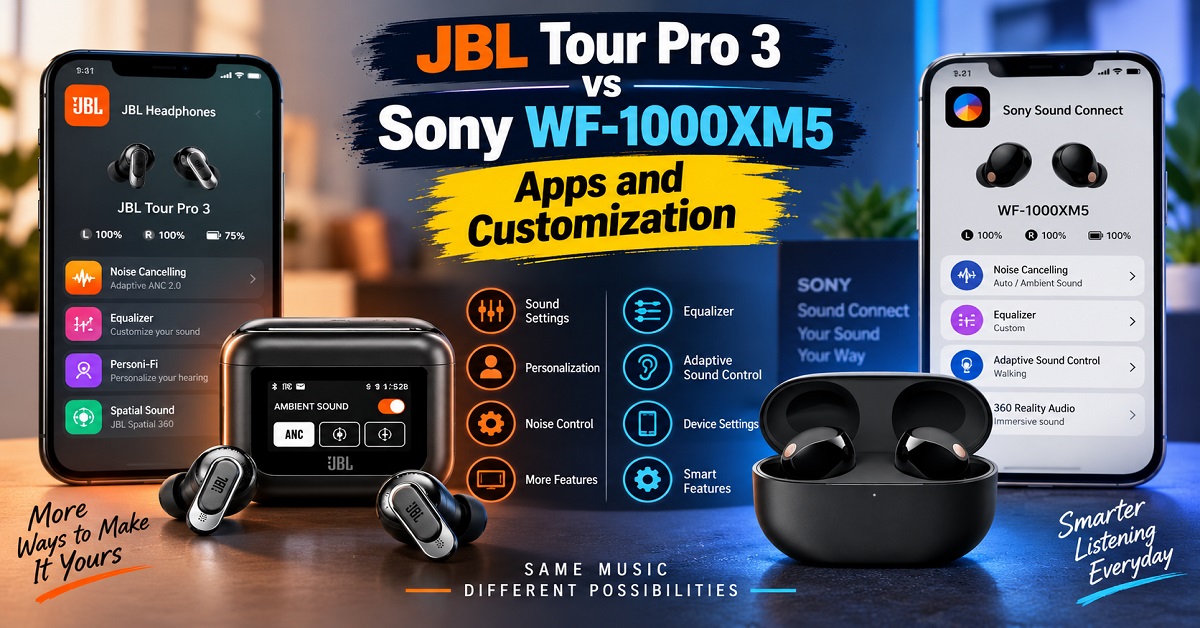
JBL Tour Pro 3 vs Sony WF-1000XM5: Apps and Customization
Both JBL and Sony provide companion apps that allow you to adjust the earbuds and access additional features.
JBL uses the JBL Headphones app, while Sony uses the Sony Sound Connect app.
These apps are important because several advanced functions are easier to manage through the app than directly from the earbuds.
JBL Headphones app
The JBL app provides extensive customization options, including EQ controls and JBL’s Personi-Fi personalization.
Personi-Fi is designed to create a more personalized sound profile based on your hearing preferences.
You can also customize ANC and ambient sound behaviour.
This makes the Tour Pro 3 a good choice for someone who likes to adjust settings and experiment.
If you’re the type of person who buys earbuds and never opens the companion app again, however, many of these features may go unused.
Sony Sound Connect app
Sony’s app also provides a lot of control.
You can adjust sound settings, manage noise cancellation and ambient sound, configure various features and personalize the listening experience.
Sony’s Adaptive Sound Control can automatically adjust behaviour based on your activity and surroundings.
For example, the earbuds can behave differently when you’re walking compared with when you’re sitting in a quieter environment.
This is useful because you don’t always want maximum ANC.
Sometimes you want to hear what’s happening around you.
Ambient Sound and Smart Listening
Both earbuds offer ways to stay aware of your surroundings.
This is useful when you’re walking outside, working in an office or waiting for a train.
The JBL Tour Pro 3 also has a Smart Talk feature that can detect when you speak and automatically pause or reduce your music while amplifying surrounding sound.
Imagine you’re listening to music in a coffee shop and someone starts talking to you.
Instead of removing the earbuds or manually pausing the music, Smart Talk is designed to make that interaction easier.
It’s a small feature, but these are the kinds of features that can make premium earbuds feel more convenient in everyday use.
Sony also offers ambient sound and adaptive control features, although its approach is more focused on automatically managing the balance between noise cancellation and environmental awareness.
Water and Dust Resistance
This is an area where JBL has a clear specification advantage.
The JBL Tour Pro 3 has an IP55 rating, while the Sony WF-1000XM5 has an IPX4 rating.
The difference is worth understanding.
An IP55 rating provides protection against dust as well as water jets from limited directions.
IPX4 means the Sony has protection against splashing water, but the “X” means there is no stated dust-protection rating.
Neither should be treated as waterproof.
You shouldn’t deliberately submerge either pair in water.
For workouts, walking in light rain and normal daily use, both provide some level of protection, but JBL has the stronger stated resistance rating.
If you exercise outdoors frequently, this could be another reason to consider the Tour Pro 3.
JBL Tour Pro 3 vs Sony WF-1000XM5: Which Is More Feature-Rich?
At this point, the difference is becoming clearer.
Sony gives you a highly capable premium TWS package focused on:
- ANC
- Sound quality
- Comfort
- Compact design
- Call quality
- Multipoint
- Sound customization
JBL adds many of those things while also offering:
- Hybrid dual-driver design
- Smart touchscreen charging case
- Audio transmitter
- Spatial 360 with head tracking
- Personi-Fi
- Smart Talk
- Longer total battery life
- IP55 protection
So if we simply count features, JBL wins comfortably.
But this brings us back to the most important question:
Are those extra features worth paying approximately ₹3,000 more?
For a frequent traveller or technology enthusiast, the answer could be yes.
For someone who primarily wants excellent ANC and sound from a compact premium earbud, the Sony may offer better value at the lower price.
Premium ANC + Smart Charging Case
JBL Tour Pro 3
- Hybrid Dual Drivers with Hi-Res LDAC Audio
- True Adaptive ANC 2.0 + Spatial 360 Head Tracking
- 6-Mic JBL Crystal AI for Calls
- Up to 44 Hours Battery + Smart Touchscreen Case
A premium pair of JBL earbuds for listeners who want high-quality sound, strong adaptive ANC, LDAC, immersive Spatial 360 audio and an unusually capable Smart Charging Case. The Tour Pro 3 is especially interesting for frequent travellers and users who want extensive customization and advanced connectivity features.
JBL Tour Pro 3: Pros and Cons
Pros
- Excellent overall feature set
- Hybrid dual-driver configuration
- LDAC support
- Strong adaptive ANC 2.0
- Smart touchscreen charging case
- Built-in audio transmitter
- Up to 44 hours of total battery life
- Spatial audio with head tracking
- Six microphones for clear calls
- Multipoint connectivity
- IP55 water and dust resistance
- Extensive sound customization with Personi-Fi 3.0
- Wireless charging support
Cons
- More expensive than the Sony WF-1000XM5 at the compared prices
- Some advanced features may be unnecessary for basic users
- Smart Charging Case is larger and more complex than a conventional case
- Actual battery life varies depending on usage and settings
- Sound preference is subjective
- Premium pricing makes discounts important
- May be overkill if you only want good sound and ANC
Sony WF-1000XM5 Wireless ANC Earbuds
• Industry-leading Active Noise Cancellation
• Rich sound with Dynamic Driver X
• Clear calls with bone conduction sensors
• Multipoint Bluetooth pairing
• Up to 36 hours battery life
• Compact, premium design
Sony WF-1000XM5: Pros and Cons
Pros
- Excellent noise cancellation
- Very good overall sound quality
- LDAC support
- Compact and lightweight design
- Multipoint connectivity
- Strong call quality technology
- Good sound customization through the Sony app
- Wireless charging support
- Fast charging support
- Up to 8 hours of playback with ANC enabled
Cons
- Lower total battery life than the JBL Tour Pro 3
- No touchscreen Smart Charging Case
- No built-in audio transmitter
- IPX4 rating is lower than JBL’s IP55 rating
- Fit and comfort can vary between users
- Premium pricing can still be difficult to justify without a discount
- Some advanced features depend on compatible devices and software
JBL Tour Pro 3 vs Sony WF-1000XM5: What Matters Most?
At this point, you might be tempted to simply choose the JBL because it has more features.
I wouldn’t recommend doing that yet.
Instead, think about how you will actually use the earbuds.
If your normal day looks like this:
Smartphone → music → YouTube → office calls → commute → occasional workout
then you probably don’t need every feature JBL has added.
The Sony could be the more sensible purchase.
But if your usage looks like this:
Smartphone → laptop → office → gym → frequent flights → movies → different audio sources → lots of customization
then the JBL Tour Pro 3 starts making much more sense.
This is why the “best earbuds” question doesn’t have one answer for everyone.
The best choice is the one whose strengths match your daily usage.
Internal link opportunity
At this point in the article, we can naturally link to your broader buying guide:
Best Premium Earbuds Under ₹25,000 in India
JBL Tour Pro 3 vs Sony WF-1000XM5: Detailed Head-to-Head Comparison
The specifications give us a good starting point, but they don’t tell the whole story.
When two earbuds are priced this high, the better choice depends on several small differences. You may care more about ANC than battery life, while another person may care about calls or travel features.
So let’s compare the JBL Tour Pro 3 and Sony WF-1000XM5 category by category.
Sound Quality: Which One Sounds Better?
This is probably the hardest category to declare a winner because sound is highly subjective.
The JBL Tour Pro 3 uses a hybrid driver configuration with a 10.2 mm dynamic driver and balanced-armature driver. It also supports Hi-Res audio and LDAC on compatible devices.
The Sony WF-1000XM5 uses Sony’s 8.4 mm Dynamic Driver X and also supports LDAC and Hi-Res audio features.
Both are capable of producing detailed sound, but they approach the experience differently.
JBL Tour Pro 3
The JBL has the advantage if you like having plenty of control over the sound.
Through the JBL Headphones app, you can adjust the EQ and use Personi-Fi to personalize the sound.
The hybrid driver setup is also interesting because the dynamic driver and balanced armature can be used to handle different parts of the frequency range.
For listeners who enjoy energetic music, strong bass and an engaging presentation, the JBL can be a very appealing choice.
It also gives you plenty of room to experiment.
For example, you might use a stronger bass profile when listening to electronic music and then switch to a more balanced profile for podcasts or classical music.
Sony WF-1000XM5
The Sony takes a slightly different approach.
The Dynamic Driver X is designed to reproduce a broad range of frequencies, while Sony’s processing technologies are used to improve the overall listening experience.
The WF-1000XM5 can produce strong bass without necessarily making vocals disappear behind it.
This is particularly useful for people who listen to different types of content throughout the day.
You may listen to a bass-heavy song in the morning, a podcast during lunch and a movie in the evening.
The Sony is designed to handle all three.
Sound quality winner
It’s a very close comparison.
I would give the JBL an advantage for listeners who want a more feature-rich and customizable audio experience.
I would recommend the Sony to listeners who prefer Sony’s tuning and processing and want a refined all-round presentation.
Winner: JBL Tour Pro 3, by a small margin for customization and hardware flexibility.
But don’t interpret this as saying everyone will prefer the JBL’s sound. Your personal preference matters more here than the specification sheet.
ANC Performance: JBL or Sony?
Noise cancellation is one of the biggest reasons people spend more money on premium earbuds.
Both models are designed to provide strong ANC, but Sony has built much of its reputation around noise cancellation.
The WF-1000XM5 uses Sony’s Integrated Processor V2 and HD Noise Cancelling Processor QN2e, along with multiple microphones in each earbud.
The system is designed to monitor surrounding noise and adjust the cancellation accordingly.
JBL’s Tour Pro 3 uses True Adaptive Noise Cancelling 2.0 and also provides customization through the JBL app.
In everyday situations such as an air conditioner, office background noise, traffic and public transportation, both should perform well.
However, there is another factor that shouldn’t be ignored.
Fit can change your ANC experience
Suppose you put the Sony in your ears and it doesn’t create a good seal.
Outside noise can enter around the ear tip.
Now imagine another person using exactly the same earbuds but finding a much better fit.
That person may experience noticeably better isolation.
This is why you should experiment with the supplied ear tips before judging ANC.
If you want to understand the basics before buying, you can also internally link to [ANC vs Passive Noise Cancellation: What Is the Difference?] here.
ANC winner
For someone whose main priority is noise cancellation, I’d lean toward the Sony WF-1000XM5.
Sony’s ANC system is one of the major reasons to consider this model.
The JBL is certainly not a weak competitor, but Sony has a particularly strong case when ANC is the deciding factor.
Winner: Sony WF-1000XM5
Call Quality: Which Earbuds Are Better for Phone Calls?
Both companies have invested heavily in microphone technology.
The JBL Tour Pro 3 has six microphones and uses JBL Crystal AI processing to reduce environmental and wind noise.
Sony’s WF-1000XM5 also uses multiple microphones, Precise Voice Pickup technology and bone-conduction sensors.
For someone who spends several hours a day on calls, this category matters more than some of the flashy features.
A good pair of earbuds should allow the person on the other side to understand you without constantly asking:
“Can you hear me?”
JBL for calls
The JBL’s six-microphone system and AI processing are designed to isolate your voice from background noise.
This can be useful when you’re outside or sitting somewhere with moderate background noise.
Sony for calls
Sony’s voice pickup system is also designed specifically for clearer voice transmission.
The bone-conduction sensors are interesting because they detect vibrations from your voice rather than relying entirely on microphones picking up sound through the surrounding environment.
This can help the earbuds distinguish your voice from background noise.
Call quality winner
This is another close category.
Both are serious calling earbuds, and the actual result can depend on the environment.
For indoor office calls, either should be more than capable.
For outdoor calls, wind and traffic can make the comparison more complicated.
Winner: Tie
Battery Life: JBL Wins the Overall Endurance Battle
As we discussed earlier, both earbuds offer around 8 hours of playback with ANC enabled.
So there isn’t much difference if we’re talking about a single continuous listening session.
The difference becomes much larger when we include the charging case.
JBL advertises up to 44 hours of total playback, while Sony’s figures are considerably lower when ANC is enabled.
That makes JBL the better choice for someone who doesn’t like charging frequently.
Example
Suppose you use your earbuds for around 2 to 3 hours every day.
With either pair, you should have enough battery for regular daily use.
But if you’re going on a long trip and don’t have easy access to a charger, the JBL’s larger total battery capacity becomes much more useful.
Winner: JBL Tour Pro 3
Charging: Which One Is More Convenient?
Both support quick charging and wireless charging.
JBL’s quick-charge specification is particularly impressive, with around 3 hours of playback from a 10-minute charge.
Sony can provide up to 60 minutes from approximately 3 minutes of charging.
Both are useful.
If you suddenly discover that your earbuds are almost dead before leaving home, you don’t need to wait for a full charge.
A few minutes can provide enough battery for a commute.
Winner: Tie
The advantage depends on whether you value JBL’s longer charge-to-playback ratio or Sony’s very short emergency charging time.
Comfort: Which One Can You Wear Longer?
There is no universal winner here.
Both are relatively lightweight.
Sony’s WF-1000XM5 weighs approximately 5.9 grams per earbud, while JBL’s Tour Pro 3 is approximately 5.6 grams per earbud.
The difference is too small to make weight alone a deciding factor.
The more important question is:
Which shape fits your ears better?
This can be completely different from person to person.
One person’s perfect earbud can be another person’s uncomfortable earbud.
Sony
The WF-1000XM5’s smaller design can appeal to people who don’t like large earbuds.
Sony also provides noise-isolation tips that can help create a secure seal.
JBL
The Tour Pro 3 also provides different ear-tip options, allowing you to experiment with the fit.
If the JBL fits your ears more securely, you may actually get better ANC and bass response as a result.
Winner: Tie
Comfort is too dependent on individual ear shape to confidently declare one model better for everyone.
Connectivity: Both Are Strong
Both earbuds support Bluetooth 5.3 and multipoint connectivity.
They also support LDAC for compatible devices.
This is particularly useful for Android users who have a phone that supports LDAC.
But remember that LDAC isn’t automatically available in every situation.
Your smartphone, operating system settings and playback source all need to support the relevant codec.
If you’re using an iPhone, you shouldn’t buy either earbud simply because it supports LDAC.
The important thing is to check what codecs your phone actually supports.
Multipoint
Both models support multipoint connectivity.
This means you can connect them to two devices at the same time.
For someone using a smartphone and laptop, this is a very useful feature.
Winner: Tie
Spatial Audio: JBL Has the More Interesting Implementation
JBL’s Spatial 360 with head tracking is one of the Tour Pro 3’s standout features.
Instead of simply making the sound wider, head tracking attempts to maintain the position of the soundstage as you move your head.
This can make supported movie and audio content feel more immersive.
Sony also offers 360 Reality Audio and spatial audio-related features.
But once again, don’t assume that spatial audio will make every song sound better.
Some tracks can sound impressive with spatial processing.
Others may sound more natural in conventional stereo.
Winner
JBL Tour Pro 3
The combination of spatial audio and head tracking makes JBL particularly interesting for movie and immersive-content fans.
Smart Features: JBL Wins Easily
There is no real contest here.
The JBL Tour Pro 3’s Smart Charging Case is one of the biggest differences between these products.
You get a touchscreen interface and an audio transmitter built into the case.
The case can effectively become part of the audio system rather than simply storing and charging the earbuds.
Sony’s charging case is much more conventional.
That’s not necessarily a criticism.
A simple charging case can actually be preferable if you value portability and simplicity.
But if we’re judging the number of innovative features, JBL clearly wins.
Winner: JBL Tour Pro 3
Water Resistance: JBL Has the Advantage
JBL’s IP55 rating is stronger than Sony’s IPX4 rating.
This gives JBL an advantage for people who use their earbuds during workouts or outdoor activities.
However, neither product should be treated as waterproof.
Don’t deliberately expose either pair to heavy water or submerge them.
Sweat and light rain are very different from taking your earbuds into a swimming pool.
Winner: JBL Tour Pro 3
JBL Tour Pro 3 vs Sony WF-1000XM5: Feature-by-Feature Winner
| Category | Winner |
|---|---|
| Sound quality | JBL Tour Pro 3 |
| ANC | Sony WF-1000XM5 |
| Call quality | Tie |
| Battery life | JBL Tour Pro 3 |
| Quick charging | Tie |
| Comfort | Tie |
| Multipoint | Tie |
| LDAC | Tie |
| Spatial audio | JBL Tour Pro 3 |
| Smart features | JBL Tour Pro 3 |
| Charging case | JBL Tour Pro 3 |
| Travel features | JBL Tour Pro 3 |
| Water resistance | JBL Tour Pro 3 |
| App customization | Tie |
| Compact design | Sony WF-1000XM5 |
| Overall features | JBL Tour Pro 3 |
| Value at the compared prices | Sony WF-1000XM5 |
That last line is particularly important.
The JBL wins more categories, but the Sony can still be the better value.
Why?
Because you’re paying approximately ₹3,000 less for the Sony based on the prices we’re comparing.
If you don’t need JBL’s Smart Charging Case and transmitter, you may not benefit enough from its additional features to justify the extra money.
JBL Tour Pro 3 vs Sony WF-1000XM5: Which One Should You Buy?
Now we come to the most important part.
There is no point spending more money simply because one product has a longer specification list.
Instead, choose according to your priorities.
Buy the JBL Tour Pro 3 if you want the most features
The JBL Tour Pro 3 is the better choice if you enjoy technology and want your earbuds to do more than the basics.
The Smart Charging Case alone makes the product different from most premium TWS earbuds.
Add the audio transmitter, spatial audio with head tracking, hybrid drivers, LDAC, extensive customization, long total battery life and IP55 protection, and JBL has created a very feature-heavy package.
If you travel frequently, the transmitter can be particularly useful.
For feature lovers, JBL is the better choice.
Buy the Sony WF-1000XM5 if ANC is your priority
If you mainly want premium earbuds with excellent noise cancellation, strong sound quality and a compact design, Sony makes a lot of sense.
You don’t need to learn a touchscreen charging case or use a transmitter.
Put the earbuds in, enable your preferred settings and start listening.
For many people, that’s exactly what a premium earbud should do.
For ANC-focused buyers, Sony is the safer choice.
Buy JBL if you travel frequently
This deserves special attention.
If you’re regularly flying, the JBL Tour Pro 3’s Smart Charging Case can be genuinely useful.
The ability to transmit audio from a compatible wired source to the earbuds means you don’t necessarily need a separate Bluetooth transmitter.
Add the longer total battery life and strong ANC, and JBL becomes an attractive travel companion.
Frequent traveller: JBL Tour Pro 3
If portability is more important than having every possible feature, Sony’s smaller design may appeal more.
You get a premium pair of earbuds without the additional functionality built into JBL’s case.
For someone who wants to put the case in their pocket and forget about it, this simplicity can actually be an advantage.
Compact and straightforward: Sony WF-1000XM5
Is JBL Tour Pro 3 Worth ₹3,000 More?
This is probably the question most Indian buyers will have after seeing the price difference.
At the prices used in this comparison:
JBL Tour Pro 3: ₹19,999
Sony WF-1000XM5: ₹16,989
Difference: approximately ₹3,010
I would not say that everyone should spend the extra ₹3,000.
If you specifically want the JBL’s Smart Charging Case, transmitter, spatial audio, longer total battery life and broader feature set, the additional money can be justified.
But if your priorities are mainly ANC, sound, calls, multipoint and portability, the Sony could be the smarter purchase.
This is especially true if you find the WF-1000XM5 at a good discount.
The price difference can also change over time.
Premium Sony and JBL products frequently receive discounts, so the buying decision should ideally be based on the current selling price, not only the launch or listed price.
If the price gap becomes very small, JBL becomes easier to recommend.
If the Sony becomes significantly cheaper, its value proposition becomes much stronger.
My Verdict: JBL Tour Pro 3 vs Sony WF-1000XM5
After comparing both earbuds across the categories that matter most, I would give the overall feature win to the JBL Tour Pro 3.
It offers more hardware features, longer total battery life, a unique Smart Charging Case, an audio transmitter, spatial audio with head tracking, hybrid drivers and a stronger IP rating.
But that doesn’t mean the Sony WF-1000XM5 becomes a bad choice.
In fact, for many buyers, Sony may be the smarter purchase.
The WF-1000XM5 gives you strong ANC, excellent sound, LDAC, multipoint connectivity, a compact design and a mature software experience while costing less at the prices used in this comparison.
So my recommendation would be:
JBL Tour Pro 3: Best for features, travel, battery life and people who want the most advanced overall package.
Sony WF-1000XM5: Best for ANC-focused buyers, compact design and buyers who want premium performance without paying extra for JBL’s additional features.
Overall winner: JBL Tour Pro 3
Better value: Sony WF-1000XM5
That’s the distinction I’d want a buyer to understand before spending their money.
If you are looking for a broader list of options in this price range, you can also add an internal link here to [Best Wireless Earbuds Under ₹20,000 in India].
Before You Buy Either One
There are a few things I’d strongly recommend checking before placing the order.
1. Check your phone’s codec support
Don’t buy an earbud just because it says LDAC.
Check whether your smartphone supports LDAC and whether you actually intend to use it.
If your phone doesn’t support it, this particular feature shouldn’t influence your decision.
2. Don’t ignore the fit
A poor fit can affect:
- Bass
- ANC
- Comfort
- Stability
- Outside-noise isolation
Try different ear tips before deciding that the earbuds aren’t performing well.
3. Consider how often you’ll use the advanced features
JBL’s Smart Charging Case is impressive.
But ask yourself honestly:
Will I actually use it?
If you don’t travel and always listen from your phone, you may rarely use the transmitter.
In that situation, paying extra for it may not make sense.
4. Don’t compare only the number of drivers
The JBL’s hybrid dual-driver configuration looks impressive on paper.
But two drivers don’t automatically mean better sound than one driver.
Tuning and implementation matter.
5. Check the price before buying
The prices mentioned in this article are the prices used for this comparison and can change.
If you find a large discount on either model, the value equation can change significantly.
For example, if the Sony becomes ₹4,000 to ₹5,000 cheaper than JBL, I’d be much more comfortable recommending Sony to a value-conscious buyer.
On the other hand, if the JBL drops close to Sony’s price, its additional features become much easier to justify.
JBL Tour Pro 3 vs Sony WF-1000XM5: Final Buying Recommendations
After looking at the sound, ANC, calls, battery life, comfort, connectivity and features, the choice becomes much easier.
Both are premium earbuds, but they are designed with slightly different priorities.
The JBL Tour Pro 3 is the more ambitious product. It tries to give you almost everything in one package, including a feature-packed charging case.
The Sony WF-1000XM5 is more focused. It concentrates on the things most people expect from premium earbuds, including noise cancellation, sound quality, comfort, calls and a compact design.
So instead of simply saying “buy JBL” or “buy Sony,” here is how I would choose between them.
Best for Music: JBL Tour Pro 3
If music is your main priority and you enjoy experimenting with sound, I’d give the edge to the JBL Tour Pro 3.
Its hybrid driver configuration, LDAC support and extensive customization options give you plenty of flexibility.
JBL’s Personi-Fi feature is also useful if you want to personalize the listening experience instead of relying only on the default tuning.
However, Sony is not far behind.
The WF-1000XM5 remains an excellent choice for music, especially if you prefer Sony’s tuning and processing.
So don’t interpret this as a dramatic difference.
Winner: JBL Tour Pro 3
Best for Noise Cancellation: Sony WF-1000XM5
This is where I would choose Sony.
The WF-1000XM5 is built around Sony’s advanced noise-cancellation technology, and ANC is one of the biggest reasons to consider this model.
Whether you’re commuting, working in a noisy office or travelling, effective ANC can make a major difference.
JBL’s adaptive ANC is also strong, but if your first question is:
“Which one should I buy mainly for noise cancellation?”
I’d lean toward Sony.
Winner: Sony WF-1000XM5
Best for Calls: Tie
Both earbuds have serious microphone and voice-processing systems.
JBL uses six microphones and Crystal AI.
Sony uses multiple microphones, Precise Voice Pickup technology and bone-conduction sensors.
Both are designed to improve voice clarity in noisy environments.
Because call performance depends on the surrounding environment, network quality, microphone positioning and fit, I wouldn’t recommend choosing between these two based solely on the microphone specification.
Winner: Tie
Best for Battery Life: JBL Tour Pro 3
There is a clear winner here.
The earbuds themselves offer similar rated playback with ANC enabled, but JBL’s charging case provides significantly more total playback.
The Tour Pro 3 is rated for up to 44 hours of total playback.
That makes it particularly attractive for travellers and people who don’t want to charge their earbuds frequently.
Winner: JBL Tour Pro 3
Best for Travel: JBL Tour Pro 3
This is one category where JBL’s unusual features become genuinely useful.
The Smart Charging Case can work as an audio transmitter.
That means you can connect the case to compatible wired audio sources and transmit the sound to the earbuds.
For frequent flyers, this can eliminate the need for a separate Bluetooth transmitter.
Add ANC, long total battery life and spatial audio, and the JBL becomes a very interesting travel-focused package.
Sony is still an excellent travel earbud because of its ANC and compact design.
But JBL offers more travel-specific functionality.
Winner: JBL Tour Pro 3
Best for Simplicity: Sony WF-1000XM5
Not everyone wants more features.
Some people want to open the case, put the earbuds in their ears and start listening.
The Sony is a better fit for this type of user.
Its conventional charging case is simple, compact and familiar.
You don’t have to interact with a touchscreen on the case or think about using it as a transmitter.
For someone who doesn’t need these features, Sony’s simpler approach can actually be an advantage.
Winner: Sony WF-1000XM5
Best for Outdoor Use: JBL Tour Pro 3
The JBL Tour Pro 3 has an IP55 rating, while the Sony WF-1000XM5 carries an IPX4 rating.
This gives JBL an advantage on paper when it comes to resistance against dust and water exposure.
However, remember that neither pair is waterproof.
You shouldn’t deliberately expose either model to heavy water or submerge them.
For regular workouts, sweat and light rain, the JBL’s higher rating provides some additional peace of mind.
Winner: JBL Tour Pro 3
Best Value for Money: Sony WF-1000XM5
This is where the comparison becomes interesting.
The JBL Tour Pro 3 is the better product if you look at the number of features.
But the Sony WF-1000XM5 can be the better value depending on the price you pay.
At the prices used in this comparison, Sony costs approximately ₹3,000 less.
If you don’t need JBL’s Smart Charging Case, transmitter or some of its other advanced features, spending that additional money may not provide enough benefit.
For a buyer who wants premium ANC, sound quality, calls and multipoint without paying for features they won’t use, Sony makes a lot of sense.
Winner: Sony WF-1000XM5
JBL Tour Pro 3 vs Sony WF-1000XM5: Final Scorecard
| Category | Winner |
|---|---|
| Sound quality | JBL Tour Pro 3 |
| ANC | Sony WF-1000XM5 |
| Call quality | Tie |
| Battery life | JBL Tour Pro 3 |
| Quick charging | Tie |
| Comfort | Tie |
| Multipoint | Tie |
| LDAC | Tie |
| Spatial audio | JBL Tour Pro 3 |
| Smart features | JBL Tour Pro 3 |
| Charging case | JBL Tour Pro 3 |
| Travel | JBL Tour Pro 3 |
| Outdoor use | JBL Tour Pro 3 |
| Simplicity | Sony WF-1000XM5 |
| Compact design | Sony WF-1000XM5 |
| Value for money | Sony WF-1000XM5 |
| Overall features | JBL Tour Pro 3 |
| Overall recommendation | JBL Tour Pro 3 |
JBL Tour Pro 3 vs Sony WF-1000XM5: Frequently Asked Questions
Is JBL Tour Pro 3 better than Sony WF-1000XM5?
The JBL Tour Pro 3 is better if you want more features, longer total battery life, a Smart Charging Case, an audio transmitter, spatial audio with head tracking and a hybrid driver setup.
The Sony WF-1000XM5 can be the better choice if your priorities are ANC, compact design, sound quality and value for money.
So, JBL is the stronger feature-focused option, while Sony can be the smarter value-focused option.
Which has better noise cancellation, JBL Tour Pro 3 or Sony WF-1000XM5?
I’d choose the Sony WF-1000XM5 if ANC is your main priority.
Sony has invested heavily in its noise-cancellation system, and ANC is one of the strongest reasons to buy the WF-1000XM5.
However, the final experience depends on ear-tip fit and how well the earbuds seal your ears.
Which has better sound quality?
Both offer excellent sound quality and support LDAC on compatible devices.
The JBL Tour Pro 3 uses a hybrid driver setup with a 10.2 mm dynamic driver and balanced armature, while Sony uses its 8.4 mm Dynamic Driver X.
I’d give JBL a slight edge for customization and its hybrid setup, but sound preference is subjective.
If possible, consider your preferred sound signature before choosing.
Does JBL Tour Pro 3 support LDAC?
Yes.
The JBL Tour Pro 3 supports LDAC, allowing compatible devices to transmit higher-quality audio wirelessly.
However, your smartphone or source device must also support LDAC for you to take advantage of it.
Does Sony WF-1000XM5 support LDAC?
Yes.
The Sony WF-1000XM5 supports LDAC as well.
Therefore, LDAC isn’t a deciding factor between these two earbuds if both are being used with a compatible device.
Which has better battery life?
The JBL Tour Pro 3 has the advantage in total battery life.
JBL rates the Tour Pro 3 for up to 44 hours of total playback with the charging case.
Sony’s WF-1000XM5 is rated for up to 8 hours of playback with ANC enabled, with additional charges available from the case.
Actual battery life will vary depending on volume, ANC, codec and other features.
Does JBL Tour Pro 3 have multipoint connectivity?
Yes.
The JBL Tour Pro 3 supports multipoint connectivity, allowing it to maintain connections with multiple devices.
This is useful if you regularly switch between a smartphone and laptop.
Does Sony WF-1000XM5 have multipoint connectivity?
Yes.
The WF-1000XM5 supports multipoint Bluetooth connectivity.
You can use it with compatible smartphones, computers and other devices, making it useful for people who move between work and personal devices.
Which is better for travel?
I’d choose the JBL Tour Pro 3 for frequent travellers.
Its Smart Charging Case can also act as an audio transmitter, which can be useful with wired audio systems such as airplane entertainment systems.
Its longer total battery life is another advantage on longer trips.
The Sony WF-1000XM5 is still an excellent travel option, particularly if your biggest concern is noise cancellation.
Which is better for workouts?
The JBL Tour Pro 3 has the stronger IP55 rating compared with the Sony’s IPX4 rating.
That gives JBL the advantage in terms of stated dust and water resistance.
However, neither pair is designed to be submerged, and you should follow the manufacturer’s care instructions after exposure to sweat or moisture.
Is JBL Tour Pro 3 worth buying at ₹19,999?
It can be worth it if you will actually use its additional features.
The Smart Charging Case, audio transmitter, hybrid drivers, spatial audio, long total battery life and extensive customization make it a feature-rich premium TWS option.
But if you mainly want ANC and high-quality sound, the Sony WF-1000XM5 may give you better value, especially if it is available at a significantly lower price.
Is Sony WF-1000XM5 still worth buying?
Yes.
Even though newer earbuds continue to enter the market, the WF-1000XM5 remains a compelling premium option if you find it at the right price.
Its ANC, sound quality, compact design, LDAC and multipoint support still make it a strong all-round package.
Should I buy JBL Tour Pro 3 or Sony WF-1000XM5?
If your priority is maximum features, travel functionality and battery life, choose the JBL Tour Pro 3.
If your priority is ANC, compact design and value, choose the Sony WF-1000XM5.
If the prices are very close, I’d lean more strongly toward JBL because its additional features become easier to justify.
If Sony is available at a much lower price, it becomes the better value proposition.
Final Verdict
The JBL Tour Pro 3 and Sony WF-1000XM5 are both excellent premium TWS earbuds, but they appeal to slightly different buyers.
The JBL Tour Pro 3 is the more feature-packed option. Its hybrid driver system, LDAC, adaptive ANC, spatial audio with head tracking, long total battery life, IP55 rating and especially the Smart Charging Case make it one of the more interesting premium earbuds for people who want additional functionality.
The Smart Charging Case is the feature that really separates JBL from Sony.
If you travel regularly, the built-in audio transmitter could be genuinely useful rather than simply being a specification you rarely touch.
The Sony WF-1000XM5 is the more straightforward premium choice.
It gives you excellent ANC, strong sound quality, LDAC, multipoint connectivity and a compact design without making the charging case part of the feature experience.
And because it costs less at the prices used in this comparison, it can make more sense for buyers who don’t need JBL’s additional features.
My recommendation
Choose JBL Tour Pro 3 if you want:
- More features
- Better total battery life
- Smart Charging Case
- Audio transmitter for travel
- Hybrid drivers
- Spatial audio with head tracking
- Stronger stated water and dust resistance
- More reasons to experiment with the earbuds
Choose Sony WF-1000XM5 if you want:
- Strong ANC
- Compact premium earbuds
- Excellent sound
- LDAC
- Multipoint
- A simpler charging case
- Lower purchase price
- Better value when heavily discounted
Overall winner: JBL Tour Pro 3
Value-for-money winner: Sony WF-1000XM5
If I were spending my own money, I would make the final decision based on the price difference at the time of purchase.
At only a small price difference, I’d pick the JBL Tour Pro 3 because you’re getting significantly more functionality.
If the Sony is available several thousand rupees cheaper, I’d seriously consider the WF-1000XM5 because you still get the core premium features that most people actually use.
In other words, JBL is the better feature-rich choice, while Sony can be the smarter buy for a value-conscious buyer.
Final Pros and Cons
JBL Tour Pro 3
Pros
- Excellent overall feature set
- Hybrid dual-driver configuration
- LDAC support
- Strong adaptive ANC 2.0
- Smart touchscreen charging case
- Built-in audio transmitter
- Up to 44 hours of total battery life
- Spatial audio with head tracking
- Six microphones for clear calls
- Multipoint connectivity
- IP55 water and dust resistance
- Extensive sound customization with Personi-Fi 3.0
- Wireless charging support
Cons
- More expensive than the Sony WF-1000XM5 at the compared prices
- Some advanced features may be unnecessary for basic users
- Smart Charging Case is larger and more complex than a conventional case
- Actual battery life varies depending on usage and settings
- Sound preference is subjective
- Premium pricing makes discounts important
- May be overkill if you only want good sound and ANC
Sony WF-1000XM5
Pros
- Excellent noise cancellation
- Very good overall sound quality
- LDAC support
- Compact and lightweight design
- Multipoint connectivity
- Strong call quality technology
- Good sound customization through the Sony app
- Wireless charging support
- Fast charging support
- Up to 8 hours of playback with ANC enabled
Cons
- Lower total battery life than the JBL Tour Pro 3
- No touchscreen Smart Charging Case
- No built-in audio transmitter
- IPX4 rating is lower than JBL’s IP55 rating
- Fit and comfort can vary between users
- Premium pricing can still be difficult to justify without a discount
- Some advanced features depend on compatible devices and software
Final Buying Tip
Before buying either pair, check the current price rather than relying only on the prices mentioned in this comparison.
Premium earbuds often receive discounts, and a ₹3,000 price gap can become much larger or smaller depending on the current offer.
If you find both at nearly the same price, JBL’s additional features make it the more attractive package.
If Sony is available at a significant discount, the WF-1000XM5 becomes a very compelling alternative.
And remember one thing above everything else:
Don’t buy an expensive pair of earbuds only because the specification sheet looks impressive. Buy the one whose features you will actually use.
For more options before making your final decision, you can link this section to Best Open-Ear Earbuds (2026).
Premium ANC + Smart Charging Case
JBL Tour Pro 3
- Hybrid Dual Drivers with Hi-Res LDAC Audio
- True Adaptive ANC 2.0 + Spatial 360 Head Tracking
- 6-Mic JBL Crystal AI for Calls
- Up to 44 Hours Battery + Smart Touchscreen Case
A premium pair of JBL earbuds for listeners who want high-quality sound, strong adaptive ANC, LDAC, immersive Spatial 360 audio and an unusually capable Smart Charging Case. The Tour Pro 3 is especially interesting for frequent travellers and users who want extensive customization and advanced connectivity features.
Sony WF-1000XM5 Wireless ANC Earbuds
• Industry-leading Active Noise Cancellation
• Rich sound with Dynamic Driver X
• Clear calls with bone conduction sensors
• Multipoint Bluetooth pairing
• Up to 36 hours battery life
• Compact, premium design

About the Author
Hari Prasad is the editor of AudioPick.in and a lifelong audio enthusiast. He writes detailed, honest reviews and guides to help everyday users pick the right gear without tech jargon. His personal interest in Bluetooth audio, neckbands, and codecs comes from testing dozens of devices over the past few years.