
Buying wireless earbuds has become confusing.
You can find earbuds for ₹1,000, ₹3,000, ₹5,000 and even more than ₹20,000. Almost every manufacturer talks about powerful bass, crystal-clear vocals, Hi-Res Audio, ANC and advanced drivers.
But there is a problem.
A long list of specifications does not automatically mean that a pair of earbuds will sound great to you.
The driver size, audio codec, tuning, ear-tip fit, EQ settings and even the phone you use can affect what you actually hear. That is why choosing the best earbuds sound quality is not simply about finding the earbuds with the biggest driver or the highest number of features.
If music quality is your main priority, you need to look beyond the marketing terms.
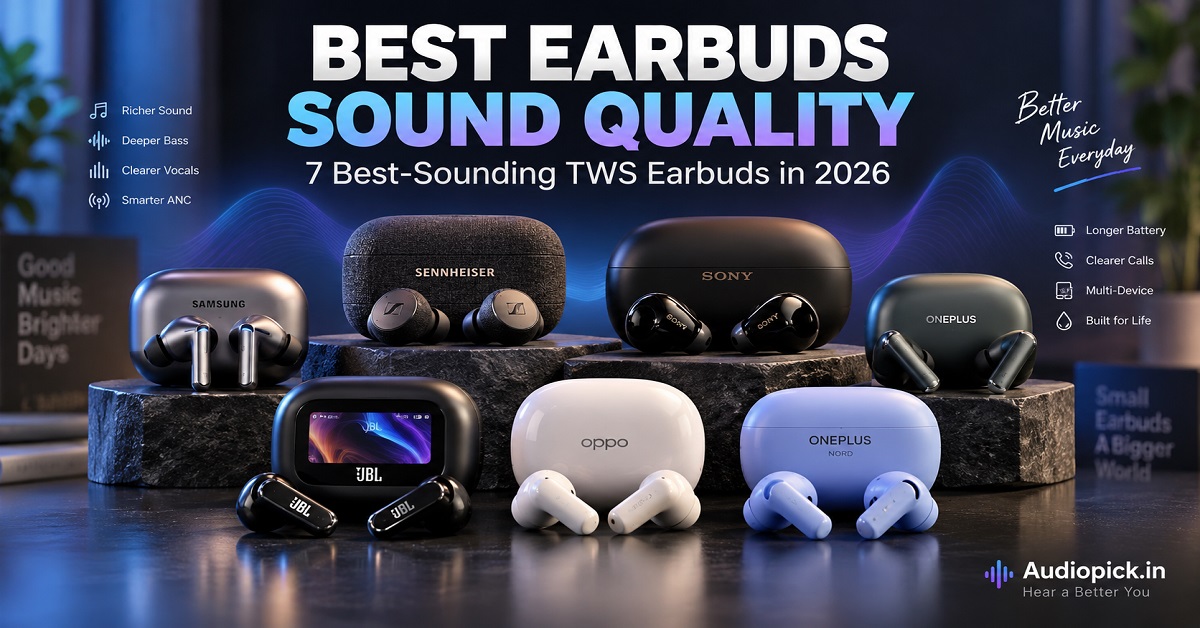
In this guide, I have selected seven TWS earbuds available in India across different price ranges. They include premium options from Sennheiser and Sony, feature-rich models from Samsung, OnePlus and JBL, and more affordable choices from OPPO and OnePlus.
The goal is simple: help you understand what each pair is good at, what its limitations are, and which type of listener should consider it.
Quick Look: Best Earbuds for Sound Quality
Here is a quick comparison before we get into the details.
| Earbuds | Best suited for | Driver setup | Price checked |
|---|---|---|---|
| Sennheiser MOMENTUM True Wireless 4 | Detailed, premium sound | 7mm TrueResponse | ₹20,990 |
| Sony WF-1000XM5 | Premium sound with ANC | Dynamic Driver X | ₹16,989 |
| Samsung Galaxy Buds3 Pro | Hi-Fi sound and Samsung users | Two-way speaker | ₹15,290 |
| OnePlus Buds Pro 3 | Sound quality and value | 11mm + 6mm dual drivers | ₹11,770 |
| JBL Live Beam 3 | JBL sound and features | 10mm dynamic | ₹11,999 |
| OPPO Enco Air5 Pro | Sound quality under ₹5,000 | 12mm dynamic | ₹4,999 |
| OnePlus Nord Buds 4 | Budget listening and bass | 12mm driver | ₹3,299 |
Prices mentioned above are the prices provided for this article and can change on Amazon.
There is no need to spend ₹20,000 simply because a pair of earbuds is expensive.
For example, someone who mainly listens to YouTube videos, Spotify playlists and podcasts may be perfectly happy with a ₹3,000 to ₹5,000 pair. On the other hand, someone who pays close attention to vocals, instruments, separation and detail may appreciate what the premium models offer.
That difference is important throughout this guide.
What Actually Determines Earbud Sound Quality?
Before looking at individual products, it is worth understanding one thing: sound quality is the result of several components working together.
This is also why comparing earbuds only by their driver size can be misleading.
1. Driver size matters, but it is not everything
The driver is the part of the earbud that converts the electrical audio signal into sound waves.
You will see specifications such as:
- 7mm driver
- 10mm driver
- 11mm driver
- 12mm driver
- Dual-driver configuration
It is tempting to assume that a 12mm driver must sound better than a 7mm driver.
That isn’t necessarily true.
Driver design, tuning, materials, amplification and software processing all influence the final result. A well-tuned smaller driver can produce a more enjoyable and detailed sound than a poorly tuned larger driver.
For example, the Sennheiser MOMENTUM True Wireless 4 uses a 7mm TrueResponse dynamic driver, while the OPPO Enco Air5 Pro uses a 12mm titanium-coated dynamic driver. The difference in driver size alone does not tell you which one will sound better.
2. Sound tuning is extremely important
Two earbuds can have completely different sound signatures.
One may emphasize bass.
Another may give more attention to vocals and the midrange.
Another may produce a more balanced presentation where bass, vocals and treble are kept relatively even.
Think about listening to a song with a male singer.
If the earbuds emphasize bass too much, the vocals may sound less prominent. If the midrange is well tuned, the singer’s voice may sound clearer and more natural.
This is why “best sound” is partly personal.
A person who loves electronic music or bass-heavy Bollywood songs may prefer a different tuning from someone who mainly listens to classical music, acoustic recordings or vocals.
3. High-resolution audio and codecs
You may have noticed terms such as LDAC, LHDC, aptX Lossless, 24-bit/96kHz and Hi-Res Audio while looking at premium earbuds.
These technologies can allow compatible devices to transmit more audio information over Bluetooth.
However, there is an important catch.
Both the earbuds and the source device need to support the relevant technology. Your music service and audio files also matter.
For example, OnePlus Buds Pro 3 supports LHDC 5.0, while Sennheiser MOMENTUM True Wireless 4 supports aptX Lossless. These capabilities are useful features, but they don’t mean that every phone or every music stream will automatically use them.
So don’t buy earbuds purely because you see “24-bit/96kHz” on the specifications sheet.
4. Ear-tip fit can change what you hear
This is one of the most overlooked factors.
Your earbuds may have excellent hardware, but if they don’t seal properly inside your ears, you may lose bass and outside noise may become more noticeable.
Imagine wearing an expensive pair of earbuds with tips that are too small.
The earbuds may technically be capable of producing powerful bass, but the poor seal can make the bass sound weak.
This is why the correct ear-tip size is important.
It can also affect ANC performance because active noise cancellation works together with the physical isolation provided by the ear tips.
5. EQ can make a significant difference
Many modern earbuds come with a companion app that lets you adjust the equalizer.
For example, you may be able to increase bass if you like a heavier sound or reduce certain frequencies if the treble feels too strong.
Sennheiser goes further with sound personalization features, including an adaptive five-band EQ and personalized sound profiles.
This is useful because your hearing and preferences are different from someone else’s.
#1. Sennheiser MOMENTUM True Wireless 4
Best for: Detailed and premium sound
Price: ₹20,990
If your main reason for buying premium earbuds is music quality, the Sennheiser MOMENTUM True Wireless 4 deserves serious attention.
Sennheiser has a long history in headphones and professional audio, and the MOMENTUM True Wireless 4 is designed around that audio-focused approach.
It is not the cheapest option in this list.
In fact, at ₹20,990 based on the price provided for this article, it costs considerably more than the OnePlus and OPPO options we’ll discuss later.
So the question is not simply whether it has more features.
The better question is whether its audio capabilities justify considering it if sound quality is your biggest priority.
Sennheiser TrueResponse driver
The MOMENTUM True Wireless 4 uses a 7mm TrueResponse dynamic driver.
Don’t let the 7mm number make you think it is behind the 11mm or 12mm earbuds in this list.
Driver size isn’t a direct measurement of sound quality.
Sennheiser has designed its TrueResponse transducer system specifically for its wireless earbuds, and the MTW4 supports high-quality Bluetooth audio, including aptX Lossless on compatible devices. Sennheiser lists a frequency response of 5Hz to 21kHz.
For someone who listens carefully to music, the combination of driver design, tuning and supported codecs is more meaningful than simply comparing millimetres.
What can you expect from the sound?
The biggest reason to consider the MOMENTUM True Wireless 4 is its focus on detail and sound personalization.
A good pair of earbuds should not simply make the music loud.
You want to be able to hear the different elements of a recording without everything becoming one compressed wall of sound.
For example, when listening to a song with vocals, guitar, drums and background instruments, good separation can make it easier to notice individual elements of the recording.
The MTW4 is designed for this type of detailed listening.
It also supports personalization features that allow you to adjust the sound to your preferences rather than being locked into one factory tuning.
aptX Lossless
One of the standout features is aptX Lossless support.
Sennheiser markets the MTW4 as capable of lossless wireless audio with compatible equipment, and its specifications support high-resolution audio capabilities.
But there is something you should know before buying it.
You need a compatible source device and compatible audio setup to take advantage of these features.
If your phone does not support the required codec, the earbuds will use another supported Bluetooth audio mode.
So if you are buying the MTW4 specifically because of aptX Lossless, check your smartphone’s Bluetooth codec compatibility first.
Sound personalization
This is another strong point.
The Sennheiser app provides several ways to customize the listening experience, including EQ and personalized sound features.
This can be particularly useful if you don’t like the default sound profile.
For example, suppose you enjoy songs with strong vocals but don’t want excessive bass.
You can adjust the EQ instead of replacing the earbuds.
Similarly, if you prefer more bass for certain genres, you can create a profile that suits that type of music.
Adaptive ANC and Transparency Mode
The MOMENTUM True Wireless 4 isn’t only about music.
It also has adaptive active noise cancellation, which adjusts noise cancellation based on the surrounding environment.
There is also a Transparency Mode that allows external sounds to come through without removing the earbuds. Sennheiser also includes an Anti-Wind mode intended to help when using the earbuds in windy conditions.
This can be useful during everyday situations.
For example, imagine you’re sitting in a busy café and want to listen to music.
ANC can reduce some of the surrounding noise, allowing you to concentrate more on your music without increasing the volume unnecessarily.
Battery life
Sennheiser rates the earbuds for up to 7.5 hours of music playback with ANC off and up to 7 hours with ANC on, with up to 30 hours total when the charging case is included.
The case also supports Qi wireless charging.
Sennheiser says an 8-minute Qi fast charge can provide up to one hour of playback under its stated conditions.
Actual battery life can vary depending on volume, codec, ANC and other settings.
Comfort and durability
The earbuds use an ergonomic design with silicone ear tips.
They are also rated IP54 for the earbuds, meaning they have protection against dust and water splashes.
That makes them more suitable for normal everyday use and light exercise than earbuds without an official resistance rating.
Still, IP54 does not mean waterproof.
You should not deliberately expose them to heavy water or submerge them.
Connectivity
The MTW4 supports Bluetooth 5.4 and can connect to two devices simultaneously.
This is particularly useful if you regularly switch between a smartphone and a laptop.
For example, you could listen to music on your laptop and then answer a call from your phone without manually disconnecting and reconnecting every time.
The earbuds also support newer Bluetooth technologies such as LE Audio and are designed to be Auracast-ready through firmware support.
What about calls?
Sennheiser uses a six-microphone system, with three microphones per earbud and beamforming for noise reduction.
That makes the MTW4 more than just a music-listening device.
If you frequently attend online meetings or make calls while travelling, microphone performance is an important part of the overall package.
However, call quality can depend heavily on your surroundings, wind and the connected device, so it is better not to treat microphone specifications as a guarantee of perfect calls in every situation.
Who should buy the Sennheiser MOMENTUM True Wireless 4?
The MTW4 makes the most sense if you:
- Put sound quality ahead of getting the lowest possible price
- Listen to music regularly
- Appreciate detailed audio
- Want extensive sound personalization
- Have a compatible device for advanced Bluetooth codecs
- Want adaptive ANC as well as good music performance
- Want multipoint connectivity
- Prefer a premium audio-focused product
Who should skip it?
You may want to look at the cheaper options in this guide if:
- Your budget is below ₹10,000
- You mostly listen to YouTube videos and podcasts
- You don’t care about advanced Bluetooth codecs
- You don’t intend to use EQ or sound personalization
- You simply want good everyday TWS earbuds without paying a premium
Spending more doesn’t automatically make sense if you won’t use the features you’re paying for.
Sennheiser MOMENTUM True Wireless 4: Pros and Cons
Pros
- Excellent detailed sound
- Wide and immersive soundstage
- Strong EQ and sound personalization
- aptX Lossless support
Cons
- Expensive compared with most options
- Fit may not suit everyone
- Battery and connectivity feedback is mixed
Should you buy the Sennheiser MOMENTUM True Wireless 4?
If sound quality is your primary reason for buying premium TWS earbuds, the MOMENTUM True Wireless 4 is one of the most interesting options in this comparison.
Its strength is not simply a large driver or a long feature list.
The combination of the TrueResponse driver system, high-quality Bluetooth support, sound personalization and Sennheiser’s audio-focused approach makes it particularly interesting for people who spend a lot of time listening to music.
However, at ₹20,990, it is also the kind of purchase where you should think about your actual usage.
If you are a casual listener, you may not need to spend this much.
If you regularly sit down and actually listen to your music, want detailed sound and appreciate the ability to personalize your listening experience, it becomes much easier to understand why a premium model like this exists.
Amazon: Check the latest price and availability before buying, because Amazon prices can change.
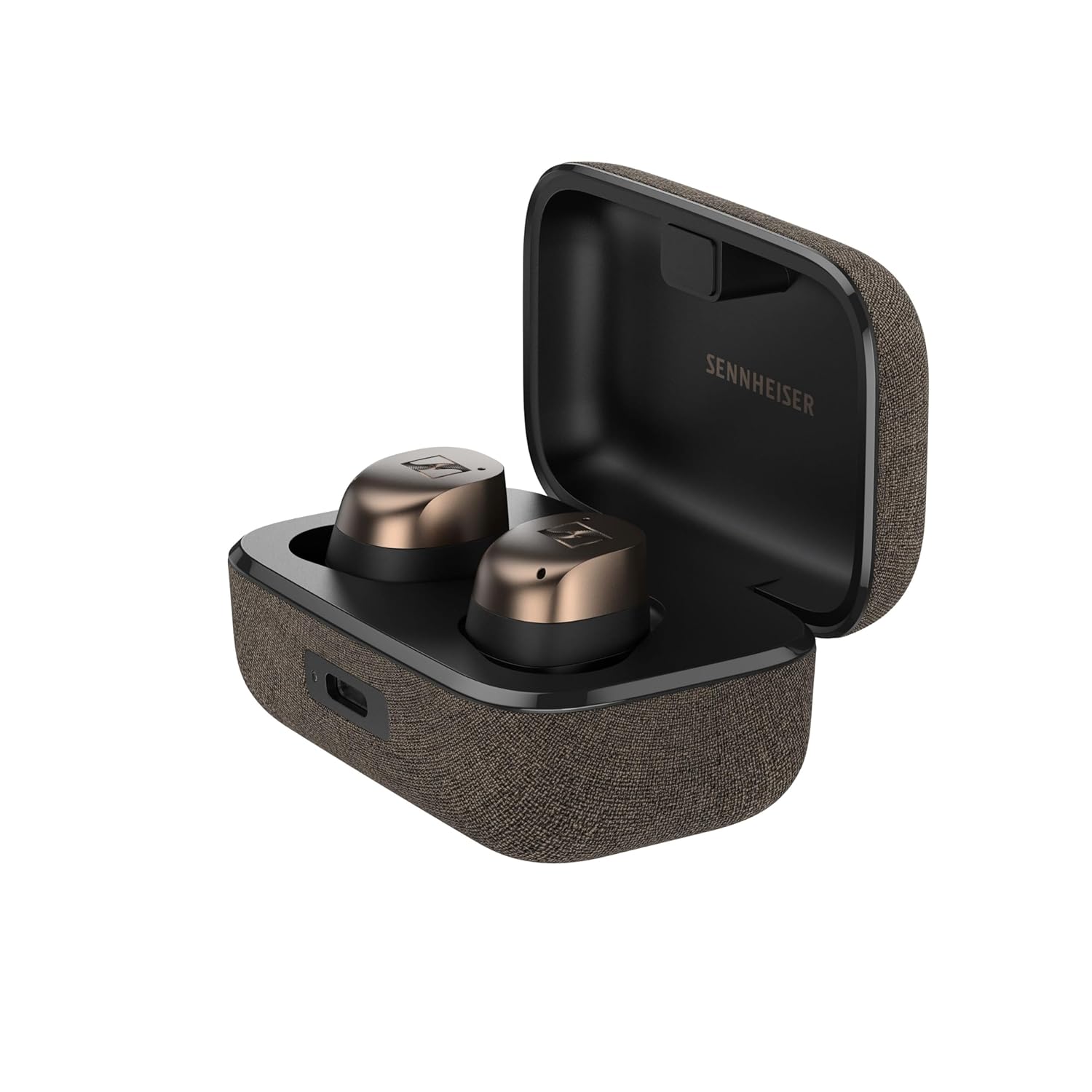
Premium wireless earbuds built for serious music listening, with detailed Sennheiser sound, TrueResponse 7mm drivers, aptX Lossless support, Adaptive ANC, up to 30 hours of total battery life, multipoint connectivity and extensive sound personalisation. A strong choice if sound quality is your top priority.
Before You Buy: One Important Thing About “Best Sound”
There is no single sound profile that every person will consider perfect.
Imagine two people listening to the same song.
Person A loves deep bass and wants the kick drum to feel powerful.
Person B mainly cares about hearing the singer’s voice clearly and wants instruments to sound natural.
Both people can listen to the same recording using the same earbuds and have completely different opinions.
That is why this article will not judge every earbud using only one simple measurement.
Instead, we’ll look at sound quality, tuning, features, compatibility, price and the type of listener each product suits.
That approach will become especially important when we compare the Sony, Samsung, OnePlus, JBL and budget OPPO models later in this guide.
#2. Sony WF-1000XM5
Best for: Premium sound with powerful noise cancellation
Price: ₹16,989
The Sony WF-1000XM5 is one of the most recognizable premium TWS earbuds in this list.
Sony has focused heavily on two areas with this model: sound quality and noise cancellation.
That combination makes the WF-1000XM5 interesting for people who want their earbuds to perform well not only in a quiet room, but also on a bus, train, airplane or busy street.
At ₹16,989 based on the price provided for this article, it is cheaper than the Sennheiser MOMENTUM True Wireless 4 while still sitting firmly in the premium category.
Dynamic Driver X for music
Sony uses its Dynamic Driver X in the WF-1000XM5.
The driver is designed for wide frequency reproduction, with Sony specifically highlighting deeper bass, clearer vocals and fine detail in higher-frequency sounds.
That combination is important because good music reproduction isn’t just about powerful bass.
Think about a song with a deep kick drum, a singer in the middle of the mix and cymbals playing in the background.
You want the bass to have weight without completely covering the vocals. At the same time, higher-frequency sounds should remain clear rather than becoming harsh.
Sony’s tuning and processing are designed around this kind of full-range reproduction.
Sony lists the WF-1000XM5 with an 8.4mm driver and support for high-quality Bluetooth audio including LDAC. It also supports DSEE Extreme, which is designed to improve the reproduction of compressed music.
What does DSEE Extreme do?
You may come across the term DSEE Extreme while researching the WF-1000XM5.
In simple terms, Sony’s processing technology attempts to restore some of the detail that can be lost during digital compression.
This can be useful when you’re listening to compressed music or streaming services that don’t provide lossless-quality audio.
It doesn’t magically turn a low-quality recording into a studio master, though.
The quality of the original recording still matters.
LDAC support
The WF-1000XM5 also supports LDAC, Sony’s higher-quality Bluetooth codec.
LDAC can transmit more audio data than the basic Bluetooth codecs used by many wireless earbuds.
But, just like aptX Lossless on the Sennheiser, there is an important condition.
Your smartphone or source device needs to support LDAC, and the appropriate Bluetooth settings need to be available.
So if you are using an Android phone that supports LDAC, the WF-1000XM5 gives you the opportunity to take advantage of higher-quality Bluetooth transmission.
If your device doesn’t support it, you won’t get the same codec benefit.
Strong ANC is part of the listening experience
Sony’s noise cancellation is one of the major reasons people consider the WF-1000XM5.
The earbuds use Sony’s Integrated Processor V2 together with its HD Noise Cancelling Processor QN2e and multiple microphones to process surrounding sound.
The practical advantage is simple.
Less background noise can make it easier to hear your music without turning up the volume.
Imagine you’re sitting inside a noisy office.
With poor noise isolation, you may find yourself increasing the volume because conversations and air-conditioning noise are competing with your music.
With effective ANC, the background becomes less distracting.
That doesn’t necessarily change the earbuds’ fundamental sound signature, but it can make the overall listening experience much better in noisy environments.
Adaptive Sound Control
Sony also includes Adaptive Sound Control, which can adjust the listening experience according to your surroundings.
For example, you may want stronger noise cancellation while travelling but more awareness when walking around a busy area.
This is more convenient than manually changing every setting whenever your surroundings change.
Multipoint connectivity
The WF-1000XM5 supports multipoint Bluetooth connectivity.
This allows the earbuds to remain connected to two devices at the same time.
For someone who works on a laptop and uses a smartphone throughout the day, this can be very useful.
For example, you could be watching a YouTube video on your laptop and then receive a call on your phone.
Instead of manually disconnecting one device and connecting another, the earbuds can switch between the two supported connections.
Sony states that multipoint works across Android, iOS, Windows and macOS devices.
Battery life
Sony rates the WF-1000XM5 for up to 8 hours of playback on the earbuds, with another 16 hours available from the charging case.
That gives a claimed total of 24 hours.
Sony also says a three-minute quick charge can provide up to 60 minutes of playback under its specified conditions.
As with every earbud, actual battery life depends on factors such as volume, ANC usage, codec and other settings.
Comfort and fit
Sony made the WF-1000XM5 smaller than its predecessor and uses an ergonomic design intended to improve the fit.
The earbuds come with noise-isolation ear tips that help create a seal inside the ear.
That seal is important for two reasons.
First, it can improve passive noise isolation.
Second, a proper seal can help the earbuds reproduce bass more effectively.
However, ear shape varies considerably from person to person.
An earbud that feels comfortable to one person may cause pressure or discomfort for another.
So fit should always be treated as a personal factor rather than something that can be guaranteed from specifications alone.
Call quality
The WF-1000XM5 uses bone-conduction sensors and Sony’s Precise Voice Pickup Technology.
Sony designed the system to isolate the user’s voice from surrounding noise during calls.
This is useful if you frequently take calls in places where there is background noise.
However, just like ANC, microphone performance can vary depending on wind, traffic and the surrounding environment.
Who should buy the Sony WF-1000XM5?
The WF-1000XM5 is worth considering if you:
- Want premium sound quality
- Want strong ANC along with good music performance
- Listen to music in noisy environments
- Have an LDAC-compatible smartphone
- Want DSEE Extreme processing
- Need multipoint connectivity
- Frequently switch between a phone and computer
- Want a relatively compact premium earbud design
Who should skip it?
You may want to look at cheaper models if:
- Your main requirement is simply good everyday sound
- You don’t need advanced ANC
- Your phone doesn’t support the higher-quality Bluetooth features you want
- You rarely listen to music in noisy environments
- Your budget is closer to ₹5,000
Sony WF-1000XM5: Pros and Cons
Pros
- Rich and detailed sound
- Excellent noise cancellation
- LDAC and Hi-Res Audio support
- Compact and comfortable design
Cons
- Premium price
- Fit can vary between users
- Mixed feedback on battery and durability
Sony WF-1000XM5 Wireless ANC Earbuds
• Industry-leading Active Noise Cancellation
• Rich sound with Dynamic Driver X
• Clear calls with bone conduction sensors
• Multipoint Bluetooth pairing
• Up to 36 hours battery life
• Compact, premium design


Should you buy the Sony WF-1000XM5?
If you want a premium pair of TWS earbuds where sound quality and noise cancellation are both important, the WF-1000XM5 is a strong candidate.
It is particularly interesting for people who listen to music while travelling or working in noisy places.
Compared with the Sennheiser MOMENTUM True Wireless 4, the Sony also gives you a strong combination of audio processing, ANC and everyday convenience.
The better choice between them depends more on your priorities than on the price alone.
If your focus is detailed listening and extensive sound personalization, Sennheiser’s approach may appeal to you.
If you want premium music playback combined with Sony’s extensive noise-control technology, the WF-1000XM5 deserves a place on your shortlist.
Amazon: Check the latest price and availability before buying.
#3. Samsung Galaxy Buds3 Pro
Best for: High-quality sound and Samsung Galaxy users
Price: ₹15,290
The Samsung Galaxy Buds3 Pro takes a somewhat different approach from the Sennheiser and Sony models.
It is not just a pair of Bluetooth earbuds.
Samsung has designed it to work particularly well as part of the Galaxy ecosystem, while also putting considerable attention into audio quality, ANC and intelligent features.
At ₹15,290 based on the supplied Amazon price, it sits between the Sony WF-1000XM5 and OnePlus Buds Pro 3 in this list.
If you use a Samsung Galaxy smartphone, the Buds3 Pro becomes especially interesting because some of its features are tied to Samsung’s ecosystem.
Two-way speaker system
One of the most important specifications for sound quality is the Buds3 Pro’s two-way speaker configuration.
Instead of asking a single driver to reproduce the entire frequency range, Samsung uses separate components for different parts of the audio spectrum.
The setup includes an independently controlled woofer and tweeter, along with a dual amplifier.
In simple terms, one part is responsible for lower frequencies while another handles higher frequencies.
This type of design can help with separation between different parts of the music.
Samsung also supports high-resolution audio features, including up to 24-bit/96kHz under compatible conditions.
What does that mean when listening to music?
Think about listening to a song containing bass guitar, vocals, acoustic guitar and cymbals.
A good two-way system can help different parts of the frequency range remain distinct.
The bass can have its own presence while vocals and higher-frequency instruments retain their clarity.
However, the number of drivers alone doesn’t determine whether you will personally prefer the sound.
Tuning remains extremely important.
Samsung’s approach is designed to deliver a detailed and immersive presentation, while features such as adaptive EQ can modify the experience based on the listening environment.
24-bit/96kHz audio
The Galaxy Buds3 Pro supports Samsung’s high-resolution audio capabilities, including 24-bit/96kHz with compatible Galaxy devices and supported content.
This is one of those specifications that sounds impressive on paper, but it needs some context.
You don’t automatically hear better music simply because an earbud says “24-bit/96kHz.”
The phone, codec, app and source recording all play a role.
If you’re using a compatible Galaxy smartphone and suitable content, however, the Buds3 Pro gives you access to Samsung’s higher-quality audio ecosystem.
That makes it more interesting to Samsung users than it may be to someone using a completely different phone ecosystem.
Intelligent sound features
Samsung includes intelligent audio processing that can adjust the listening experience according to your surroundings.
The Buds3 Pro can also detect certain environmental sounds and selectively allow important sounds through.
For example, being able to hear someone speaking to you without completely removing the earbuds can be useful when you’re outside or working around other people.
This is one reason why modern premium earbuds are becoming more than simple music players.
They are increasingly designed to adapt to how you’re using them.
Active Noise Cancellation
The Galaxy Buds3 Pro includes Active Noise Cancellation and Adaptive Noise Control.
For music listeners, ANC can be particularly useful during travel.
Suppose you’re listening to a quiet song on a flight.
Engine noise can mask low-level details in the music.
Reducing that background noise can make the music easier to hear without requiring you to push the volume higher.
The Buds3 Pro also uses its microphones to monitor environmental sound and adjust certain listening functions.
360 Audio
Samsung includes 360 Audio for a more immersive listening experience.
This is particularly relevant when watching supported video content.
Instead of feeling like all the sound is coming directly from two tiny speakers inside your ears, spatial processing can create a wider presentation.
However, spatial audio isn’t necessarily better for every music track.
Some listeners prefer a conventional stereo presentation because it can sound more natural.
So treat 360 Audio as an additional feature rather than the main reason to buy the earbuds.
Design and controls
The Galaxy Buds3 Pro uses Samsung’s newer blade-style design with LED lighting.
The controls are also different from traditional tap-based earbuds.
You can use pinch controls to manage playback and other functions, while swiping can be used for volume control.
This can be convenient once you become familiar with the controls.
Fit and comfort
Samsung says the Buds3 Pro was designed using 3D ear data analysis and simulations to improve fit.
The earbuds use soft silicone tips.
But again, there is no universal earbud shape.
Your ear anatomy is different from someone else’s.
That is why I recommend spending some time testing the available ear-tip sizes before deciding whether a particular pair is comfortable enough for long listening sessions.
IP57 rating
One of the useful specifications of the Galaxy Buds3 Pro is its IP57 rating.
This gives it a higher level of water and dust protection than some of the other earbuds in this comparison.
That can be useful for people who regularly exercise or spend time outdoors.
Still, water resistance does not mean you should deliberately submerge the earbuds or expose them to unnecessary amounts of water.
Battery life
Samsung lists up to 37 hours of total battery life under its specified conditions, with the charging case included.
The actual runtime you get will depend on factors such as ANC, volume, connectivity and other features.
This is an important distinction with all TWS earbuds.
A manufacturer’s maximum battery figure is a test-condition figure, not a guarantee that the earbuds will last exactly that long during your daily usage.
Who should buy the Samsung Galaxy Buds3 Pro?
The Buds3 Pro makes particular sense if you:
- Use a Samsung Galaxy smartphone
- Want a premium TWS experience
- Want detailed, high-quality audio
- Like the idea of a two-way speaker system
- Want ANC and Adaptive Noise Control
- Watch movies or videos and want spatial audio features
- Want a high level of water and dust resistance
- Prefer Samsung’s ecosystem features
Who should skip it?
Consider another model if:
- You don’t use a Samsung phone and don’t need its ecosystem features
- Your budget is below ₹10,000
- You want the simplest possible earbuds
- You don’t care about high-resolution audio or spatial features
- You have had problems with Samsung earbud fit in the past
Sony WF-1000XM5 Wireless ANC Earbuds
• Industry-leading Active Noise Cancellation
• Rich sound with Dynamic Driver X
• Clear calls with bone conduction sensors
• Multipoint Bluetooth pairing
• Up to 36 hours battery life
• Compact, premium design
Samsung Galaxy Buds3 Pro: Pros and Cons
Pros
- Clear and detailed sound
- Strong ANC performance
- Excellent Galaxy ecosystem features
- 24-bit/96kHz audio support
Cons
- Best experience with Samsung devices
- Fit may not suit everyone
- Mixed feedback on charging and reliability
Should you buy the Samsung Galaxy Buds3 Pro?
The Galaxy Buds3 Pro is particularly compelling when you already use a Samsung Galaxy phone.
That is because you are not only buying the earbuds themselves. You are also getting access to Samsung’s ecosystem-focused audio features.
For music, its two-way speaker system and high-resolution audio capabilities make it a serious premium option.
However, if you use an iPhone or a non-Samsung Android phone, you should look carefully at which features are actually available to your device before buying.
Amazon: Check the latest price and availability before buying.
#4. OnePlus Buds Pro 3
Best for: High-quality sound without going all the way to premium flagship pricing
Price: ₹11,770
If the Sennheiser and Sony options are outside your budget, the OnePlus Buds Pro 3 is where the comparison becomes particularly interesting.
At ₹11,770 based on the supplied Amazon price, it costs considerably less than the Sennheiser MOMENTUM True Wireless 4 while offering a surprisingly advanced audio setup.
OnePlus has clearly positioned these earbuds toward people who want more than basic TWS sound.
Dual drivers for different frequencies
The OnePlus Buds Pro 3 uses two drivers in each earbud:
- 11mm woofer
- 6mm tweeter
Each driver is paired with its own DAC.
This is called a dual-driver, dual-DAC design.
Why does that matter?
A woofer can focus more on lower frequencies, while the tweeter handles higher frequencies.
The idea is to give each driver a more specific job rather than asking one driver to reproduce everything.
This can help create a more separated and expansive sound.
But again, don’t assume that dual drivers automatically mean better sound.
The tuning and implementation are just as important.
Dynaudio tuning
OnePlus worked with Dynaudio on the sound profiles.
The earbuds offer different EQ profiles designed around different listening preferences.
This gives users more flexibility than earbuds that provide only one fixed sound signature.
For someone who enjoys experimenting with sound, this is useful.
You may prefer one profile for music and another for movies or podcasts.
LHDC 5.0
The Buds Pro 3 supports LHDC 5.0, with OnePlus advertising support for up to 24-bit/192kHz audio and a transmission rate of up to 1Mbps.
As always, these capabilities depend on device compatibility and the source material.
So don’t assume your phone will automatically use LHDC simply because the earbuds support it.
Before buying specifically for LHDC, check whether your smartphone supports the codec.
Strong bass without ignoring detail
The dual-driver arrangement is particularly useful for listeners who want strong low frequencies while retaining clarity in the upper range.
Imagine listening to a song where the bass guitar and kick drum are prominent while a singer and guitar are also present.
A well-implemented dual-driver design can help prevent the bass from overwhelming the rest of the mix.
The final result still depends on tuning and your personal preferences.
50dB adaptive ANC
The Buds Pro 3 also includes adaptive noise cancellation rated by OnePlus at up to 50dB.
The important word here is “up to.”
Noise-cancellation figures such as 50dB are not a universal measurement of how much noise the earbuds will remove in every situation.
Different frequencies and environments behave differently.
Still, adaptive ANC is useful for everyday situations such as commuting, working in cafés or travelling.
Dual connection
OnePlus also includes dual-device connectivity.
You can connect the earbuds to two devices at the same time, which is useful if you regularly switch between your phone and computer.
For example, you could be listening to music from your laptop and then move to your smartphone when a call arrives.
Battery life
OnePlus claims up to 43 hours of total battery life.
The earbuds also support fast charging, with the company stating that 10 minutes of charging can provide more than five hours of music playback under its stated conditions.
That can be extremely useful if you forget to charge your earbuds overnight.
IP55 rating
The OnePlus Buds Pro 3 carries an IP55 rating, providing protection against dust and water jets.
That makes it suitable for everyday use and workouts where sweat or light rain may be involved.
As always, water resistance isn’t the same as waterproofing.
Who should buy OnePlus Buds Pro 3?
Consider it if you:
- Want high-quality music without spending ₹20,000
- Like strong bass with a more detailed presentation
- Want a dual-driver setup
- Have an LHDC-compatible phone
- Want Dynaudio-tuned EQ options
- Need adaptive ANC
- Want dual-device connectivity
- Want long battery life
- Prefer a premium feature set at a mid-premium price
Who should skip it?
Another model may make more sense if:
- Your budget is below ₹5,000
- You don’t care about advanced audio codecs
- You prefer Samsung ecosystem features
- You want the strongest possible integration with another brand’s ecosystem
- You prefer a simpler earbud with fewer settings to manage
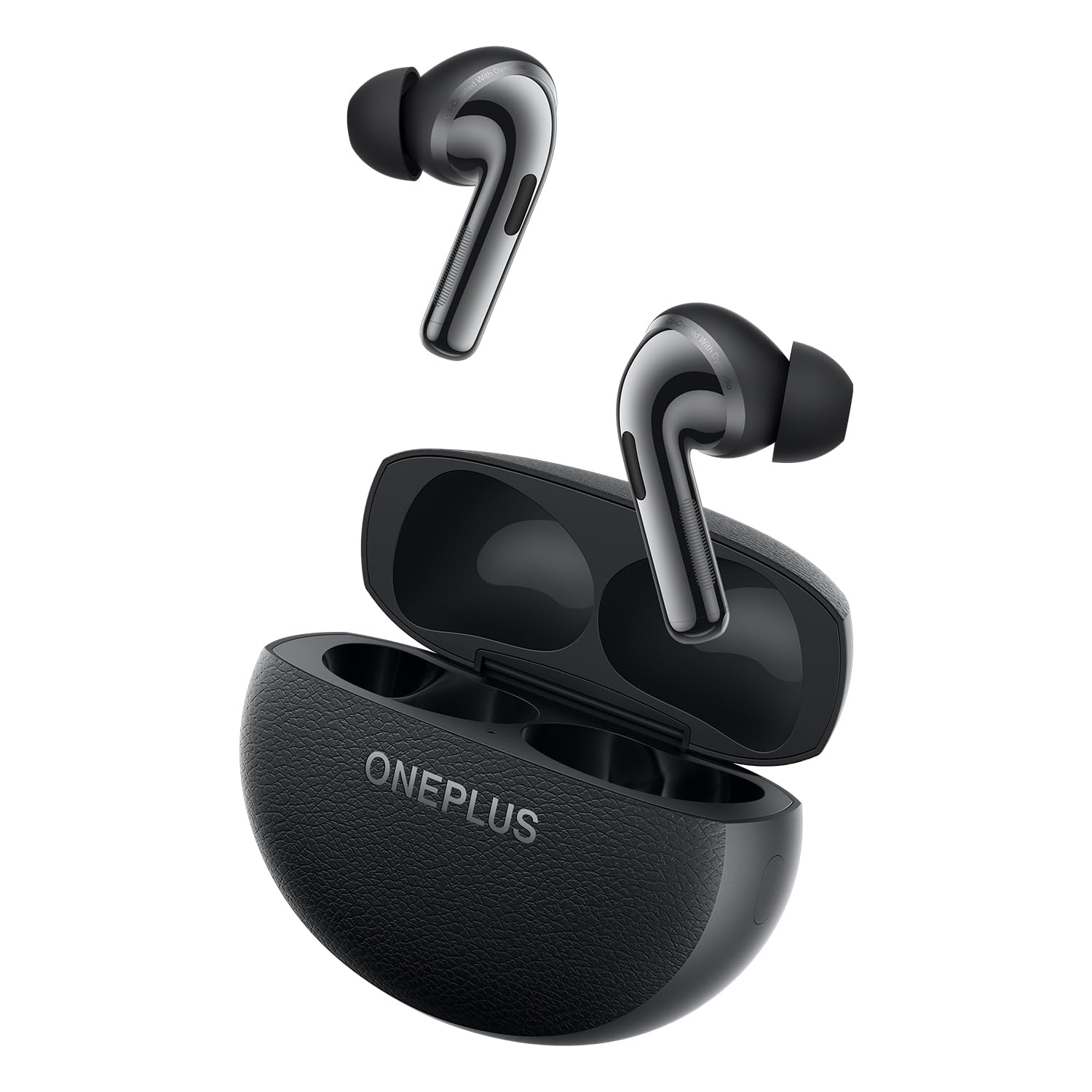
Best for Sound Quality & Value
OnePlus Buds Pro 3
- 11mm + 6mm Dual Drivers
- Dynaudio-Tuned Sound
- LHDC 5.0 Hi-Res Audio
- Up to 50dB Adaptive ANC
Want premium sound without spending ₹20,000? The OnePlus Buds Pro 3 combines dual drivers, dual DACs and Dynaudio-tuned sound for detailed audio with deep bass and clear highs. It also supports LHDC 5.0, adaptive ANC and up to 43 hours of total battery life, making it a strong option for music lovers looking for a premium feature set at a lower price.
OnePlus Buds Pro 3: Pros and Cons
Pros
- Detailed dual-driver sound
- Dynaudio-tuned audio
- Strong bass and clear highs
- Excellent feature set for the price
Cons
- Some features depend on compatible devices
- Fit can vary between users
- Not as affordable as budget options
Should you buy the OnePlus Buds Pro 3?
The OnePlus Buds Pro 3 is an interesting middle ground in this list.
You don’t have to spend ₹20,000 to get features such as dual drivers, dual DACs, high-resolution Bluetooth audio and adaptive ANC.
At the same time, it isn’t positioned as a basic budget earbud.
For someone who wants good sound quality, strong features and a more reasonable price than flagship TWS models, it deserves serious consideration.
It is also a good example of why you shouldn’t judge earbuds purely by their price.
The Sennheiser, Sony and Samsung models have their own strengths, but the OnePlus Buds Pro 3 gives the reader another route: spend less while still getting an advanced audio setup.
Amazon: Check the latest price and availability before buying.
#5. JBL Live Beam 3
Best for: JBL Signature Sound and a feature-rich listening experience
Price: ₹11,999
JBL Live Beam 3 is an interesting choice for people who want good sound quality but also want a lot of features in their earbuds.
At ₹11,999 based on the price provided for this article, it sits close to the OnePlus Buds Pro 3. So this isn’t really a budget option.
Instead, JBL is trying to offer a more complete package with Hi-Res Audio, adaptive ANC, spatial sound, personalized audio, multipoint connectivity and a touchscreen charging case.
If you like the JBL sound signature and want plenty of controls without constantly opening your phone, the Live Beam 3 deserves a look.
10mm dynamic drivers
The Live Beam 3 uses 10mm dynamic drivers.
JBL says the drivers are tuned to deliver its Signature Sound, with an emphasis on deep bass, balanced midrange and refined high frequencies.
That combination makes the Live Beam 3 suitable for a wide range of everyday music.
For example, if you move between Bollywood songs, Telugu songs, pop, rock, podcasts and movies throughout the day, a balanced tuning can be more practical than an earbud designed almost entirely around heavy bass.
Of course, the exact sound you experience will also depend on the fit and the sound profile you choose.
Hi-Res Audio Wireless
The Live Beam 3 supports Hi-Res Audio Wireless.
This is useful if you have compatible source devices and high-quality audio content.
But as we discussed earlier, don’t treat the Hi-Res label as a guarantee of superior sound.
The quality of the recording, Bluetooth codec, source device, tuning and earbud fit all matter.
The important point is that JBL has equipped the Live Beam 3 for higher-quality wireless playback rather than limiting it to basic Bluetooth audio.
Personi-Fi 3.0
One of the more interesting features is JBL Personi-Fi 3.0.
The idea is to create a personalized listening profile based on your hearing characteristics and preferences.
This can be useful because the way one person perceives different frequencies isn’t necessarily the same as another person.
Think of it like getting a pair of glasses adjusted to your eyes.
The earbuds start with their standard sound profile, but personalization attempts to adjust the sound more specifically to you.
Whether you prefer the personalized result is ultimately subjective, but having the option is useful.
JBL Spatial Sound
The Live Beam 3 also supports JBL Spatial Sound.
Spatial audio can make supported content feel wider and more immersive.
This can be particularly enjoyable while watching movies or certain video content.
For example, instead of feeling that dialogue and effects are coming from a tiny point inside each ear, spatial processing can create the impression of a larger sound field.
However, spatial audio isn’t something every listener needs.
If you mainly listen to conventional stereo music, you may prefer the standard stereo presentation.
Adaptive noise cancellation
The Live Beam 3 includes True Adaptive Noise Cancelling.
It allows you to adjust how much outside sound is blocked or allowed through.
This is useful for people who use earbuds in different environments.
You might want strong ANC on a flight but more awareness when sitting in a café.
Instead of removing the earbuds, you can switch modes.
Smart Charging Case
The feature that immediately makes the Live Beam 3 different from most of the other earbuds here is the Smart Charging Case.
The case has a 1.45-inch touchscreen.
You can use it to control various functions without always reaching for your smartphone.
For someone who likes changing settings frequently, this can be convenient.
It also makes the Live Beam 3 feel more like a premium gadget rather than a conventional TWS earbud.
Multipoint connectivity
JBL includes multipoint connectivity.
This allows the earbuds to remain connected to two Bluetooth devices and switch between them.
It can be particularly useful for people who work on a computer while also using their smartphone.
For example, you can listen to music from your laptop and quickly move to a phone call without manually disconnecting the earbuds.
Battery life
JBL advertises up to 48 hours of total playtime.
The actual battery life you experience will depend on ANC, volume, Bluetooth settings and other features.
This is worth keeping in mind because maximum battery figures from manufacturers are normally measured under specific test conditions.
Still, the high claimed total battery capacity makes the Live Beam 3 suitable for people who don’t want to charge their earbuds frequently.
IP55 protection
The Live Beam 3 has an IP55 rating.
That provides protection against dust and water jets and makes the earbuds better suited to everyday outdoor use and workouts than models without a comparable rating.
However, IP55 does not mean the earbuds are designed to be submerged.
Who should buy JBL Live Beam 3?
The Live Beam 3 makes sense if you:
- Like JBL’s sound signature
- Want balanced sound with strong bass
- Want Hi-Res Audio Wireless
- Like personalized sound profiles
- Want spatial audio
- Need adaptive ANC
- Want multipoint connectivity
- Like the idea of controlling settings from the charging case
- Want long claimed battery life
- Want wireless charging and a premium feature set
Who should skip it?
You may want another model if:
- Your main priority is pure audio quality and you don’t care about additional features
- You want the cheapest possible earbuds with good sound
- You don’t need a touchscreen charging case
- You rarely use ANC or spatial audio
- You prefer a smaller or simpler charging case
Premium TWS Earbuds

JBL New Launch Live Beam 3 TWS,Hi-Res Audio True ANC Earbuds,Smart Case with Touch Display,48H Playtime,Wireless Charging,6 Mic,Multipoint Connection,Ip55 Proof, Headphones App,Personi-Fi 3.0 (Black)
- ✅ Convenient Smart Charging Case for app-free control: You can customize every aspect of your JBL Live Beam 3 earbuds with the 1.45-inch touchscreen display on your Smart Charging Case. The display gives you full control of your sound on any devices – laptop, TV, smartphones, or tablets –
- ✅ Hi-Res Audio Wireless with Spatial sound: The JBL Live Beam 3’s 10mm dynamic drivers are powered by JBL Signature Sound. Each driver is perfectly tuned to deliver deep bass, balanced mid-range, and refined high frequencies—all at any volume level. JBL Spatial Sound makes you feel like you’re at a concert as the sound comes from virtually everywhere around you.
- ✅ True adaptive noise cancelling with custom control: Tune out the outside world entirely or customize just how much ambient sound you decide to let in.
JBL Live Beam 3: Pros and Cons
Pros
- Balanced and engaging sound
- Strong bass performance
- Excellent battery life
- Feature-rich smart charging case
Cons
- Charging case is relatively bulky
- Premium price for a JBL model
- Mixed feedback on connectivity and fit
Should you buy JBL Live Beam 3?
The JBL Live Beam 3 is worth considering if you want sound quality together with a large number of useful features.
Its biggest advantage isn’t one particular specification.
Instead, it combines JBL’s sound tuning with Hi-Res Audio, personalization, spatial sound, adaptive ANC, multipoint connectivity and an unusual touchscreen charging case.
If you’re mainly interested in sitting quietly and listening to music, the Sennheiser, Sony or other audio-focused options may deserve closer comparison.
But if you want your earbuds to do much more than play music, the Live Beam 3 becomes more interesting.
Amazon: Check the latest price and availability before buying.
#6. OPPO Enco Air5 Pro
Best for: Sound quality under ₹5,000
Price: ₹4,999
This is where the list becomes particularly interesting for budget-conscious buyers.
You don’t necessarily need to spend ₹10,000 or ₹20,000 to get features such as ANC and high-quality Bluetooth audio.
The OPPO Enco Air5 Pro brings several premium-sounding specifications into the ₹5,000 price range.
At ₹4,999 based on the price provided for this article, it is significantly cheaper than every other model we’ve discussed so far.
That makes it a particularly important option for someone searching for the best earbuds sound quality without spending too much.
12mm titanium-coated dynamic drivers
The Enco Air5 Pro uses a 12mm titanium-coated dynamic driver.
OPPO says the driver is designed to provide deep bass, clear vocals and detailed sound.
The larger driver should not automatically be interpreted as meaning it will outperform the 7mm Sennheiser driver.
Instead, think of it as one component of the overall sound system.
OPPO’s tuning, DSP, codec support and physical design all contribute to the final listening experience.
LHDC 5.0
One of the most impressive specifications at this price is support for LHDC 5.0.
OPPO says the Enco Air5 Pro supports up to 24-bit/96kHz audio and transmission rates of up to 1Mbps.
That gives it a specification normally associated with more expensive wireless earbuds.
But there’s a catch that budget buyers should understand.
Your smartphone needs to support the appropriate codec.
If it doesn’t, the earbuds will use another available Bluetooth audio mode.
So don’t buy this model solely because you see “LHDC 5.0” on the product page.
Check your phone’s compatibility first.
What about the sound?
The Enco Air5 Pro is aimed at people who want a combination of strong bass, clear vocals and detail.
That makes it suitable for everyday music listening.
If your playlist contains bass-heavy songs, pop, movie soundtracks or Indian music with strong low-frequency elements, you may appreciate the tuning.
At the same time, OPPO isn’t positioning the earbuds as a bass-only product.
The company describes the titanium-coated driver as being designed for balanced audio with clarity across the frequency range.
55dB ANC
For ₹4,999, the inclusion of up to 55dB ANC is one of the major attractions.
However, the “55dB” figure should be understood correctly.
It does not mean that every outside sound will become 55dB quieter.
Noise cancellation performance depends on the frequency of the noise, the fit of the earbuds and the environment.
Low-frequency continuous sounds such as an air conditioner, bus engine or fan can generally be easier for ANC systems to reduce than unpredictable voices or sudden sounds.
Still, having adaptive ANC at this price makes the Enco Air5 Pro a strong feature-packed budget option.
Adaptive ANC
OPPO says the earbuds can adjust noise cancellation according to your surroundings and ear fit.
This is useful because the noise around you isn’t always the same.
For example, you may need different noise cancellation when sitting in a quiet office compared with travelling on a bus.
Battery life
OPPO advertises up to 54 hours of total playback.
Again, this is a maximum figure under specified conditions.
Actual battery life can be lower depending on ANC, volume, codec and usage.
Still, the large claimed total makes the Enco Air5 Pro appealing for people who don’t want to charge their earbuds every day.
Comfort and fit
The Enco Air5 Pro is designed for everyday use, with an in-ear design intended to provide a stable seal.
Fit is especially important here because it affects both bass response and ANC.
If the earbuds don’t seal properly, you may notice weaker bass and more external noise.
So if you buy them, try the supplied ear tips and choose the size that creates a comfortable seal without excessive pressure.
Dual connectivity
The earbuds also support dual-device connectivity.
This can be convenient if you regularly use both a phone and a computer.
You don’t have to manually disconnect and reconnect every time you move between devices.
Who should buy OPPO Enco Air5 Pro?
This model makes sense if you:
- Want good sound quality under ₹5,000
- Want strong bass without giving up vocal clarity
- Want ANC at a lower price
- Have an LHDC-compatible phone
- Want Hi-Res Audio support
- Want long claimed battery life
- Need dual-device connectivity
- Don’t want to spend ₹10,000 or more
Who should skip it?
Consider another option if:
- You want the most refined premium sound available
- Your phone doesn’t support the advanced codec you specifically want
- You need the best possible microphone performance
- You are willing to spend considerably more for premium audio hardware
- You want a particular brand ecosystem such as Samsung
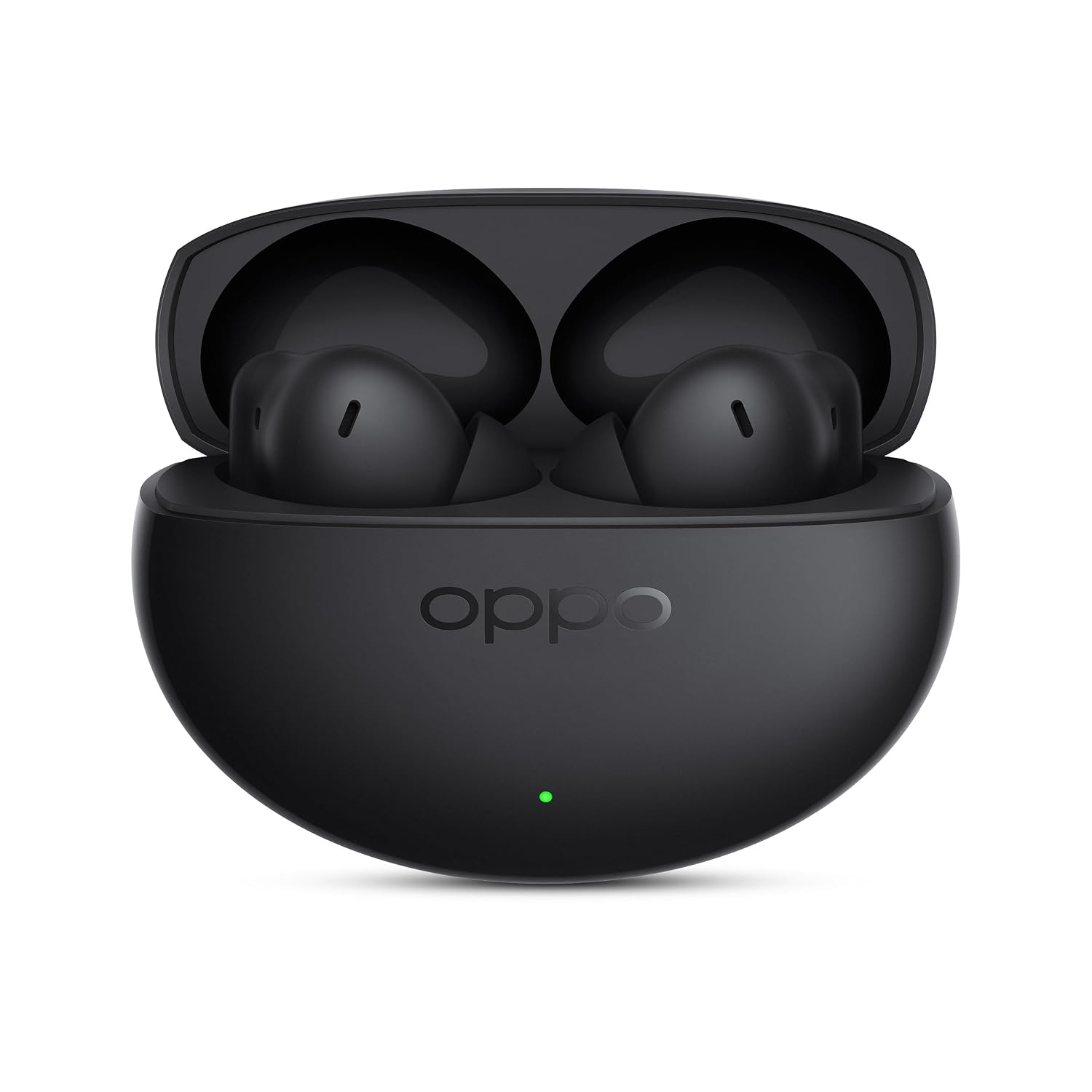
Best Sound Quality Under ₹5,000
OPPO Enco Air5 Pro
- 12mm Titanium-Coated Driver
- LHDC 5.0 Hi-Res Audio
- 55dB Active Noise Cancellation
- Up to 54 Hours Battery
Looking for great sound without spending too much? The OPPO Enco Air5 Pro combines a 12mm titanium-coated driver with LHDC 5.0 Hi-Res Audio for a detailed, punchy listening experience. With 55dB ANC and up to 54 hours of total playback, it offers a strong mix of sound quality, features, and value for music lovers.
OPPO Enco Air5 Pro: Pros and Cons
Pros
- Detailed sound with punchy bass
- 12mm titanium-coated driver
- LHDC 5.0 Hi-Res Audio support
- Strong ANC for the price
Cons
- Some features depend on device support
- Call quality feedback is mixed
- Fit may not suit every ear
Should you buy the OPPO Enco Air5 Pro?
If your budget is around ₹5,000, this is one of the earbuds you should put on your shortlist.
The reason isn’t simply the 12mm driver.
It’s the combination of driver design, LHDC 5.0, Hi-Res audio support, ANC and long claimed battery life at a considerably lower price than the premium options.
You should still keep your expectations realistic.
A ₹5,000 earbud doesn’t suddenly become equivalent to a ₹20,000 audiophile-focused model because it supports the same headline audio resolution.
But if your goal is to get a lot of sound-related features and good everyday performance without spending a large amount, the Enco Air5 Pro is a compelling option.
Amazon: Check the latest price and availability before buying.
Internal link opportunity: best earbuds under ₹5000
#7. OnePlus Nord Buds 4
Best for: Budget listening, bass and everyday use
Price: ₹3,299
If ₹5,000 is already more than you want to spend on TWS earbuds, the OnePlus Nord Buds 4 brings the price down further.
At ₹3,299 based on the supplied Amazon price, it is the most affordable model in this seven-earbud comparison.
That doesn’t mean it should automatically be dismissed by someone who cares about sound quality.
The important question is what you’re expecting from a ₹3,000-range earbud.
If you want enjoyable everyday music, strong bass, ANC, good battery life and useful features, the Nord Buds 4 has a lot to offer.
If you’re looking for the finest possible detail and resolution for critical music listening, the premium models higher up this list are designed for a different type of buyer.
12mm titanium-coated drivers
The Nord Buds 4 uses 12mm titanium-coated drivers.
OnePlus focuses on a natural-sounding acoustic design while also offering features intended to enhance the listening experience.
The larger driver can help provide a fuller low-frequency response, but once again, driver size alone doesn’t determine sound quality.
The tuning is what ultimately determines whether you like what you hear.
Bass-focused everyday listening
The Nord Buds 4 is particularly suitable for people who enjoy a stronger low end.
That can make songs feel more energetic.
Think about listening to a song during your morning walk.
A little extra bass can make the music feel more lively, particularly with pop, electronic music, hip-hop and movie tracks.
However, if you prefer a very neutral presentation where bass is kept strictly controlled, you may prefer one of the more audio-focused earbuds in this list.
52dB real-time ANC
For a ₹3,299 earbud, up to 52dB real-time ANC is an attractive specification.
OnePlus says the system works across a wide frequency range and adjusts in real time.
Again, don’t interpret “52dB” as meaning that every surrounding sound will be reduced by exactly 52dB.
ANC performance varies significantly depending on the type of sound and the seal created by the ear tips.
But for commuting, office use or sitting in a café, ANC can reduce some background noise and make listening more comfortable.
Spatial Audio
The Nord Buds 4 also supports Game Spatial Audio.
This feature is designed particularly with gaming in mind.
If you play games such as BGMI, Free Fire or Call of Duty, spatial processing can help make directional sounds more noticeable.
For example, footsteps or gunshots may appear easier to place in the virtual sound field.
This isn’t necessarily a reason for a music listener to buy the earbuds, but it’s a useful bonus if you also game on your phone.
Low latency
OnePlus advertises latency as low as 47ms under its stated conditions.
Lower latency can be useful for gaming and video because it reduces the delay between what happens on screen and when you hear the corresponding sound.
For casual YouTube viewing, you may not notice a difference between different low-latency modes.
Gamers are more likely to appreciate it.
Six microphones and AI call processing
The Nord Buds 4 has three microphones in each earbud, giving you six microphones in total.
OnePlus also uses AI-based processing for calls.
The company says the system is designed to keep your voice clear in noisy environments and wind.
This is useful if you regularly make calls while walking outdoors.
However, microphone performance can still vary depending on the environment.
A busy road with traffic noise is a much harder situation than a quiet room.
Battery life
OnePlus advertises up to 54 hours of playback.
The earbuds also support fast charging, with the company stating that 10 minutes of charging can provide up to 11 hours of playback with the case under its test conditions.
That is a useful feature for people who frequently forget to charge their earbuds.
Imagine you are leaving home in 15 minutes and discover that the charging case is nearly empty.
A short charge can give you enough listening time for a significant part of the day.
Bluetooth 6.1
The Nord Buds 4 supports Bluetooth 6.1.
Newer Bluetooth versions can bring improvements in connectivity and efficiency, but the Bluetooth version by itself should not be treated as a direct measurement of sound quality.
For music quality, the codec, source device, tuning and overall audio implementation remain more relevant.
IP55 protection
The earbuds carry an IP55 rating, making them better suited to sweat, dust and everyday outdoor use than earbuds without comparable protection.
That can be useful for walking, commuting or workouts.
As always, water resistance does not mean waterproofing.
Who should buy OnePlus Nord Buds 4?
The Nord Buds 4 is worth considering if you:
- Have a budget around ₹3,000
- Want enjoyable everyday sound
- Like stronger bass
- Want ANC at a low price
- Want long claimed battery life
- Play mobile games
- Want low-latency audio
- Make calls outdoors
- Want a relatively affordable pair for daily use
Who should skip it?
Look at the more expensive options if:
- Critical music listening is your top priority
- You want the highest level of audio detail
- You need advanced high-resolution Bluetooth codecs
- You want premium sound personalization
- You want the most sophisticated ANC performance
- Your budget allows you to spend ₹10,000 or more on premium TWS earbuds

Best Budget Earbuds for Bass
OnePlus Nord Buds 4
- 12mm Titanium-Coated Drivers
- 52dB Active Noise Cancellation
- Up to 54 Hours Battery
- 6-Mic AI Clear Calls
Want powerful bass and useful premium features without spending too much? The OnePlus Nord Buds 4 delivers punchy sound with 12mm titanium-coated drivers, 52dB ANC, and up to 54 hours of battery life. It’s a great value option for everyday music, videos, calls, and travel
OnePlus Nord Buds 4: Pros and Cons
Pros
- Good sound for the price
- Punchy bass performance
- 52dB active noise cancellation
- Excellent battery life
Cons
- Sound detail is below premium models
- Call quality can vary
- Fit may not suit everyone
Should you buy the OnePlus Nord Buds 4?
If you’re looking for a budget TWS earbud that sounds enjoyable and doesn’t feel stripped down, the Nord Buds 4 is worth considering.
It gives you several features that would have been difficult to find at this price a few years ago.
You get a 12mm driver, ANC, spatial audio, six microphones, low-latency functionality and a long claimed battery life.
The important thing is to keep expectations realistic.
It isn’t trying to replace a premium Sennheiser or Sony earbud for critical listening.
Instead, it is aimed at someone who wants a good everyday listening experience without spending a lot of money.
At ₹3,299, that distinction matters.
Amazon: Check the latest price and availability before buying.
Internal link opportunity: best OnePlus earbuds under ₹5000
Comparing the Seven Earbuds at a Glance
Now that we’ve covered all seven models, the differences become easier to understand.
| Model | Price | Main audio strength | ANC | High-resolution audio | Best suited for |
|---|---|---|---|---|---|
| Sennheiser MOMENTUM True Wireless 4 | ₹20,990 | Detailed premium sound | Yes | aptX Lossless | Serious music listeners |
| Sony WF-1000XM5 | ₹16,989 | Detailed sound + ANC | Yes | LDAC | Music + travel |
| Samsung Galaxy Buds3 Pro | ₹15,290 | Two-way high-resolution audio | Yes | Up to 24-bit/96kHz* | Samsung users |
| OnePlus Buds Pro 3 | ₹11,770 | Dual-driver sound | Yes | LHDC 5.0 | Sound + value |
| JBL Live Beam 3 | ₹11,999 | JBL Signature Sound | Yes | Hi-Res Wireless | Feature-focused listeners |
| OPPO Enco Air5 Pro | ₹4,999 | Strong budget audio package | Yes | LHDC 5.0 | Budget music listeners |
| OnePlus Nord Buds 4 | ₹3,299 | Bass + everyday listening | Yes | More limited | Budget buyers |
*Availability of certain high-resolution features depends on the compatible device and audio source.
The Big Difference Between These Seven Earbuds
The biggest mistake would be to look at this table and assume that the ₹20,990 Sennheiser must be more than six times better than the ₹3,299 OnePlus Nord Buds 4.
That’s not how earbuds work.
The price difference reflects much more than sound.
You’re also paying for things such as:
- Driver design
- Audio processing
- Codec support
- ANC technology
- Materials and construction
- Microphone systems
- Apps and personalization
- Multipoint connectivity
- Ecosystem integration
- Charging features
- Premium engineering and positioning
A person spending ₹3,299 may be extremely happy with the Nord Buds 4.
Another person may be willing to spend ₹20,990 because they care much more about detailed music reproduction and premium audio features.
Both purchases can make sense for different people.
That is exactly why the rest of this guide focuses on matching the earbuds to the listener, rather than simply looking at the highest price.
One More Thing: Don’t Ignore Your Smartphone
Before buying any of these earbuds specifically for their advanced audio features, check your phone’s compatibility.
This is particularly important with codecs such as:
- aptX Lossless
- LDAC
- LHDC
For example, buying earbuds because they support LHDC doesn’t guarantee that your phone will use LHDC.
The same applies to Samsung’s advanced audio features.
Some features work particularly well within specific ecosystems.
So before placing an order, check:
Your smartphone + earbuds + codec + music service/content
Those four things work together.
If your phone doesn’t support the codec, paying extra for that codec may not provide the benefit you expected.
This is one of the easiest ways to avoid spending money on a feature you cannot actually use.
Which Earbuds Have the Best Sound Quality?
After looking at all seven earbuds, you may still be wondering which one you should actually buy.
The answer depends on what you mean by “best sound quality.”
If you want highly detailed audio and extensive sound personalization, your requirements are different from someone who simply wants enjoyable music under ₹5,000.
So instead of giving every earbud an arbitrary score, here is how I would look at them based on different listening needs.
The Sennheiser MOMENTUM True Wireless 4 is the model to look at if your priority is a premium, detailed listening experience.
Its TrueResponse driver system, aptX Lossless support and extensive sound personalization make it particularly interesting for people who spend a lot of time listening to music.
It is also the most expensive option in this list, so it makes more sense for someone who will actually take advantage of its audio capabilities.
The Sony WF-1000XM5 combines high-quality audio with a strong focus on noise cancellation.
This combination is particularly useful for people who listen to music while travelling.
A good ANC system can reduce distracting background noise, making it easier to concentrate on your music.
Sony’s LDAC and DSEE Extreme features also make the WF-1000XM5 interesting for people who care about higher-quality wireless audio.
For Samsung Galaxy users
The Samsung Galaxy Buds3 Pro is particularly worth considering if you already use a compatible Samsung Galaxy smartphone.
Its two-way speaker system, high-resolution audio capabilities, ANC, Adaptive Noise Control and 360 Audio give it a feature-rich package.
The important thing is to check which features are available with your particular phone before buying.
For sound quality without going to the ₹20,000 range
The OnePlus Buds Pro 3 is an interesting middle-ground option.
Its dual-driver and dual-DAC setup, Dynaudio tuning, LHDC 5.0 and adaptive ANC give you a lot of technology without reaching the price of the Sennheiser or Sony models.
If your budget is around ₹10,000 to ₹12,000, this is one of the models worth comparing closely.
For JBL fans and feature lovers
The JBL Live Beam 3 is a different kind of recommendation.
It combines JBL Signature Sound with Hi-Res Audio Wireless, spatial sound, Personi-Fi 3.0, adaptive ANC and a touchscreen charging case.
If you enjoy having lots of controls and personalization options, it is worth considering.
For sound quality around ₹5,000
The OPPO Enco Air5 Pro is particularly interesting for budget-conscious music listeners.
You get a 12mm titanium-coated dynamic driver, LHDC 5.0, Hi-Res Audio support and ANC at ₹4,999 based on the price provided for this article.
You should check smartphone compatibility before buying specifically for LHDC.
For a budget of around ₹3,000
The OnePlus Nord Buds 4 is aimed more at everyday users.
It combines a 12mm driver with ANC, spatial audio, low-latency features, six microphones and a long claimed battery life.
It won’t be the choice for someone looking for the most refined premium audio experience, but it can make much more sense for someone who simply wants good everyday earbuds without spending a lot.
Best Earbuds for Sound Quality by Budget
Your budget is probably one of the biggest factors in the buying decision.
Here is a simpler way to narrow down the options.
Best earbuds around ₹3,000
OnePlus Nord Buds 4
At ₹3,299, it is the most affordable option in this list.
It is suitable for everyday music, videos, gaming and calls, while also giving you ANC and a large driver.
If you’re looking for your first pair of TWS earbuds and don’t want to spend much, this is the price category to consider.
Best earbuds under ₹5,000
OPPO Enco Air5 Pro
At ₹4,999, it offers an unusually long list of audio-related features for the price.
The combination of a 12mm titanium-coated driver, LHDC 5.0, Hi-Res Audio support and ANC makes it an interesting choice for someone who wants more than basic Bluetooth earbuds.
Best earbuds around ₹10,000 to ₹12,000
OnePlus Buds Pro 3 and JBL Live Beam 3
These two models take different approaches.
The OnePlus focuses heavily on its dual-driver audio system, Dynaudio tuning and high-resolution wireless audio.
The JBL combines its sound profile with a large feature set including spatial sound, Personi-Fi and the Smart Charging Case.
Your choice here should depend on which feature set and sound presentation you prefer.
Best earbuds around ₹15,000 to ₹17,000
Sony WF-1000XM5 and Samsung Galaxy Buds3 Pro
Both are premium options, but their strengths are different.
The Sony makes a strong case for people who want premium sound and noise cancellation across different devices.
The Samsung becomes particularly interesting for people already using compatible Galaxy devices.
Sennheiser MOMENTUM True Wireless 4
The Sennheiser is the most expensive model in this comparison based on the prices provided.
Its strongest argument is its audio-focused feature set, including TrueResponse drivers, aptX Lossless, sound personalization and adaptive ANC.
If you are spending this much, however, make sure you actually care about these features.
Which Earbuds Are Best for Different Types of Listeners?
There is another way to choose your earbuds.
Instead of starting with your budget, start with how you listen.
If you love bass
Look toward the OnePlus Nord Buds 4 or OPPO Enco Air5 Pro.
Both offer large dynamic drivers and are suitable for listeners who enjoy a stronger low-frequency presentation.
The OnePlus is the cheaper option, while the OPPO gives you additional high-resolution audio features.
If you care about vocals
Look at models with a more detailed and controlled presentation, particularly the Sennheiser MOMENTUM True Wireless 4, Sony WF-1000XM5 and OnePlus Buds Pro 3.
For vocal-heavy music, the midrange is especially important.
The singer’s voice should remain clear instead of being buried underneath excessive bass.
If you listen to classical or acoustic music
You may appreciate an earbud that provides good separation and detail rather than simply emphasizing bass.
The Sennheiser MOMENTUM True Wireless 4 is particularly worth investigating for this type of listening.
The Sony and Samsung models are also worth considering because of their high-quality audio processing and detailed presentation.
If you travel frequently
ANC becomes much more important.
The Sony WF-1000XM5, Sennheiser MOMENTUM True Wireless 4, Samsung Galaxy Buds3 Pro, OnePlus Buds Pro 3 and JBL Live Beam 3 all offer active noise cancellation.
For flights and long train journeys, reducing continuous background noise can make listening much more comfortable.
You may also find yourself using a lower volume because you don’t have to compete with as much environmental noise.
If you watch a lot of movies
Spatial audio can be useful if you enjoy a wider and more immersive presentation.
The Samsung Galaxy Buds3 Pro, JBL Live Beam 3 and OnePlus Nord Buds 4 all offer spatial audio-related features.
But don’t assume spatial audio is automatically better.
Some people prefer normal stereo sound because it can feel more natural with music.
If you use a Samsung phone
The Galaxy Buds3 Pro deserves particular attention.
Samsung has designed many of its advanced features around its Galaxy ecosystem.
If you’re already using compatible Samsung devices, the additional integration can be more useful than simply choosing earbuds based on specifications.
If you use a OnePlus phone
The OnePlus Buds Pro 3 and OnePlus Nord Buds 4 are natural models to investigate.
The Buds Pro 3 is the more premium choice, while the Nord Buds 4 is aimed at a much lower budget.
If you have a compatible device, you may also be able to take advantage of additional OnePlus-specific features.
If you use an iPhone
Don’t automatically choose earbuds based on Android-focused codecs such as LHDC or aptX Lossless.
Instead, check what features work with your iPhone and consider the overall sound, fit, ANC, microphone performance and app support.
This is an important point because an impressive specification is useful only when your devices can actually use it.
How to Make Your Earbuds Sound Better
Even after buying good earbuds, there are several things you can do to improve your listening experience.
You don’t always need new hardware.
1. Try different ear-tip sizes
This is probably the first thing you should try.
If the tips are too small, outside noise can leak in and bass may sound weak.
If they’re too large, the earbuds may feel uncomfortable.
Try the different sizes included with your earbuds and find the combination that provides a secure but comfortable seal.
2. Don’t ignore the companion app
Most premium earbuds have a dedicated smartphone app.
Use it.
You may find:
- EQ controls
- ANC settings
- Transparency controls
- Sound personalization
- Firmware updates
- Touch-control customization
- Spatial audio settings
- Device connection options
Many people buy feature-rich earbuds and then never open the companion app.
That means they may never experience some of the features they paid for.
3. Experiment with EQ
If your earbuds sound too bass-heavy, reduce the bass slightly.
If vocals aren’t prominent enough, try a small adjustment in the midrange.
If the treble sounds too sharp, reducing the higher frequencies may make listening more comfortable.
Don’t make huge EQ changes immediately.
Small adjustments are usually easier to evaluate.
If you want to learn more about EQ, what is an equalizer and how does it work? would be a useful internal article to link here.
4. Use the best codec your devices actually support
If your phone and earbuds both support LDAC, LHDC or aptX Lossless, you may be able to take advantage of higher-quality Bluetooth transmission.
But don’t obsess over codecs.
A good recording through a well-tuned earbud can sound better to you than a technically higher-resolution stream through an earbud whose tuning you dislike.
5. Keep your earbuds updated
Manufacturers sometimes release firmware updates that improve connectivity, ANC, battery behavior, sound processing or other functions.
So after buying your earbuds, check the manufacturer’s app occasionally for updates.
6. Keep the volume at a sensible level
Turning the volume up doesn’t necessarily reveal more detail.
It can simply make everything louder.
Listening at an excessively high volume for long periods can also be harmful to your hearing.
If you find yourself constantly increasing the volume because outside noise is masking your music, a better ear-tip seal or ANC may help.
7. Clean the earbuds regularly
Earwax and dust can accumulate around the speaker grille.
Even a small amount of buildup can affect the sound coming from the earbuds.
Clean them carefully according to the manufacturer’s recommendations.
Avoid pushing dirt further into the speaker opening.
Are Bigger Drivers Better for Sound Quality?
No.
This is one of the biggest misconceptions in the TWS market.
A 12mm driver isn’t automatically better than a 7mm driver.
In this comparison alone, we have:
- Sennheiser: 7mm TrueResponse driver
- JBL: 10mm dynamic driver
- OnePlus Buds Pro 3: 11mm + 6mm dual-driver setup
- OPPO: 12mm dynamic driver
- OnePlus Nord Buds 4: 12mm driver
If driver size alone determined sound quality, the 12mm earbuds would automatically win.
But that clearly isn’t how audio works.
The driver material, design, tuning, amplifier, DSP, enclosure, ear-tip seal and source all contribute to what you hear.
So use driver size as one specification, not as your final buying decision.
Is Hi-Res Audio Really Worth Paying More For?
It can be useful, but not everyone needs it.
Hi-Res Audio and high-resolution Bluetooth codecs can become more valuable if you:
- Listen to high-quality music files
- Use a compatible streaming service
- Have a phone that supports the required codec
- Can actually hear and appreciate the difference
- Care about getting the most from your music collection
But if you mainly listen to YouTube, podcasts or heavily compressed streams, spending a large amount specifically for high-resolution codec support may not be necessary.
This is why your actual listening habits should influence your purchase.
Does ANC Improve Sound Quality?
ANC and sound quality are technically different things.
ANC’s primary job is to reduce external noise.
But reducing background noise can make the music easier to hear.
For example, imagine listening to a quiet song on a train.
Without ANC, the continuous train noise can mask subtle details.
With ANC, those details may become easier to notice.
So ANC can improve the overall listening experience, even though it isn’t itself a measure of how accurately an earbud reproduces music.
The quality of the earbud’s tuning and driver system still matters.
Are Expensive Earbuds Always Better?
Not necessarily.
Expensive earbuds often include more advanced hardware, better ANC systems, additional microphones, premium materials, better apps and advanced codecs.
But that doesn’t mean every listener will hear a proportionally large improvement.
For example, someone who spends most of the day listening to YouTube videos may not benefit enough from a ₹20,000 earbud to justify the additional cost.
On the other hand, someone who listens to music for several hours every day and cares about detail may appreciate the additional features.
The right question isn’t:
“Which one costs more?”
It’s:
“Which features and sound characteristics matter to me?”
What About Amazon Customer Reviews?
Amazon reviews can be useful, but they should be read carefully.
For this comparison, customer feedback is mixed across several models.
Some customers praise sound quality and comfort, while others report problems with fit, connectivity, battery performance or durability.
This is normal with TWS earbuds because fit is highly personal and individual experiences can vary.
A five-star review saying “amazing bass” tells you that one customer loved the bass.
It doesn’t prove that everyone will prefer that sound.
Likewise, a one-star review about fit doesn’t necessarily mean the earbuds will be uncomfortable for you.
When checking Amazon reviews, look for repeated patterns rather than isolated comments.
For example, if many unrelated buyers mention the same issue, it deserves more attention than a single unusual complaint.
Things to Check Before Ordering
Before clicking the Buy Now button, take a few minutes to check these things.
Check your phone compatibility
Especially if you are buying because of:
- LDAC
- LHDC
- aptX Lossless
- Samsung-specific features
- OnePlus-specific features
- Spatial audio
Check the current Amazon price
Prices change frequently.
The price mentioned in this article is based on the information available while preparing the article and may be different when you read it.
Check the return policy
Fit is personal.
Even after checking specifications and reviews, you may discover that an earbud doesn’t suit your ears.
Knowing the seller’s current return or replacement conditions before ordering is sensible.
Check the warranty
Premium earbuds are a significant investment.
Look at the manufacturer’s warranty and after-sales support before purchasing.
Don’t buy only because of the ANC number
You may see figures such as 50dB, 52dB or 55dB.
Don’t assume the highest number automatically means the best real-world ANC.
The type of noise, frequency range, ear-tip seal and ANC implementation all matter.
Best Earbuds Sound Quality: Final Verdict
There isn’t one pair of earbuds that will be the perfect choice for every listener.
The seven models in this guide target different needs and budgets.
The Sennheiser MOMENTUM True Wireless 4 is aimed at people who place a high value on detailed sound and personalization and are comfortable paying a premium.
The Sony WF-1000XM5 combines premium audio with a strong focus on noise cancellation, making it particularly relevant for people who travel or regularly listen in noisy surroundings.
The Samsung Galaxy Buds3 Pro is especially interesting for compatible Galaxy users who want high-resolution audio and Samsung’s ecosystem features.
The OnePlus Buds Pro 3 provides an advanced dual-driver and dual-DAC setup at a lower price than the flagship premium options.
The JBL Live Beam 3 is a feature-rich alternative with JBL Signature Sound, personalization, spatial audio and its unusual touchscreen charging case.
If your budget is around ₹5,000, the OPPO Enco Air5 Pro offers an impressive combination of a 12mm driver, LHDC 5.0, Hi-Res Audio support and ANC.
And if you want to spend around ₹3,000, the OnePlus Nord Buds 4 provides a practical combination of sound, bass, ANC, battery life and everyday features.
So before buying, think about three things:
What kind of music do you listen to?
What features will you actually use?
How much are you comfortable spending?
Once you answer those three questions, choosing the right earbuds becomes much easier.
And remember, the best earbuds sound quality for you isn’t necessarily the most expensive pair on the list. It is the pair whose sound signature, features, fit and price match the way you actually listen.
Frequently Asked Questions
Which earbuds have the best sound quality?
The answer depends on your preferred sound signature and budget. Among the models covered here, the Sennheiser MOMENTUM True Wireless 4 is particularly focused on detailed premium audio, while the Sony WF-1000XM5, Samsung Galaxy Buds3 Pro and OnePlus Buds Pro 3 offer different combinations of sound quality and advanced features.
Which earbuds are best for audiophiles?
The Sennheiser MOMENTUM True Wireless 4 is worth considering if detailed music reproduction and sound personalization are your priorities. It supports features such as aptX Lossless and offers multiple ways to customize the sound.
However, serious audiophiles should also consider the source device, codec, music quality and fit rather than choosing based on the earbud brand alone.
Are bigger drivers better for sound quality?
No. Driver size is only one factor in sound quality. A larger driver doesn’t automatically sound better than a smaller one. Driver design, tuning, materials, DSP, amplification and ear-tip fit all influence the final sound.
Which are the best earbuds for sound quality under ₹5,000?
The OPPO Enco Air5 Pro is one of the options in this guide aimed at this price range. It offers a 12mm titanium-coated dynamic driver, LHDC 5.0, Hi-Res Audio support and ANC.
Before buying, check whether your smartphone supports the audio features you want to use.
Is the Sony WF-1000XM5 good for music?
Yes, the WF-1000XM5 is designed as a premium music-focused TWS earbud and includes Dynamic Driver X, LDAC and DSEE Extreme. It also combines its audio features with advanced noise cancellation.
Is Sennheiser MOMENTUM True Wireless 4 good for music?
The MOMENTUM True Wireless 4 is designed with a strong emphasis on audio quality. It uses Sennheiser’s 7mm TrueResponse driver system and supports aptX Lossless on compatible devices, along with extensive sound personalization.
Which is better for sound quality, OnePlus Buds Pro 3 or OPPO Enco Air5 Pro?
Both are interesting at their respective prices, but they target different buyers. The OnePlus Buds Pro 3 has a more advanced dual-driver and dual-DAC configuration and sits in a higher price category. The OPPO Enco Air5 Pro is considerably cheaper while still offering a 12mm driver, LHDC 5.0 and Hi-Res Audio support.
Your budget and the features supported by your smartphone should be part of the decision.
Does ANC improve sound quality?
ANC doesn’t directly make an earbud’s driver reproduce music more accurately. Instead, it reduces surrounding noise. This can make music easier to hear, especially in noisy environments, and may reduce the need to increase the volume.
Is lossless audio worth it on wireless earbuds?
It can be worthwhile if your earbuds, smartphone and music source all support the required technology and you care about high-quality audio. But it isn’t essential for everyone. The quality of the recording, earbud tuning and fit can have a major effect on your listening experience.
How can I make my earbuds sound better?
Start by getting the correct ear-tip seal. Then use the manufacturer’s app to check for firmware updates and experiment with EQ settings. If your phone and earbuds support higher-quality Bluetooth codecs, make sure the appropriate codec is enabled where useful.
Also keep the earbuds clean and avoid listening at unnecessarily high volumes.
Final Buying Checklist
Before ordering your new earbuds, use this quick checklist:
- Does the sound signature match your music taste?
- Does your phone support the codec you want?
- Do the earbuds have the ANC you need?
- Is the fit likely to be comfortable for long listening?
- Does the battery life suit your daily routine?
- Do you need multipoint connectivity?
- Do you need spatial audio?
- Do you need water and dust resistance?
- Have you checked the current Amazon price?
- Have you checked the current warranty and return conditions?
If you can answer these questions before buying, you’re much less likely to choose earbuds simply because they have an impressive specification sheet.
Amazon prices can change, so check the current price before placing your order.
Which Earbuds Have the Best Sound Quality?
After looking at all seven earbuds, you may still be wondering which one you should actually buy.
The answer depends on what you mean by “best sound quality.”
If you want highly detailed audio and extensive sound personalization, your requirements are different from someone who simply wants enjoyable music under ₹5,000.
So instead of giving every earbud an arbitrary score, here is how I would look at them based on different listening needs.
The Sennheiser MOMENTUM True Wireless 4 is the model to look at if your priority is a premium, detailed listening experience.
Its TrueResponse driver system, aptX Lossless support and extensive sound personalization make it particularly interesting for people who spend a lot of time listening to music.
It is also the most expensive option in this list, so it makes more sense for someone who will actually take advantage of its audio capabilities.
The Sony WF-1000XM5 combines high-quality audio with a strong focus on noise cancellation.
This combination is particularly useful for people who listen to music while travelling.
A good ANC system can reduce distracting background noise, making it easier to concentrate on your music.
Sony’s LDAC and DSEE Extreme features also make the WF-1000XM5 interesting for people who care about higher-quality wireless audio.
For Samsung Galaxy users
The Samsung Galaxy Buds3 Pro is particularly worth considering if you already use a compatible Samsung Galaxy smartphone.
Its two-way speaker system, high-resolution audio capabilities, ANC, Adaptive Noise Control and 360 Audio give it a feature-rich package.
The important thing is to check which features are available with your particular phone before buying.
For sound quality without going to the ₹20,000 range
The OnePlus Buds Pro 3 is an interesting middle-ground option.
Its dual-driver and dual-DAC setup, Dynaudio tuning, LHDC 5.0 and adaptive ANC give you a lot of technology without reaching the price of the Sennheiser or Sony models.
If your budget is around ₹10,000 to ₹12,000, this is one of the models worth comparing closely.
For JBL fans and feature lovers
The JBL Live Beam 3 is a different kind of recommendation.
It combines JBL Signature Sound with Hi-Res Audio Wireless, spatial sound, Personi-Fi 3.0, adaptive ANC and a touchscreen charging case.
If you enjoy having lots of controls and personalization options, it is worth considering.
For sound quality around ₹5,000
The OPPO Enco Air5 Pro is particularly interesting for budget-conscious music listeners.
You get a 12mm titanium-coated dynamic driver, LHDC 5.0, Hi-Res Audio support and ANC at ₹4,999 based on the price provided for this article.
You should check smartphone compatibility before buying specifically for LHDC.
For a budget of around ₹3,000
The OnePlus Nord Buds 4 is aimed more at everyday users.
It combines a 12mm driver with ANC, spatial audio, low-latency features, six microphones and a long claimed battery life.
It won’t be the choice for someone looking for the most refined premium audio experience, but it can make much more sense for someone who simply wants good everyday earbuds without spending a lot.
Best Earbuds for Sound Quality by Budget
Your budget is probably one of the biggest factors in the buying decision.
Here is a simpler way to narrow down the options.
Best earbuds around ₹3,000
OnePlus Nord Buds 4
At ₹3,299, it is the most affordable option in this list.
It is suitable for everyday music, videos, gaming and calls, while also giving you ANC and a large driver.
If you’re looking for your first pair of TWS earbuds and don’t want to spend much, this is the price category to consider.
Best earbuds under ₹5,000
OPPO Enco Air5 Pro
At ₹4,999, it offers an unusually long list of audio-related features for the price.
The combination of a 12mm titanium-coated driver, LHDC 5.0, Hi-Res Audio support and ANC makes it an interesting choice for someone who wants more than basic Bluetooth earbuds.
Best earbuds around ₹10,000 to ₹12,000
OnePlus Buds Pro 3 and JBL Live Beam 3
These two models take different approaches.
The OnePlus focuses heavily on its dual-driver audio system, Dynaudio tuning and high-resolution wireless audio.
The JBL combines its sound profile with a large feature set including spatial sound, Personi-Fi and the Smart Charging Case.
Your choice here should depend on which feature set and sound presentation you prefer.
Best earbuds around ₹15,000 to ₹17,000
Sony WF-1000XM5 and Samsung Galaxy Buds3 Pro
Both are premium options, but their strengths are different.
The Sony makes a strong case for people who want premium sound and noise cancellation across different devices.
The Samsung becomes particularly interesting for people already using compatible Galaxy devices.
Sennheiser MOMENTUM True Wireless 4
The Sennheiser is the most expensive model in this comparison based on the prices provided.
Its strongest argument is its audio-focused feature set, including TrueResponse drivers, aptX Lossless, sound personalization and adaptive ANC.
If you are spending this much, however, make sure you actually care about these features.
Which Earbuds Are Best for Different Types of Listeners?
There is another way to choose your earbuds.
Instead of starting with your budget, start with how you listen.
If you love bass
Look toward the OnePlus Nord Buds 4 or OPPO Enco Air5 Pro.
Both offer large dynamic drivers and are suitable for listeners who enjoy a stronger low-frequency presentation.
The OnePlus is the cheaper option, while the OPPO gives you additional high-resolution audio features.
If you care about vocals
Look at models with a more detailed and controlled presentation, particularly the Sennheiser MOMENTUM True Wireless 4, Sony WF-1000XM5 and OnePlus Buds Pro 3.
For vocal-heavy music, the midrange is especially important.
The singer’s voice should remain clear instead of being buried underneath excessive bass.
If you listen to classical or acoustic music
You may appreciate an earbud that provides good separation and detail rather than simply emphasizing bass.
The Sennheiser MOMENTUM True Wireless 4 is particularly worth investigating for this type of listening.
The Sony and Samsung models are also worth considering because of their high-quality audio processing and detailed presentation.
If you travel frequently
ANC becomes much more important.
The Sony WF-1000XM5, Sennheiser MOMENTUM True Wireless 4, Samsung Galaxy Buds3 Pro, OnePlus Buds Pro 3 and JBL Live Beam 3 all offer active noise cancellation.
For flights and long train journeys, reducing continuous background noise can make listening much more comfortable.
You may also find yourself using a lower volume because you don’t have to compete with as much environmental noise.
If you watch a lot of movies
Spatial audio can be useful if you enjoy a wider and more immersive presentation.
The Samsung Galaxy Buds3 Pro, JBL Live Beam 3 and OnePlus Nord Buds 4 all offer spatial audio-related features.
But don’t assume spatial audio is automatically better.
Some people prefer normal stereo sound because it can feel more natural with music.
If you use a Samsung phone
The Galaxy Buds3 Pro deserves particular attention.
Samsung has designed many of its advanced features around its Galaxy ecosystem.
If you’re already using compatible Samsung devices, the additional integration can be more useful than simply choosing earbuds based on specifications.
If you use a OnePlus phone
The OnePlus Buds Pro 3 and OnePlus Nord Buds 4 are natural models to investigate.
The Buds Pro 3 is the more premium choice, while the Nord Buds 4 is aimed at a much lower budget.
If you have a compatible device, you may also be able to take advantage of additional OnePlus-specific features.
If you use an iPhone
Don’t automatically choose earbuds based on Android-focused codecs such as LHDC or aptX Lossless.
Instead, check what features work with your iPhone and consider the overall sound, fit, ANC, microphone performance and app support.
This is an important point because an impressive specification is useful only when your devices can actually use it.
How to Make Your Earbuds Sound Better
Even after buying good earbuds, there are several things you can do to improve your listening experience.
You don’t always need new hardware.
1. Try different ear-tip sizes
This is probably the first thing you should try.
If the tips are too small, outside noise can leak in and bass may sound weak.
If they’re too large, the earbuds may feel uncomfortable.
Try the different sizes included with your earbuds and find the combination that provides a secure but comfortable seal.
2. Don’t ignore the companion app
Most premium earbuds have a dedicated smartphone app.
Use it.
You may find:
- EQ controls
- ANC settings
- Transparency controls
- Sound personalization
- Firmware updates
- Touch-control customization
- Spatial audio settings
- Device connection options
Many people buy feature-rich earbuds and then never open the companion app.
That means they may never experience some of the features they paid for.
3. Experiment with EQ
If your earbuds sound too bass-heavy, reduce the bass slightly.
If vocals aren’t prominent enough, try a small adjustment in the midrange.
If the treble sounds too sharp, reducing the higher frequencies may make listening more comfortable.
Don’t make huge EQ changes immediately.
Small adjustments are usually easier to evaluate.
If you want to learn more about EQ, what is an equalizer and how does it work? would be a useful internal article to link here.
4. Use the best codec your devices actually support
If your phone and earbuds both support LDAC, LHDC or aptX Lossless, you may be able to take advantage of higher-quality Bluetooth transmission.
But don’t obsess over codecs.
A good recording through a well-tuned earbud can sound better to you than a technically higher-resolution stream through an earbud whose tuning you dislike.
5. Keep your earbuds updated
Manufacturers sometimes release firmware updates that improve connectivity, ANC, battery behavior, sound processing or other functions.
So after buying your earbuds, check the manufacturer’s app occasionally for updates.
6. Keep the volume at a sensible level
Turning the volume up doesn’t necessarily reveal more detail.
It can simply make everything louder.
Listening at an excessively high volume for long periods can also be harmful to your hearing.
If you find yourself constantly increasing the volume because outside noise is masking your music, a better ear-tip seal or ANC may help.
7. Clean the earbuds regularly
Earwax and dust can accumulate around the speaker grille.
Even a small amount of buildup can affect the sound coming from the earbuds.
Clean them carefully according to the manufacturer’s recommendations.
Avoid pushing dirt further into the speaker opening.
Are Bigger Drivers Better for Sound Quality?
No.
This is one of the biggest misconceptions in the TWS market.
A 12mm driver isn’t automatically better than a 7mm driver.
In this comparison alone, we have:
- Sennheiser: 7mm TrueResponse driver
- JBL: 10mm dynamic driver
- OnePlus Buds Pro 3: 11mm + 6mm dual-driver setup
- OPPO: 12mm dynamic driver
- OnePlus Nord Buds 4: 12mm driver
If driver size alone determined sound quality, the 12mm earbuds would automatically win.
But that clearly isn’t how audio works.
The driver material, design, tuning, amplifier, DSP, enclosure, ear-tip seal and source all contribute to what you hear.
So use driver size as one specification, not as your final buying decision.
Is Hi-Res Audio Really Worth Paying More For?
It can be useful, but not everyone needs it.
Hi-Res Audio and high-resolution Bluetooth codecs can become more valuable if you:
- Listen to high-quality music files
- Use a compatible streaming service
- Have a phone that supports the required codec
- Can actually hear and appreciate the difference
- Care about getting the most from your music collection
But if you mainly listen to YouTube, podcasts or heavily compressed streams, spending a large amount specifically for high-resolution codec support may not be necessary.
This is why your actual listening habits should influence your purchase.
Does ANC Improve Sound Quality?
ANC and sound quality are technically different things.
ANC’s primary job is to reduce external noise.
But reducing background noise can make the music easier to hear.
For example, imagine listening to a quiet song on a train.
Without ANC, the continuous train noise can mask subtle details.
With ANC, those details may become easier to notice.
So ANC can improve the overall listening experience, even though it isn’t itself a measure of how accurately an earbud reproduces music.
The quality of the earbud’s tuning and driver system still matters.
Are Expensive Earbuds Always Better?
Not necessarily.
Expensive earbuds often include more advanced hardware, better ANC systems, additional microphones, premium materials, better apps and advanced codecs.
But that doesn’t mean every listener will hear a proportionally large improvement.
For example, someone who spends most of the day listening to YouTube videos may not benefit enough from a ₹20,000 earbud to justify the additional cost.
On the other hand, someone who listens to music for several hours every day and cares about detail may appreciate the additional features.
The right question isn’t:
“Which one costs more?”
It’s:
“Which features and sound characteristics matter to me?”
What About Amazon Customer Reviews?
Amazon reviews can be useful, but they should be read carefully.
For this comparison, customer feedback is mixed across several models.
Some customers praise sound quality and comfort, while others report problems with fit, connectivity, battery performance or durability.
This is normal with TWS earbuds because fit is highly personal and individual experiences can vary.
A five-star review saying “amazing bass” tells you that one customer loved the bass.
It doesn’t prove that everyone will prefer that sound.
Likewise, a one-star review about fit doesn’t necessarily mean the earbuds will be uncomfortable for you.
When checking Amazon reviews, look for repeated patterns rather than isolated comments.
For example, if many unrelated buyers mention the same issue, it deserves more attention than a single unusual complaint.
Things to Check Before Ordering
Before clicking the Buy Now button, take a few minutes to check these things.
Check your phone compatibility
Especially if you are buying because of:
- LDAC
- LHDC
- aptX Lossless
- Samsung-specific features
- OnePlus-specific features
- Spatial audio
Check the current Amazon price
Prices change frequently.
The price mentioned in this article is based on the information available while preparing the article and may be different when you read it.
Check the return policy
Fit is personal.
Even after checking specifications and reviews, you may discover that an earbud doesn’t suit your ears.
Knowing the seller’s current return or replacement conditions before ordering is sensible.
Check the warranty
Premium earbuds are a significant investment.
Look at the manufacturer’s warranty and after-sales support before purchasing.
Don’t buy only because of the ANC number
You may see figures such as 50dB, 52dB or 55dB.
Don’t assume the highest number automatically means the best real-world ANC.
The type of noise, frequency range, ear-tip seal and ANC implementation all matter.
Best Earbuds Sound Quality: Final Verdict
There isn’t one pair of earbuds that will be the perfect choice for every listener.
The seven models in this guide target different needs and budgets.
The Sennheiser MOMENTUM True Wireless 4 is aimed at people who place a high value on detailed sound and personalization and are comfortable paying a premium.
The Sony WF-1000XM5 combines premium audio with a strong focus on noise cancellation, making it particularly relevant for people who travel or regularly listen in noisy surroundings.
The Samsung Galaxy Buds3 Pro is especially interesting for compatible Galaxy users who want high-resolution audio and Samsung’s ecosystem features.
The OnePlus Buds Pro 3 provides an advanced dual-driver and dual-DAC setup at a lower price than the flagship premium options.
The JBL Live Beam 3 is a feature-rich alternative with JBL Signature Sound, personalization, spatial audio and its unusual touchscreen charging case.
If your budget is around ₹5,000, the OPPO Enco Air5 Pro offers an impressive combination of a 12mm driver, LHDC 5.0, Hi-Res Audio support and ANC.
And if you want to spend around ₹3,000, the OnePlus Nord Buds 4 provides a practical combination of sound, bass, ANC, battery life and everyday features.
So before buying, think about three things:
What kind of music do you listen to?
What features will you actually use?
How much are you comfortable spending?
Once you answer those three questions, choosing the right earbuds becomes much easier.
And remember, the best earbuds sound quality for you isn’t necessarily the most expensive pair on the list. It is the pair whose sound signature, features, fit and price match the way you actually listen.
Frequently Asked Questions
Which earbuds have the best sound quality?
The answer depends on your preferred sound signature and budget. Among the models covered here, the Sennheiser MOMENTUM True Wireless 4 is particularly focused on detailed premium audio, while the Sony WF-1000XM5, Samsung Galaxy Buds3 Pro and OnePlus Buds Pro 3 offer different combinations of sound quality and advanced features.
Which earbuds are best for audiophiles?
The Sennheiser MOMENTUM True Wireless 4 is worth considering if detailed music reproduction and sound personalization are your priorities. It supports features such as aptX Lossless and offers multiple ways to customize the sound.
However, serious audiophiles should also consider the source device, codec, music quality and fit rather than choosing based on the earbud brand alone.
Are bigger drivers better for sound quality?
No. Driver size is only one factor in sound quality. A larger driver doesn’t automatically sound better than a smaller one. Driver design, tuning, materials, DSP, amplification and ear-tip fit all influence the final sound.
Which are the best earbuds for sound quality under ₹5,000?
The OPPO Enco Air5 Pro is one of the options in this guide aimed at this price range. It offers a 12mm titanium-coated dynamic driver, LHDC 5.0, Hi-Res Audio support and ANC.
Before buying, check whether your smartphone supports the audio features you want to use.
Is the Sony WF-1000XM5 good for music?
Yes, the WF-1000XM5 is designed as a premium music-focused TWS earbud and includes Dynamic Driver X, LDAC and DSEE Extreme. It also combines its audio features with advanced noise cancellation.
Is Sennheiser MOMENTUM True Wireless 4 good for music?
The MOMENTUM True Wireless 4 is designed with a strong emphasis on audio quality. It uses Sennheiser’s 7mm TrueResponse driver system and supports aptX Lossless on compatible devices, along with extensive sound personalization.
Which is better for sound quality, OnePlus Buds Pro 3 or OPPO Enco Air5 Pro?
Both are interesting at their respective prices, but they target different buyers. The OnePlus Buds Pro 3 has a more advanced dual-driver and dual-DAC configuration and sits in a higher price category. The OPPO Enco Air5 Pro is considerably cheaper while still offering a 12mm driver, LHDC 5.0 and Hi-Res Audio support.
Your budget and the features supported by your smartphone should be part of the decision.
Does ANC improve sound quality?
ANC doesn’t directly make an earbud’s driver reproduce music more accurately. Instead, it reduces surrounding noise. This can make music easier to hear, especially in noisy environments, and may reduce the need to increase the volume.
Is lossless audio worth it on wireless earbuds?
It can be worthwhile if your earbuds, smartphone and music source all support the required technology and you care about high-quality audio. But it isn’t essential for everyone. The quality of the recording, earbud tuning and fit can have a major effect on your listening experience.
How can I make my earbuds sound better?
Start by getting the correct ear-tip seal. Then use the manufacturer’s app to check for firmware updates and experiment with EQ settings. If your phone and earbuds support higher-quality Bluetooth codecs, make sure the appropriate codec is enabled where useful.
Also keep the earbuds clean and avoid listening at unnecessarily high volumes.
Final Buying Checklist
Before ordering your new earbuds, use this quick checklist:
- Does the sound signature match your music taste?
- Does your phone support the codec you want?
- Do the earbuds have the ANC you need?
- Is the fit likely to be comfortable for long listening?
- Does the battery life suit your daily routine?
- Do you need multipoint connectivity?
- Do you need spatial audio?
- Do you need water and dust resistance?
- Have you checked the current Amazon price?
- Have you checked the current warranty and return conditions?
If you can answer these questions before buying, you’re much less likely to choose earbuds simply because they have an impressive specification sheet.
Amazon prices can change, so check the current price before placing your order.
::

About the Author
Hari Prasad is the editor of AudioPick.in and a lifelong audio enthusiast. He writes detailed, honest reviews and guides to help everyday users pick the right gear without tech jargon. His personal interest in Bluetooth audio, neckbands, and codecs comes from testing dozens of devices over the past few years.