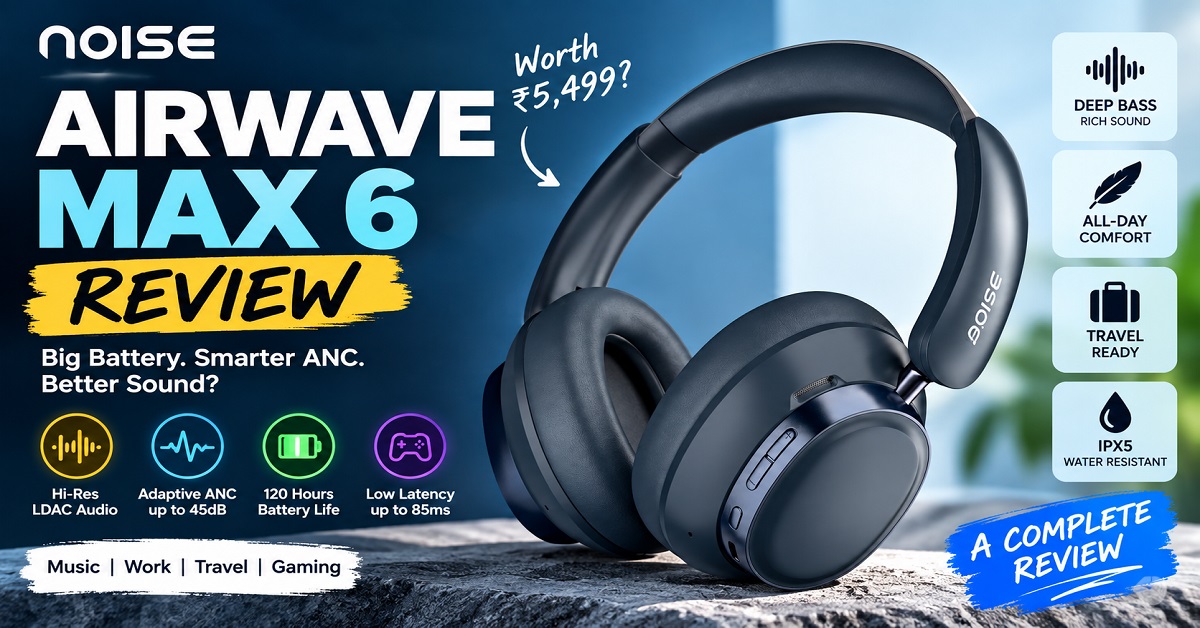
Noise Airwave Max 6 Review
The Noise Airwave Max 6 looks like the kind of wireless headphone that tries to win you over with big numbers. Hi-Res LDAC audio, adaptive ANC up to 45dB, up to 120 hours of playback, dual-device pairing and a dedicated low-latency mode all sound impressive on paper. Noise also uses a 40mm + 12mm dual-driver setup and adds features such as Transparency Mode, Spatial Audio, ENC calling and IPX5 water resistance.
But specifications alone don’t tell you whether a headphone is actually worth buying.
At a price around ₹5,499, the real question is whether the Airwave Max 6 gives you a noticeably better experience than cheaper wireless headphones, especially when it comes to sound quality, ANC, comfort, battery life and everyday usability.
That is exactly what this review will help you figure out.
I’ll look at what the Noise Airwave Max 6 offers, what its important features actually mean in daily use, where it makes sense, where you should be cautious, and what type of buyer should consider it.
My focus in this review is simple: don’t just look at the feature list. Let’s find out whether the features actually justify the price.
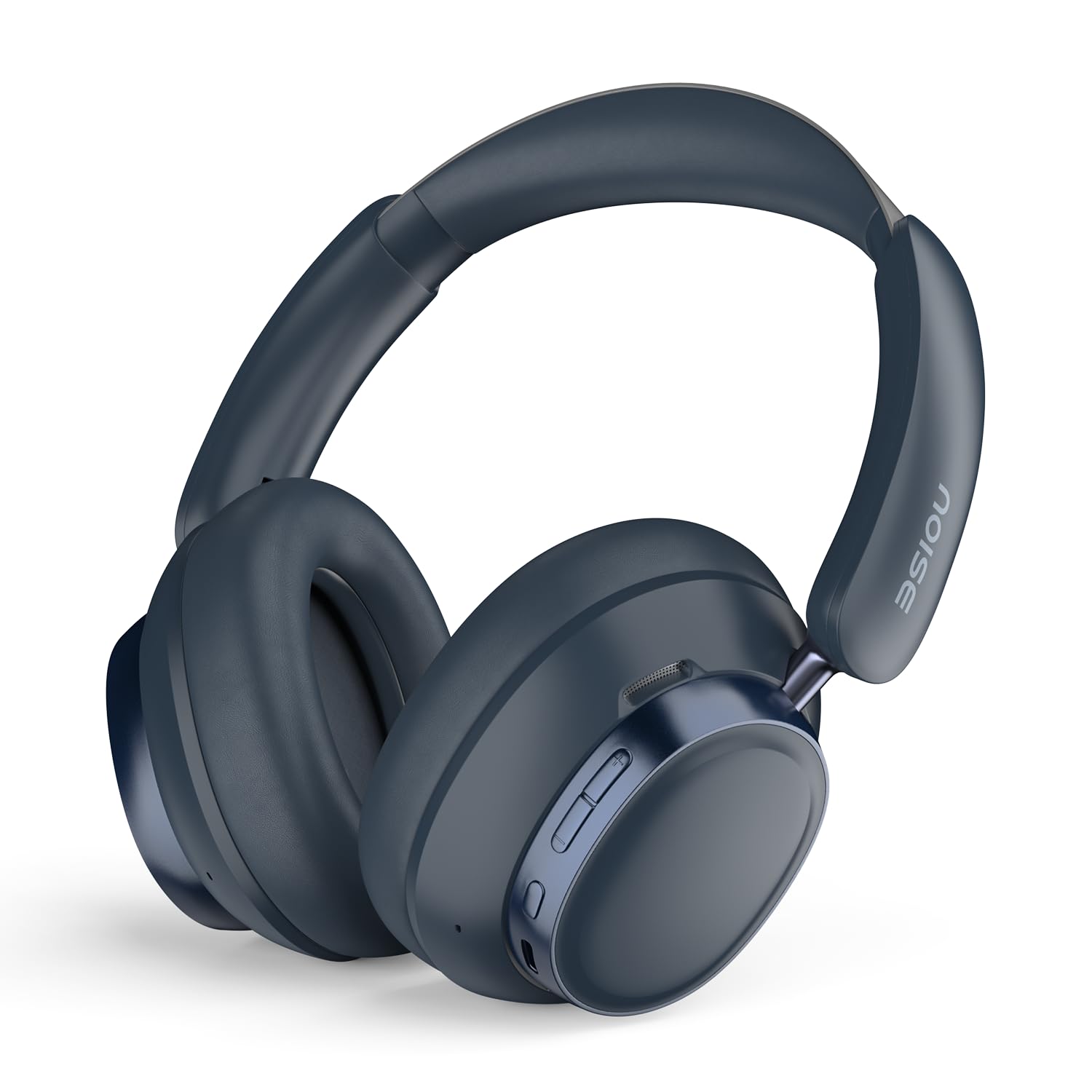
120H Battery | LDAC | Adaptive ANC
Noise Airwave Max 6 Wireless Headphones
- 120H Playtime
- Adaptive ANC
- Hi-Res LDAC Audio
- Dual-Device + Low Latency
The Noise Airwave Max 6 packs a lot into one over-ear headphone, including LDAC audio, adaptive ANC, 120-hour battery life, dual-device pairing and a dedicated low-latency mode. It makes the most sense for buyers who want a feature-rich headphone for music, work, travel and everyday use.
Quick Verdict
The Noise Airwave Max 6 looks like a feature-packed wireless headphone for buyers who want a combination of long battery life, high-resolution Bluetooth audio, adaptive ANC and everyday convenience features.
Its biggest attractions are the LDAC support, 40mm + 12mm dual-driver system, adaptive ANC, 120-hour advertised battery life, Transparency Mode and dual-device pairing. Noise also lists IPX5 water resistance and a low-latency gaming mode.
The battery claim is especially impressive, although the headline figure comes with usage conditions. Noise states that the 120-hour figure is based on specific conditions, and its Instacharge feature is rated at up to 15 hours of playback from 10 minutes of charging with ANC off at 60% volume.
Best suited for
- People who want very long battery life
- Frequent travelers and commuters
- Users who have an LDAC-compatible phone
- People who want ANC without moving into much more expensive headphones
- Office users who switch between a phone and laptop
Think twice if
- You mainly want the lightest possible headphones
- Gaming latency is your top priority
- You don’t have an LDAC-compatible source device
- You can get a significantly better-sounding alternative at the same price
The important thing is that this is not simply a headphone with a huge battery. It is trying to offer a more complete feature set while still staying in a comparatively accessible price range.
Noise Airwave Max 6 Specifications
| Feature | Details |
|---|---|
| Product type | Wireless over-ear headphones |
| Driver setup | 40mm + 12mm dual drivers |
| Audio codec | LDAC, AAC, SBC |
| Noise cancellation | Adaptive ANC |
| ANC level | Up to 45dB |
| Playtime | Up to 120 hours |
| Fast charging | Up to 15 hours from 10 minutes under specified conditions |
| Charging port | USB Type-C |
| Bluetooth range | Up to 10 metres |
| Dual-device pairing | Yes |
| Low latency | Up to 85ms on current official product specification |
| Microphones | ENC for calls |
| Transparency Mode | Yes |
| Spatial Audio | Yes |
| Water resistance | IPX5 |
| Weight | 304g |
| Wired connection | AUX |
| Compatibility | Android and iOS |
| In-ear detection | No |
Noise’s official product page lists the 40mm + 12mm dual-driver system, LDAC, adaptive ANC, 120-hour playtime, dual-device pairing, IPX5, 304g weight, AUX support and Android/iOS compatibility. It also specifies 2 hours for a full charge.
One thing worth pointing out is the low-latency specification. Some retail information lists 80ms, while Noise’s current product page lists the gaming mode as up to 85ms. For this review, I am using the manufacturer’s current official specification rather than treating the older retail figure as definitive.
What’s in the Box?
Noise’s official listing says the package includes:
- Noise Airwave Max 6 headphones
- USB charging cable
- AUX cable
- User manual
- Warranty card
- Zipper carrying case
The carrying case is a useful inclusion for a headphone designed with travel and everyday portability in mind.
What Makes the Noise Airwave Max 6 Interesting?
There are a few features here that deserve more attention than the usual specification-sheet numbers.
LDAC is one of the biggest ones
The Airwave Max 6 supports LDAC, Sony’s high-resolution Bluetooth audio codec. Noise says the headphone can transmit audio through LDAC at up to 990 kbps.
But there is an important catch.
Having LDAC support on the headphones does not automatically mean every listener will hear a dramatic improvement. Your phone or source device also needs to support LDAC, and the audio source and Bluetooth settings matter.
Noise’s own support page confirms that LDAC appears as an available codec when the connected mobile device supports it. Otherwise, the connection uses AAC or SBC.
So, if you already have an Android phone that supports LDAC, this feature could be much more meaningful to you than it would be to someone using a device limited to standard Bluetooth codecs.
Adaptive ANC is another major reason to consider it
Noise rates the Airwave Max 6’s adaptive ANC at up to 45dB. The idea behind adaptive ANC is that the headphone can adjust its noise cancellation according to the surrounding environment rather than simply applying one fixed level of cancellation. Noise also provides a physical mode switch that cycles through ANC, Adaptive ANC and Normal/Transparency modes.
That makes ANC one of the most important parts of the review.
A number such as 45dB sounds impressive, but what matters to a normal buyer is much simpler:
Does it actually make travel, office work and noisy surroundings more comfortable?
We’ll come back to that in detail.
And then there is the 120-hour battery claim
This is probably the easiest feature to understand.
Noise advertises up to 120 hours of playback, which is an unusually large number for a wireless over-ear headphone. The official specifications also state that a full charge takes about two hours.
The more useful feature for day-to-day life, though, may be Instacharge.
Noise states that 10 minutes of charging can provide up to 15 hours of playback with ANC turned off and volume at 60%.
That means even a quick top-up before leaving home could potentially be enough for several days of moderate listening.
Of course, real battery life will depend on how loudly you listen and whether features such as ANC or LDAC are being used. So later in this review, we’ll separate the headline battery number from what it means in practical terms.
One More Feature That Could Matter More Than You Think
The Airwave Max 6 also supports dual-device pairing.
This is particularly useful if you use a headphone with both a phone and a laptop.
For example, imagine you’re working on your laptop while listening to music. Your phone rings, and instead of manually disconnecting and pairing the headphones again, dual-device connectivity is designed to make switching between the two devices much easier.
Noise officially lists dual-device pairing as a feature of the Airwave Max 6.
For someone who works from home or spends a lot of time moving between a smartphone and computer, this can be more useful in everyday life than some of the more flashy specifications on the box.
My First Take
At first glance, the Noise Airwave Max 6 is clearly trying to offer more than just basic wireless audio.
You get high-resolution LDAC support, a dual-driver setup, adaptive ANC, Transparency Mode, Spatial Audio, long battery life, dual-device pairing, ENC calling and IPX5 protection.
But that creates a higher expectation.
A headphone with this many features should not be judged simply by asking, “Does it work?”
The better question is:
Does it do these things well enough to justify the price?
That’s what we’ll examine throughout this review.
Design, Build Quality and Comfort
The Noise Airwave Max 6 follows the familiar over-ear headphone design, but its feature set makes it more interesting than a basic wireless model. Noise lists the headphone at 304 grams, so this is not an especially lightweight pair. The company also includes a zipper carrying case, which is useful if you plan to take it to work, college or on trips.
The overall design appears to focus more on comfort and everyday practicality than on an ultra-compact form factor.
The earcups use soft cushioning, while the over-ear design is meant to surround the ears instead of sitting directly on them. That matters during long listening sessions because a good over-ear fit can feel less tiring than smaller on-ear headphones.
At the same time, the 304g weight is something to keep in mind.
A headphone that weighs noticeably more than a lightweight travel model can still be comfortable, but comfort becomes more dependent on the headband padding, earcup pressure and how long you wear it at a stretch. This is especially relevant if you’re planning to use the Airwave Max 6 for several hours while working.
Is the Noise Airwave Max 6 Good for Long Hours?
On paper, the answer looks promising because Noise specifically positions the Airwave Max 6 for travel, work and long listening sessions, and includes comfort-focused ear cushions.
But there is an important difference between “designed for all-day use” and “feels comfortable on every head.”
Headphone comfort is highly personal.
Someone with smaller ears may find the earcups roomy, while another person may notice pressure after a few hours. Similarly, the 304g weight may not bother one person at all but could become noticeable to another.
So I wouldn’t buy the Airwave Max 6 purely because it is marketed as an all-day headphone. Its comfort needs to be judged alongside its weight and fit.
What About Portability?
This is where the included zipper case becomes useful.
You can fold and carry the headphone rather than simply throwing it into a backpack, and the case provides an extra layer of protection while travelling. Noise specifically mentions that the headphone comes with a zipper case.
For frequent travelers, that is a small but welcome addition.
My take: The design makes sense for travel and everyday use, but the 304g weight means people who specifically want an ultra-light headphone should look elsewhere.
Noise Airwave Max 6 Sound Quality
Sound quality is arguably the most important part of this entire review.
A headphone can have excellent battery life and impressive ANC, but if the sound doesn’t suit you, those extra features won’t save it.
The Airwave Max 6 takes a more ambitious approach than a standard single-driver budget headphone. Noise uses a 40mm + 12mm dual-driver configuration, and the company says the setup is designed to provide rich bass, detailed mids and clearer highs.
But what does that mean for an actual listener?
40mm + 12mm Dual Drivers Explained
You don’t need to understand complicated audio engineering to understand the basic idea.
The Airwave Max 6 uses two differently sized drivers as part of its audio system rather than relying on one driver for everything.
The larger 40mm driver is the part most people will immediately associate with a full-sized headphone sound. The additional 12mm driver is intended to contribute to the overall presentation and separation.
However, a dual-driver design doesn’t automatically guarantee excellent sound.
Tuning, amplifier implementation, source quality and the headphone’s overall acoustic design all matter.
That’s why I would treat the dual-driver setup as an interesting feature, rather than assuming it automatically makes the Airwave Max 6 better than every single-driver headphone.
Bass Performance
Noise markets the Airwave Max 6 around rich bass and an engaging listening experience.
For listeners who enjoy Bollywood, EDM, hip-hop, pop or action-heavy movie soundtracks, that should be an appealing direction.
A good bass response can make music feel more energetic and can add weight to movie sound effects.
But there is a difference between strong bass and overpowering bass.
That’s something I would pay particular attention to when judging this headphone.
If the bass is controlled, it can make the Airwave Max 6 fun and engaging.
If it becomes too dominant, vocals and finer details can get pushed into the background.
That distinction becomes especially important because Noise also describes the headphone as having clarity across different frequency ranges.
Vocals and Midrange
For podcasts, YouTube videos, interviews and dialogue-heavy movies, midrange clarity matters more than huge bass numbers.
This is also where a headphone needs to show that its “immersive” sound isn’t simply another way of saying “lots of bass.”
The Airwave Max 6 is positioned as a headphone with detailed mids and clear highs, according to Noise.
For someone who listens to a mix of music and spoken content, that balance is important.
If you’re buying the Airwave Max 6 primarily for movies and music, you don’t want background instruments or dialogue to disappear every time the bass gets stronger.
Is LDAC Actually Important?
This is one of the biggest questions surrounding the Airwave Max 6.
Noise supports LDAC, and its official material says LDAC can transmit audio at up to 990 kbps.
That sounds impressive, but there’s a common misunderstanding here:
LDAC support doesn’t automatically make your music sound better.
Your source device also needs to support LDAC.
Noise’s own support documentation says that when you connect the Airwave Max 6 to a mobile device, LDAC will be available only if the connected device supports the codec. Otherwise, the connection will use AAC or SBC.
So, imagine two buyers.
Buyer A uses a phone that supports LDAC and listens to high-quality music.
Buyer B uses a device that doesn’t support LDAC and primarily watches YouTube videos.
The Airwave Max 6 offers the same hardware to both, but the value of LDAC is clearly different.
Who Should Care About LDAC?
LDAC becomes more interesting if you:
- have an LDAC-capable Android phone
- use high-quality music sources
- care about preserving more audio data over Bluetooth
- are willing to explore Bluetooth codec settings
For casual YouTube, social media and basic streaming, I wouldn’t choose the Airwave Max 6 just because it supports LDAC.
Think of LDAC as a feature that can add value to the right setup, not as a magic switch for better sound.
My take: The dual-driver design and LDAC support make the Airwave Max 6 much more interesting for music-focused buyers than a basic Bluetooth headphone, but sound quality should ultimately be judged by tuning and real listening rather than the specification sheet alone.

Noise Airwave Max 6 ANC Performance
The Airwave Max 6 includes adaptive ANC rated up to 45dB, and this is one of the major reasons someone might consider spending more on it instead of buying a basic wireless headphone.
If you’re not familiar with how active noise cancellation actually works or what claims such as 45dB ANC really mean, our guide to what ANC in headphones means explains it in simple terms.
But first, let’s clear up what the “45dB” figure actually means.
It does not mean the headphone will make a noisy environment 45dB quieter in every situation.
Noise cancellation performance depends on the type of sound around you.
What ANC Is Good At
ANC is generally most useful against steady, lower-frequency background noise.
Think:
- airplane cabin noise
- train or bus rumble
- air conditioners
- ceiling fans
- general office hum
- traffic background noise
These are the kinds of sounds active noise cancellation is designed to reduce.
It is much harder for ANC to completely eliminate sudden sounds, nearby conversations or sharp high-frequency noises.
That’s why you should never interpret a headline such as “45dB ANC” as “almost complete silence.”
What Makes Adaptive ANC Different?
The Airwave Max 6 supports Adaptive ANC, meaning the headphone is designed to adjust its noise-cancellation behaviour according to the surrounding environment. Noise also provides ANC, Adaptive ANC and Transparency modes.
The benefit is convenience.
Instead of manually trying to decide which fixed cancellation level you need, the headphone is designed to adapt to changing surroundings.
This could be particularly useful while travelling.
For example, the noise inside a train may be relatively constant for one part of your journey, then become mixed with announcements and conversations when you reach a busy station.
Adaptive processing is intended to make that transition easier.
Transparency Mode
There are times when you don’t want isolation.
Suppose you’re sitting at an airport and waiting for a boarding announcement.
You could remove the headphones, listen for the announcement and put them back on.
Or you can use Transparency Mode to hear more of what’s happening around you without fully removing the headphones. Noise lists Transparency Mode as one of the Airwave Max 6’s main features.
This is one of those features that sounds less exciting than LDAC or 120-hour battery life, but can actually become more useful in everyday life.
ANC vs Transparency: Which Should You Use?
It’s simple.
Use ANC when you want fewer outside distractions.
Use Transparency when you want to stay aware of your surroundings.
Use Normal mode when you don’t need either.
Noise’s support documentation confirms that the Airwave Max 6 has separate ANC, Adaptive, Normal and Transparency modes.
My take: Adaptive ANC is one of the Airwave Max 6’s strongest reasons to consider it, particularly for travel and office use. But don’t judge it by the 45dB number alone. The quality of noise reduction matters much more than the headline figure.
Noise Airwave Max 6 Call Quality and ENC
The Airwave Max 6 also includes ENC microphones for calls. Noise describes the microphones as designed to improve voice clarity by reducing environmental noise around your voice.
This is different from ANC.
That distinction is important.
ANC helps reduce the outside noise you hear through the headphones.
ENC is designed to help the other person hear your voice more clearly during a call.
So if you’re sitting in a noisy café and making a phone call, ANC may help you hear the conversation, while ENC is intended to help the person on the other end hear you.
Noise’s support documentation also has a dedicated troubleshooting section for Airwave Max 6 ENC calling performance, including situations where calling sound is less effective.
That tells us something useful from a review perspective.
The feature is there, but microphone performance should not be treated as automatically perfect simply because the product has ENC.
Is It Good for Work Calls?
The feature set makes the Airwave Max 6 a logical option for work calls because you get over-ear isolation, ANC and ENC together.
For someone working from home or using a laptop throughout the day, that combination could be more useful than a headphone focused purely on music.
I’d especially value this combination for:
Google Meet, Zoom, Microsoft Teams, regular phone calls and voice chats.
But microphone quality can vary significantly depending on surrounding noise, microphone processing and the other person’s device.
So I would call the Airwave Max 6 promising for regular calls, rather than automatically declaring it a professional-grade microphone solution.
Noise Airwave Max 6 Battery Life
Now we come to the feature that is probably easiest to market and easiest for buyers to understand:
120 hours of battery life.
Noise officially rates the Airwave Max 6 for up to 120 hours of playtime. It also lists a roughly 2-hour charging time.
That’s a huge number.
For someone who listens for two or three hours a day, 120 hours theoretically represents a very long period between full charges.
But there’s an important word in that specification:
“Up to.”
Battery estimates are normally measured under particular testing conditions.
Real-world usage can change depending on listening volume, wireless codec, ANC usage and other features.
So I wouldn’t expect every user to get exactly 120 hours from a single full charge.
Instacharge Could Be More Useful Than the 120-Hour Number
Here’s the feature that may actually save you from battery anxiety.
Noise says the Airwave Max 6’s Instacharge can provide up to 15 hours of playback from a 10-minute charge, with ANC turned off and volume at 60%.
That is a much more practical number.
Imagine you’re leaving for work in 15 minutes and notice that your headphones are nearly empty.
You don’t need to wait for a complete charge.
A short top-up can potentially give you enough listening time for several hours.
That’s useful for commuters, office workers and travelers.
Does ANC Affect Battery Life?
Yes, this is where headline battery figures need some context.
Running additional processing such as ANC can affect battery consumption compared with using the headphone in a simpler mode.
The manufacturer’s Instacharge specification itself is based on ANC being turned off at 60% volume, which is a good reminder that battery claims depend on the operating conditions.
The same applies to other features.
LDAC, higher volume and different usage patterns can all influence how long the battery lasts.
So I would treat 120 hours as the manufacturer’s maximum claim, not as a promise that every user will see that exact figure.
My take: Even after allowing for real-world variation, the battery specification is one of the Airwave Max 6’s biggest strengths. And for most people, the 10-minute quick-charge capability may matter more in daily life than the headline 120-hour number.
Connectivity and Bluetooth
The Noise Airwave Max 6 is designed to work with both Android and iOS devices, and Noise lists a wireless range of up to 10 metres in open space. It also supports common Bluetooth profiles along with AAC, SBC and LDAC.
For normal use, that covers most of what you would expect from a modern wireless headphone.
You can connect it to a smartphone, tablet or laptop and use it for music, videos, calls and other everyday audio.
The useful thing here is that the Airwave Max 6 isn’t limited to Bluetooth audio alone. It also includes an AUX-IN wired connection, so you can use a cable when Bluetooth isn’t convenient or when you want to preserve battery life. Noise includes an AUX cable in the box.
That makes the headphone more versatile for travel.
For example, Bluetooth is convenient on your phone, while the wired connection can be useful with compatible devices or in situations where you don’t want to rely on wireless connectivity.
Does Noise Airwave Max 6 Support Dual-Device Pairing?
There is an important detail here that I would not gloss over.
Noise’s main product description currently advertises Dual Device Pairing as a feature. However, the detailed specifications on the same official product page currently say “Dual device pairing: No.”
Because the manufacturer’s own page contains this contradiction, I would not make a firm claim that the Airwave Max 6 supports true simultaneous dual-device pairing without confirming the feature on the exact retail unit or user manual.
This is actually something buyers should pay attention to.
If you regularly switch between a laptop and phone, true dual-device connectivity can be a genuinely useful feature. If the specific unit doesn’t support it, you may have to disconnect and reconnect manually.
So for this review, I would treat dual-device pairing as a feature that needs verification rather than a guaranteed benefit.
That kind of clarification is more useful to a buyer than simply copying a feature list.
Noise Airwave Max 6 Controls and Everyday Operation
Noise says the Airwave Max 6 uses physical controls on the earcup, including a multifunction button and a dedicated mode button. These controls can be used for playback, calls and switching between listening modes.
Physical buttons have one major advantage over touch controls.
You can usually feel the button and know that you’ve pressed it.
That’s particularly useful when you’re walking outside or wearing gloves. You don’t have to search for a particular touch-sensitive spot on the earcup.
The dedicated mode control is also practical because ANC and Transparency are features you’re likely to change depending on where you are.
At home, you may want normal listening.
On a flight, ANC makes more sense.
At an airport or while walking near traffic, Transparency Mode can be more useful.
That makes physical mode controls a sensible choice for a headphone designed around travel and everyday use.
Noise Airwave Max 6 Gaming Performance
The Airwave Max 6 has a dedicated low-latency gaming mode, with Noise currently specifying latency of up to 85ms. The company positions this mode for gaming as well as video streaming.
Now, 85ms is worth putting into context.
Low latency is about reducing the delay between an action on screen and the corresponding sound reaching your ears.
For example, imagine you’re playing a mobile game and fire a weapon.
With noticeable audio delay, the sound can arrive slightly after the visual action, making the experience feel disconnected.
Lower latency helps reduce that mismatch.
Is 85ms Good for Gaming?
For casual mobile gaming, this should be perfectly reasonable.
It can also be useful for games where perfect split-second audio timing isn’t critical.
However, I would not buy the Airwave Max 6 specifically as a competitive gaming headset.
A latency figure around this level is aimed more at making everyday gaming and video watching feel smoother than turning the headphone into professional gaming equipment.
Noise’s own support documentation also has a dedicated troubleshooting section for Airwave Max 6 latency issues, which shows that latency behaviour can depend on the connected phone, apps and specific content. The company recommends testing with different phones and apps when investigating problems.
So the sensible expectation is:
Good for casual gaming and video. Not a specialist competitive gaming headset.
Spatial Audio: Is It Actually Useful?
The Airwave Max 6 also supports Spatial Audio.
Noise describes this as a software-based feature that creates a more immersive listening effect by simulating audio positioning from multiple channels.
This is different from simply making the sound louder.
The aim is to make audio feel like it has more width and positional depth.
You may notice the effect more with:
- movies
- TV shows
- certain games
- live recordings
- specially produced spatial content
But Spatial Audio is one of those features that will not appeal equally to everyone.
Some people enjoy the wider, more cinematic presentation.
Others prefer the more natural sound of standard stereo.
So I would treat Spatial Audio as a nice extra, not the main reason to buy the headphone.
There is also no reason to keep it enabled all the time just because the feature exists. Try it with different types of content and use whichever presentation you prefer.
Noise Airwave Max 6 Water Resistance
The Airwave Max 6 carries an IPX5 water-resistance rating according to Noise. The company positions it as suitable for sweat and splash exposure, including workouts and outdoor use.
For everyday use, that’s reassuring.
If you’re wearing the headphones during a workout and they come into contact with sweat, an IPX5 rating gives you more protection than a headphone with no water-resistance rating.
But don’t confuse water resistance with waterproofing.
I wouldn’t treat an IPX5 headphone as something you can take into a shower, swimming pool or heavy rain for extended periods.
The safer approach is simple:
Sweat and light water exposure are one thing. Submersion is another.
Battery, ANC and LDAC: How the Features Work Together
One of the biggest mistakes people make when judging wireless headphones is looking at each feature independently.
The Airwave Max 6 can offer:
LDAC for higher-quality Bluetooth audio.
ANC for reducing outside noise.
Spatial Audio for a wider virtual presentation.
Gaming mode for lower latency.
And a huge 120-hour advertised battery.
But these features can affect the overall experience differently depending on how you use them.
For example, someone using basic Bluetooth audio without ANC is likely to have a different battery experience from someone listening loudly with ANC and other processing enabled.
That’s why I would judge the 120-hour number as a maximum advertised figure, not as a guarantee that every combination of features will deliver 120 hours.
Noise’s own Instacharge specification reinforces this point. The company quotes up to 15 hours from a 10-minute charge with ANC turned off at 60% volume.
So the more practical question isn’t:
“Will I get exactly 120 hours?”
It’s:
“Will I have enough battery that charging stops being something I worry about?”
For most buyers, that is the more useful question.
And based on the advertised capacity, the answer looks promising.
What You Get With Noise Airwave Max 6
The Airwave Max 6 has a fairly extensive feature list for a headphone in this segment.
Key features
Hi-Res LDAC audio: Useful for compatible phones and high-quality audio sources.
Adaptive ANC: Designed to adjust noise cancellation according to the surrounding environment.
Transparency Mode: Lets outside sound pass through when you need awareness of your surroundings.
120-hour advertised battery: One of the headphone’s biggest selling points.
Instacharge: Up to 15 hours from a 10-minute charge under Noise’s stated conditions.
40mm + 12mm dual drivers: A more ambitious driver configuration than many basic wireless headphones.
ENC microphones: Intended to improve voice pickup during calls.
Spatial Audio: Adds a virtual immersive effect.
Gaming Mode: Low-latency mode rated up to 85ms by Noise’s current product page.
IPX5: Protection against sweat and water splashes.
AUX: Allows wired listening.
Voice assistant: Support for Siri and Google Assistant.
These are a lot of features to find in one headphone. Noise itself positions the Airwave Max 6 as a product for audiophiles, gamers, commuters and professionals.
But the feature count alone shouldn’t determine whether it’s worth buying.
What You Don’t Get
There are also some limitations worth considering.
No in-ear detection
Noise’s detailed specification lists in-ear detection as “No.”
That means the headphone doesn’t have the kind of automatic wear detection you might see on some premium models.
For example, you shouldn’t expect playback to automatically pause simply because you removed the headphone.
It’s not a major issue, but it is one of those small convenience features that can matter once you’ve become used to it.
Gaming isn’t its strongest reason to buy
The low-latency mode is useful, but the Airwave Max 6 shouldn’t be positioned as a dedicated competitive gaming headphone.
For normal gaming and video watching, it makes sense.
For serious competitive play where audio timing is critical, I’d look for a gaming-focused model designed around much lower latency.
Dual-device pairing needs verification
As mentioned earlier, Noise’s current official page contains conflicting information about dual-device pairing.
Because of that, I would not use dual-device connectivity as a primary purchase reason until the exact unit or current manual confirms it.
This is especially important if you’re buying the Airwave Max 6 specifically to switch between your phone and laptop.
Pros and Cons
Pros
- Hi-Res LDAC audio support
- 40mm + 12mm dual-driver setup
- Adaptive ANC up to 45dB
- Up to 120 hours of advertised playback
- Fast charging with Instacharge
- Transparency Mode
- Spatial Audio support
- IPX5 water resistance
- AUX wired connectivity
- ENC for calls
- Low-latency mode for gaming and video
- Carrying case included
Cons
- 304g weight may feel heavy during long sessions
- 120-hour battery claim depends on usage conditions
- Low-latency mode is not aimed at competitive gaming
- No in-ear detection
- Dual-device pairing information is inconsistent on Noise’s official page
- Customer feedback is mixed on sound quality and value for money
The last point is worth taking seriously. The customer feedback you supplied is not universally positive, so the final verdict should not be based purely on the impressive specification list.
Best Wireless Headphones Under ₹10000 in India
The Airwave Max 6’s combination of ANC, long battery life, wired connectivity and carrying case makes the travel angle particularly relevant.
Where the Airwave Max 6 Makes the Most Sense
After looking at the feature set, I think the product makes the most sense for a particular kind of buyer.
Imagine someone who leaves home in the morning with a phone, commutes to work, spends several hours at a desk, takes a few calls, listens to music in the evening and occasionally watches movies or plays games.
That person doesn’t necessarily need a specialist product.
They need one headphone that can do many jobs reasonably well.
That’s where the Airwave Max 6 becomes interesting.
The combination of ANC, LDAC, long battery life, Transparency Mode, wired use and multiple listening features gives it flexibility.
And the large battery means you don’t have to constantly remember where you left the charging cable.
The bigger question is whether all these features justify the ₹5,499 price.

Noise Airwave Max 6 Price and Value for Money
The Noise Airwave Max 6 is currently listed at ₹5,499 on Noise’s official store, against an MRP of ₹6,999. The same ₹5,499 price is also currently shown by Flipkart, although actual offers can change.
At ₹5,499, the Airwave Max 6 enters a more competitive part of the headphone market.
That means I would not recommend buying it simply because it has a 120-hour battery or 45dB adaptive ANC. At this price, you should look at the complete package.
And that is where the Airwave Max 6 becomes interesting.
You are getting LDAC, a dual-driver setup, adaptive ANC, Transparency Mode, Spatial Audio, 120-hour advertised playtime, fast charging, AUX connectivity, ENC microphones, IPX5 protection and low-latency gaming mode.
For someone who wants one headphone that can handle music, movies, work, travel and occasional gaming, that’s a strong feature list.
Is ₹5,499 a Good Price for Noise Airwave Max 6?
At ₹5,499, I would consider it worth considering, but not an automatic buy.
The reason is simple.
Noise itself currently sells the Airwave Max 5 at ₹4,999 and the Airwave Max XR at ₹2,999, so the Airwave Max 6 has to justify its higher price.
The Max 5 is especially interesting because it also offers adaptive ANC, dual-device pairing, IPX5 protection and up to 80 hours of advertised battery life, while weighing about 251.4g.
So you’re effectively paying about ₹500 more for the Airwave Max 6 at the current official prices.
What do you get for that extra money?
The Max 6 adds the 40mm + 12mm dual-driver configuration and LDAC support, along with its 120-hour battery claim.
That’s the argument in favour of the Max 6.
If you care about higher-resolution Bluetooth audio and want the more ambitious audio hardware, the additional ₹500 can make sense.
If you mainly want ANC, long battery life and everyday wireless listening, the cheaper Max 5 becomes a much more interesting alternative.
Noise Airwave Max 6 vs Airwave Max 5
This is probably the comparison I would make before spending ₹5,499.
| Feature | Noise Airwave Max 6 | Noise Airwave Max 5 |
|---|---|---|
| Current Noise price | ₹5,499 | ₹4,999 |
| Drivers | 40mm + 12mm dual drivers | 40mm |
| Audio codec | LDAC, AAC, SBC | Bluetooth audio profiles listed |
| ANC | Adaptive ANC | Adaptive ANC |
| Advertised battery | Up to 120 hours | Up to 80 hours |
| Quick charging | Up to 15 hours/10 min under specified conditions | Up to 10 hours/10 min at 60% volume |
| Dual-device pairing | Manufacturer information needs verification | Yes |
| Weight | 304g | 251.4g |
| Water resistance | IPX5 | IPX5 |
| Low latency | Up to 85ms on current detailed specification | Ultra-low latency |
| AUX | Yes | Yes |
If you’re considering the cheaper model, our detailed Noise Airwave Max 5 review explains its sound, ANC, comfort, battery life and everyday performance in more detail.
The Max 5 is considerably lighter and already includes many of the features people want from a lifestyle headphone.
The Max 6’s biggest advantages are its dual-driver audio system, LDAC and larger advertised battery capacity.
So my choice would depend on the buyer.
Choose Airwave Max 6 if audio features and LDAC matter to you.
Choose Airwave Max 5 if you want to save ₹500 and prefer a lighter headphone with a strong feature set.
There isn’t a universal winner here.
Noise Airwave Max 6 vs Airwave Max XR
The Airwave Max XR makes the comparison even more interesting because Noise currently lists it at around ₹2,999, which is substantially cheaper than the Max 6.
The Max XR also offers up to 120 hours of advertised playtime, dual-device pairing, 40mm drivers, Bluetooth 6.0 and 85ms low latency. However, its ANC is rated at up to 22dB compared with the Max 6’s advertised 45dB adaptive ANC. The XR is also much lighter at about 233.8g.
That gives us a very clear distinction.
If your priority is battery life, lighter weight and basic ANC at a lower price, the Max XR is worth considering.
If you specifically want LDAC, the dual-driver setup and stronger advertised ANC, the Max 6 has a more ambitious feature set.
So the Max 6 isn’t simply “better” because it costs more. It is aimed at someone who wants more advanced audio features.
What About Sound Quality?
This is where I would be cautious about making a final judgment based only on specifications.
Noise’s official product information positions the Max 6 as a dual-driver headphone with rich bass, detailed mids and clear highs, and the company specifically highlights LDAC support.
There is also some independent review coverage that describes the headphone as having strong bass and focuses on its dual-driver and ANC features.
However, the customer feedback you supplied is mixed on sound quality.
Some buyers like the sound, while others consider it poor. Value-for-money feedback is similarly mixed.
That means I would not write something like “the Airwave Max 6 has the best sound under ₹6,000”.
We don’t have enough evidence to make that claim responsibly.
A better conclusion is:
The hardware and codec support make the Airwave Max 6 technically interesting, but buyers who are very particular about sound should judge the actual tuning rather than buying it purely for LDAC or the dual-driver specification.
That’s a much more honest recommendation.
Is Noise Airwave Max 6 Good for Travel?
This is one of the areas where the feature combination makes a lot of sense.
Imagine a long flight.
You have the Airwave Max 6 on your head, ANC reducing the steady engine rumble, your phone connected over Bluetooth, and several hours of music or movies ahead of you.
The long battery rating means charging is less of a concern.
If the battery happens to be low before the trip, the quick-charge feature is also useful.
And because the headphone supports AUX, you have a wired option when needed. Noise includes an AUX cable in the package.
The carrying case is another small but useful travel addition.
So even though the 304g weight prevents me from calling it an ultra-light travel headphone, the overall feature set is well suited to travel.
For frequent flyers, commuters and people who spend long hours on buses or trains, the ANC + battery + wired option combination is arguably more useful than the flashy LDAC specification.
If you’re comparing several ANC headphones before travelling, you can also see our updated list of best ANC headphones under ₹5000 to compare features, battery life and overall value.
Is Noise Airwave Max 6 Good for Office Use?
It can make sense here too.
The combination of over-ear isolation, ANC and ENC calling gives it a practical office or work-from-home use case.
The real advantage is that you don’t need one device for music and another for calls.
You can use the same headphone for:
Music → meetings → phone calls → YouTube → back to work.
The dual-device pairing claim could make this even more useful, but because Noise’s current product page contains conflicting information about that feature, I would verify the specific unit’s documentation before relying on it as a purchase reason.
This is one detail I’d specifically recommend checking before ordering if phone-and-laptop switching is important to you.
Who Should Buy Noise Airwave Max 6?
I would consider the Airwave Max 6 a good fit for someone who wants one versatile over-ear headphone instead of buying separate products for different situations.
It makes the most sense for:
Music listeners who have an LDAC-capable phone
If your phone supports LDAC and you use good-quality music sources, the codec support gives you an additional reason to choose the Max 6.
Frequent travelers
ANC, long battery life, Transparency Mode, AUX support and the carrying case make the overall package travel-friendly.
Office and work-from-home users
The combination of over-ear design, ANC and ENC calling can work well for someone who spends several hours each day on a computer and phone.
People who hate charging
120 hours is a huge advertised battery figure, and even if real-world usage falls below that maximum, the battery should still be one of the headphone’s main strengths. Noise’s quick-charge claim also makes short top-ups useful.
Buyers who want features instead of a bare-bones headphone
If you like experimenting with LDAC, Spatial Audio, ANC and different listening modes, the Max 6 gives you much more to play with than a basic Bluetooth headphone.
Who Should Skip Noise Airwave Max 6?
I would look elsewhere if your priorities are very specific.
Skip it if you want an extremely lightweight headphone
At 304g, the Max 6 is substantially heavier than the Airwave Max 5 at 251.4g and the Airwave Max XR at 233.8g.
Skip it if competitive gaming is your main requirement
The low-latency mode is useful for casual gaming and video, but I wouldn’t choose this headphone primarily as a competitive gaming headset.
Skip it if you don’t care about LDAC or advanced audio features
If you’re mainly listening to YouTube, podcasts and casual streaming, you may not get enough benefit from the Max 6’s more advanced audio features to justify paying extra over a simpler alternative.
This is still a consumer-focused headphone rather than a high-end audiophile product.
The impressive specification sheet shouldn’t create unrealistic expectations.
Best Price to Buy Noise Airwave Max 6
Here’s how I would approach the purchase.
Around ₹5,000 or lower
Strong buy.
At this price, the feature package becomes much more attractive.
₹5,000-₹5,500
Worth considering.
At the current ₹5,499 price, I’d buy it if I specifically want LDAC, the dual-driver design, adaptive ANC and the very long battery claim. Noise currently lists it at ₹5,499.
₹5,500-₹6,000
Compare before buying.
At this point, the Airwave Max 5 becomes more tempting, and there are likely to be competing headphones worth checking.
Above ₹6,000
I’d wait for a sale or compare alternatives.
The Max 6 becomes harder to recommend as the price moves significantly above its current ₹5,499 official selling price.
Noise Airwave Max 6: My Verdict
The Noise Airwave Max 6 is an ambitious wireless headphone.
It isn’t trying to win buyers with just one feature.
Instead, it combines LDAC, dual drivers, adaptive ANC, long battery life, Transparency Mode, Spatial Audio, ENC calling, AUX connectivity and low-latency gaming into one package.
That makes it particularly appealing to someone who wants a versatile headphone for music, work, travel and entertainment.
But there are two things I would keep in mind.
First, 304g is not lightweight.
Second, the impressive specifications don’t automatically guarantee that every listener will love the sound or find it worth the price. Your supplied buyer feedback is mixed on sound quality and value, so expectations should stay realistic.
At ₹5,499, my verdict is:
BUY at around ₹5,000-₹5,500 if you want LDAC, adaptive ANC and a feature-rich headphone with very long advertised battery life.
WAIT for a lower price if you’re not particularly interested in LDAC or the dual-driver setup.
SKIP it if lightweight comfort or competitive gaming is your highest priority.
For the right buyer, the Airwave Max 6 makes a convincing case. But its value comes from the combination of features, not from one impressive number on the specification sheet.
Watch the Noise Airwave Max 6 in Action
Want to see the Noise Airwave Max 6 before deciding whether it is worth your money? Take a few minutes to watch the video below for a closer look at the headphones, their design, features and overall experience.
The video is around 9 minutes long, so it can give you a better visual idea of the product. Once you finish watching, come back to this article because we go much deeper into the sound, ANC, battery life, comfort, features, drawbacks, alternatives and overall value for money.
Video Credit: Electrical Unboxing
Frequently Asked Questions
Is Noise Airwave Max 6 worth buying?
Yes, especially around ₹5,000-₹5,500 if you want LDAC, adaptive ANC, long battery life and a feature-rich over-ear headphone. At higher prices, compare it with alternatives first. Noise currently lists it at ₹5,499.
Does Noise Airwave Max 6 support LDAC?
Yes. Noise lists LDAC among the supported audio profiles for the Airwave Max 6. Your source device also needs to support LDAC to use the codec.
Does Noise Airwave Max 6 have ANC?
Yes. It supports adaptive ANC, with Noise advertising noise cancellation of up to 45dB.
How long does the Noise Airwave Max 6 battery last?
Noise advertises up to 120 hours of playtime. Actual battery life can vary depending on listening volume, ANC, codec and other usage conditions.
Does Noise Airwave Max 6 support fast charging?
Yes. Noise says its Instacharge feature can provide substantial playback time from a short charge. The detailed official specification currently states up to 15 hours from 10 minutes under specified conditions.
Is Noise Airwave Max 6 good for gaming?
It is suitable for casual gaming and video because it has a dedicated low-latency mode. I would not buy it specifically for competitive gaming.
Does Noise Airwave Max 6 support wired use?
Yes. It supports wired audio through AUX, and Noise includes an AUX cable in the package.
Is Noise Airwave Max 6 waterproof?
It has an IPX5 water-resistance rating, which provides protection against sweat and water splashes. It should not be treated as a fully waterproof headphone or submerged in water.
Is Noise Airwave Max 6 compatible with iPhone?
Yes. Noise lists compatibility with both Android and iOS devices.
Does Noise Airwave Max 6 have dual-device pairing?
Noise’s current product information is inconsistent. The feature list advertises dual-device pairing, while the detailed specifications conflict with that claim. I recommend confirming the feature on the exact retail unit or current documentation before buying specifically for simultaneous phone-and-laptop connectivity.
Is the Noise Airwave Max 6 better than Airwave Max 5?
Not for every buyer. The Max 6 offers a 40mm + 12mm dual-driver setup, LDAC and up to 120 hours of advertised playtime, while the Max 5 is lighter, costs less at Noise’s current listed price and still provides adaptive ANC, dual-device pairing, IPX5 and up to 80 hours of playtime.
Should you buy Noise Airwave Max 6 at ₹5,499?
Yes, provided its particular feature set is what you need. At ₹5,499, it is most compelling for buyers who specifically want LDAC, adaptive ANC, long battery life and the dual-driver setup. If those features don’t matter to you, cheaper alternatives within Noise’s own lineup may offer better value.
120H Battery | LDAC | Adaptive ANC
Noise Airwave Max 6 Wireless Headphones
- 120H Playtime
- Adaptive ANC
- Hi-Res LDAC Audio
- Dual-Device + Low Latency
The Noise Airwave Max 6 packs a lot into one over-ear headphone, including LDAC audio, adaptive ANC, 120-hour battery life, dual-device pairing and a dedicated low-latency mode. It makes the most sense for buyers who want a feature-rich headphone for music, work, travel and everyday use.
Final Recommendation
The Noise Airwave Max 6 makes the most sense when you look at it as an all-rounder rather than a headphone built around one headline feature.
Its 120-hour battery gets the attention, but the combination of ANC, LDAC, dual drivers, wired connectivity, Transparency Mode and everyday features is what gives the headphone its appeal.
At around ₹5,499, I’d consider it a good buy for feature-focused users, but I’d keep an eye on sale pricing because the Airwave Max 5 is currently only about ₹500 cheaper and the Airwave Max XR is considerably less expensive.
My final rating: 4/5
Best reason to buy: Feature-rich package with LDAC, adaptive ANC and very long advertised battery life.
Biggest concern: 304g weight and mixed buyer feedback mean it isn’t an automatic recommendation for everyone.
Best buying range: ₹5,000-₹5,500
Final verdict: Worth buying at the right price, especially for music, travel and work.

About the Author
Hari Prasad is the editor of AudioPick.in and a lifelong audio enthusiast. He writes detailed, honest reviews and guides to help everyday users pick the right gear without tech jargon. His personal interest in Bluetooth audio, neckbands, and codecs comes from testing dozens of devices over the past few years.