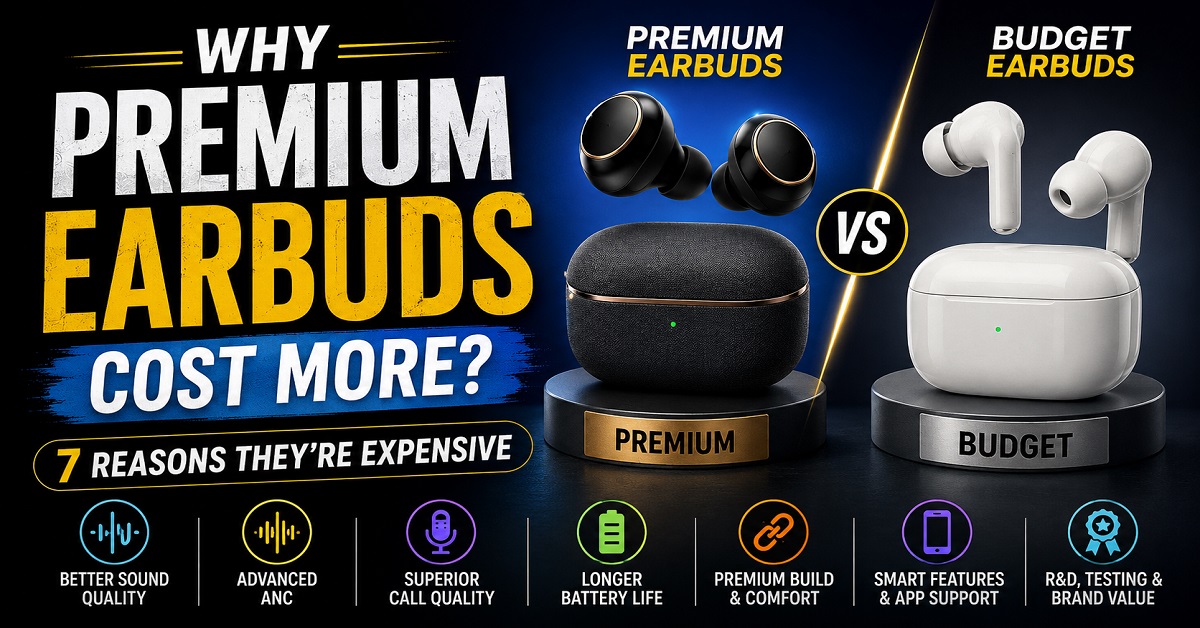
Why premium earbuds cost more is a question many people ask when they see one pair of wireless earbuds selling for ₹5,000 and another for ₹25,000 or even more. At first glance, the price difference can seem difficult to justify.
But why do premium earbuds cost more?
The answer is not simply that expensive earbuds use better speakers. Premium models can include more advanced drivers, multiple microphones, dedicated audio processors, sophisticated noise cancellation, better wireless technology, extensive sound tuning, improved comfort and much more software engineering.
However, there is another side to the story.
A higher price does not automatically mean better sound or better value for everyone.
A ₹5,000 pair may be a better purchase for one listener, while an audiophile, frequent traveller or someone who spends hours on calls may find the additional features of a ₹20,000 pair genuinely useful.
So, before spending your money on premium earbuds, it is worth understanding where that extra money actually goes and which improvements you are likely to notice.
Quick Answer: Why Do Premium Earbuds Cost More?
Premium earbuds cost more because manufacturers spend more on a combination of hardware, acoustic engineering, software, research, testing, materials and advanced features.
The biggest differences usually come from:
- Better drivers and acoustic design
- More advanced Active Noise Cancellation (ANC)
- Additional microphones for calls and noise processing
- Better audio processors and wireless chipsets
- Support for higher-quality Bluetooth codecs
- More sophisticated sound tuning
- Personalized audio features
- Better fit and comfort
- Higher-quality components and construction
- More extensive app and software features
- Research, development and testing
- Brand support and after-sales service
But these improvements don’t all matter equally to every person.
For example, someone who mainly listens to YouTube videos at home may not benefit much from spending ₹25,000 on earbuds. A frequent traveller who spends hours in aircraft cabins may value excellent ANC much more.
That is why the better question isn’t simply “Are expensive earbuds better?”
It is:
“Do the improvements offered by these premium earbuds matter to me?”
What Actually Makes an Earbud Premium?
The term “premium” is not a technical standard.
There is no universal rule saying that an earbud becomes premium after crossing a particular price.
Instead, manufacturers generally use a combination of higher-end hardware, engineering and features to create a more complete product.
Consider what happens inside a small pair of true wireless earbuds.
You need a speaker driver to reproduce sound, batteries to power everything, Bluetooth hardware to receive audio, microphones for calls and noise cancellation, processors to handle the audio and wireless signals, sensors to detect different conditions, and software to control all of it.
All of these components have to fit inside something small enough to sit comfortably in your ear.
That creates a surprisingly difficult engineering problem.
Premium earbuds often try to solve more of these problems at the same time.
For example, some flagship earbuds use multiple processors and several microphones in each earbud to improve noise cancellation and call quality. Other premium models use personalized audio technologies that analyze the listener’s ears and adjust the sound accordingly.
These technologies don’t guarantee that every listener will hear a dramatic difference, but they demonstrate that premium wireless earbuds can contain considerably more engineering than their small size suggests.
1. Better Drivers and Acoustic Engineering
The driver is one of the most important parts of an earbud.
It is the component that converts the electrical audio signal into the sound you hear.
Budget earbuds can produce surprisingly good sound with relatively inexpensive drivers. This is one reason the affordable earbud market has become so competitive.
Premium earbuds, however, may use more carefully designed drivers, different diaphragm materials, stronger magnetic systems or specialized acoustic structures.
But there is an important point that is often misunderstood:
A bigger driver does not automatically mean better sound.
A 12mm driver is not necessarily better than a well-engineered 7mm driver.
What matters is the complete acoustic system.
The driver, enclosure, ear tip, acoustic chamber, tuning and digital processing all work together.
A premium manufacturer may spend considerable time tuning these components so that vocals sound natural, bass remains controlled and high frequencies retain detail without becoming harsh.
This is one reason two earbuds with similar-looking specifications can sound completely different.
What can you actually hear?
A well-engineered premium earbud may offer:
- Cleaner vocals
- Better instrument separation
- More controlled bass
- Smoother treble
- Better detail retrieval
- A wider or more convincing sense of space
- Less distortion at higher volume
But these differences are not guaranteed to be dramatic.
If you mostly listen to heavily compressed music through noisy environments, you may not notice every improvement.
That is why you should never buy premium earbuds based only on the driver size printed on the box.
2. Advanced Active Noise Cancellation Costs More
ANC is another major reason premium earbuds can cost more.
Basic noise cancellation can already be found in relatively affordable earbuds. But creating effective ANC across different environments is considerably more complicated.
ANC earbuds need microphones to detect surrounding sounds.
The electronics then process that information and generate an opposing signal designed to reduce the unwanted sound reaching your ears.
The system has to work quickly and continuously.
And real-world noise is rarely simple.
An aircraft engine produces a relatively steady low-frequency sound. A busy street contains traffic, horns, voices and constantly changing sounds.
A premium ANC system may therefore use multiple microphones, dedicated processing hardware and sophisticated algorithms to react to these changes.
Some flagship earbuds use several microphones and dedicated processors to improve noise cancellation, while others use personalized technologies that adjust ANC according to the shape of the listener’s ears.
Why does this matter?
Imagine you are sitting on a flight.
With weaker ANC, the constant engine rumble may remain noticeable even while music is playing.
With a better ANC system, much of that low-frequency background noise can be reduced, allowing you to listen at a more comfortable volume.
This is one area where spending more can provide a benefit that is easy to appreciate.
However, premium does not mean every expensive earbud has the best ANC.
Some manufacturers prioritize sound quality over noise cancellation.
So if ANC is your main reason for upgrading, compare ANC performance specifically rather than assuming that the most expensive model will win.
3. More Microphones for Better Calls
Premium earbuds also tend to invest more heavily in microphones.
This matters because the tiny microphones inside earbuds have a difficult job.
They need to capture your voice while dealing with:
- Traffic noise
- Wind
- Conversations around you
- Air conditioning
- Keyboard sounds
- Cafes and restaurants
- Other background noise
Some premium earbuds use several microphones per earbud along with beamforming and software-based noise reduction.
The goal isn’t simply to record more sound.
The system needs to determine:
“Which sound is the user’s voice, and which sounds should be reduced?”
That requires hardware and software working together.
This can be particularly useful if you frequently use earbuds for work calls.
A person who only listens to music may not care much about microphone quality. Someone who spends two hours a day on calls may consider it one of the most important features.
4. Better Bluetooth Codecs and Wireless Audio Technology
Wireless earbuds have another limitation that wired earphones don’t face in exactly the same way: the audio has to travel wirelessly from your device to the earbuds.
Bluetooth technology compresses and transmits the audio.
Different codecs use different methods to handle this transmission.
Premium earbuds may support advanced codecs such as LDAC, aptX Adaptive or aptX Lossless, depending on the product and device ecosystem.
But there is an important catch.
Having a premium codec does not automatically mean you will hear a huge improvement.
Your smartphone, operating system and music source also need to support the relevant technology.
If your phone doesn’t support a particular codec, the earbuds cannot magically create that connection.
There can also be trade-offs involving power consumption, compatibility and real-world availability.
So codecs are valuable, particularly for enthusiasts, but they should not be the only reason you buy expensive earbuds.
5. Sound Tuning and Personalization
This is one of the less obvious costs of premium earbuds.
Good sound doesn’t happen simply because a manufacturer installs an expensive driver.
Someone has to decide how that driver should sound.
Engineers can spend considerable time testing and adjusting the earbud’s frequency response.
They may listen to vocals, acoustic instruments, electronic music, rock, classical recordings and other material while making small adjustments.
Premium earbuds may also include personalized sound features.
Some flagship earbuds can analyze how sound behaves in the user’s ears and use that information to adjust the listening experience.
This is important because your ears are not identical to someone else’s.
The shape of your ear canal, the way the earbud fits and even the choice of ear tip can influence what you hear.
That means a sound profile that works beautifully for one person may not sound exactly the same to another.
And this is one reason “best sound” is ultimately subjective.
A premium earbud can provide more tools to personalize the experience, but the final choice still depends on your ears and your musical preferences.
What Else Are You Paying For in Premium Earbuds?
6. Better Fit, Comfort and Ergonomics
Comfort is one of the easiest things to overlook when comparing earbuds.
You might spend a lot of time comparing drivers, ANC and Bluetooth codecs, but if the earbuds hurt your ears after 30 minutes, those specifications won’t matter much.
Premium earbuds often receive more attention during the design stage because manufacturers know that people may wear them for several hours at a time.
This can involve:
- Smaller or lighter earbud bodies
- Better-shaped housings
- Multiple ear tip sizes
- Stability fins or wings
- Improved weight distribution
- Better pressure management
- More carefully designed charging cases
The shape of an earbud also affects its sound.
A proper seal between the ear tip and your ear canal can improve bass response and passive noise isolation. If the seal is poor, even an excellent driver may not sound its best.
This is why two people can have completely different experiences with the same pair of earbuds.
One person may find them extremely comfortable and secure, while another may struggle to get a proper fit.
Flagship models sometimes include several ear tip sizes or different fitting accessories.
This might seem like a small addition, but it can make a meaningful difference.
For example, if the included medium ear tips don’t create a proper seal, switching to a smaller or larger size may immediately improve both comfort and bass response.
Some premium earbuds even include different stability bands or wings to help keep the earbuds securely positioned during movement.
So part of what you are paying for isn’t just the earbud itself. You are also paying for a more carefully considered wearing experience.
7. Premium Materials and Build Quality
Material quality is another factor that can increase the cost of a product.
This doesn’t necessarily mean that expensive earbuds are made entirely from metal or premium materials.
In fact, plastic can be an excellent choice for earbuds because it is lightweight and allows manufacturers to create complex shapes.
The difference is often found in the quality of the materials, finishing and construction.
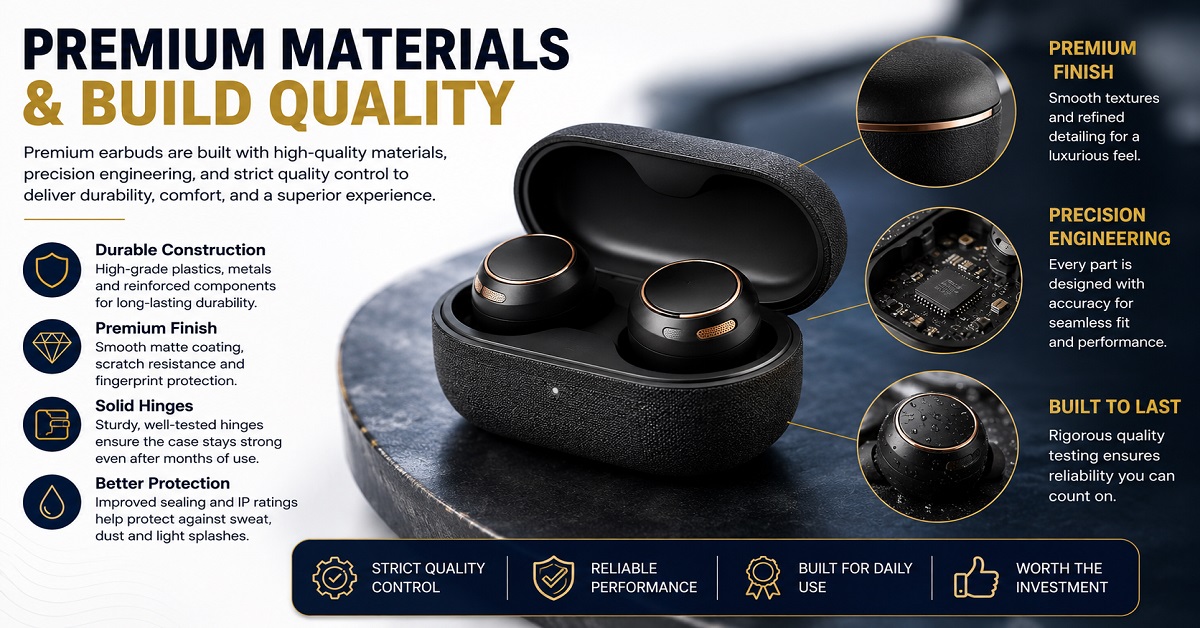
A premium product may have:
- Better surface finishing
- More precise assembly
- Stronger hinges
- Better buttons or touch surfaces
- More durable charging contacts
- Improved resistance to dust and moisture
- Higher-quality internal components
The charging case is particularly important because you open and close it constantly.
A cheap-feeling hinge can become annoying after months of use, while a well-designed case can continue to feel solid for years.
However, build quality is another area where you should avoid assuming that higher price always equals higher durability.
An expensive earbud can still be damaged by sweat, water, drops or poor handling.
Always check the actual IP rating and manufacturer recommendations if durability is important to you.
8. Better Water and Dust Resistance
Premium earbuds are increasingly designed for different environments.
Depending on the model, you may find ratings such as IPX4, IP54 or higher.
These ratings indicate resistance to specific levels of water and dust exposure.
For example, an earbud designed to handle sweat and light splashes can be much more suitable for workouts than a model without meaningful water resistance.
But don’t confuse water resistance with waterproofing.
An IP rating does not mean you can safely take every pair of earbuds swimming.
If you regularly exercise outdoors, go to the gym or live in a hot and humid environment, paying attention to durability can be more useful than chasing the highest audio specifications.
9. More Advanced Audio Processing
Modern premium earbuds aren’t simply miniature speakers.
They are small computers dedicated to processing sound.
A wireless earbud can perform several tasks at the same time:
- Receive audio over Bluetooth.
- Decode the wireless audio stream.
- Process the sound.
- Adjust the sound according to the selected EQ.
- Manage ANC.
- Process transparency mode.
- Handle microphone input.
- Detect gestures or button presses.
- Communicate with the smartphone.
- Manage battery consumption.
Premium earbuds may use more powerful or specialized processors to perform these tasks efficiently.
This additional processing can enable features such as:
- Adaptive ANC
- Personalized sound
- Automatic sound adjustments
- Spatial audio
- Voice processing
- Wind-noise reduction
- Transparency modes
- Head tracking
- Low-latency modes
- Advanced EQ controls
The important point is that the processor itself isn’t what you hear.
You notice the result of the processing.
For example, if ANC adjusts smoothly when you move from a quiet room into a busy street, that is the result of hardware and software working together.
10. Personalized Audio Takes More Engineering
Personalized audio has become an important feature in premium earbuds.
The basic idea is simple.
Instead of giving every user exactly the same sound profile, the earbuds try to create a listening experience that is better suited to the individual.
Different manufacturers approach this differently.
Some use hearing tests. Others analyze how sound interacts with the user’s ears. Some allow detailed manual adjustment through an app.
The purpose is usually the same:
Make the sound feel more natural or more suitable to the individual listener.
This can be especially useful for people who find that standard EQ presets don’t quite work for them.
However, personalized audio shouldn’t be treated as a magic feature.
You may prefer the standard tuning. You may prefer a manually adjusted EQ. Or you may not notice enough difference to care.
Once again, the value depends on the listener.
11. Better Transparency and Ambient Sound Modes
ANC gets most of the attention, but transparency mode is equally useful for many people.
Transparency mode uses the earbuds’ microphones to bring outside sound into your ears.
This means you can continue wearing your earbuds while hearing what’s happening around you.
Imagine you’re listening to music at work and a colleague starts talking to you.
Instead of removing both earbuds, you can switch to transparency mode and hear them.
The same feature can be useful when:
- Walking through an office
- Waiting at an airport
- Ordering food
- Listening for announcements
- Talking to someone briefly
- Walking in environments where awareness is important
Premium earbuds may offer more natural-sounding transparency modes.
The goal is to make outside sounds feel less like they are being played through a microphone and more like you are simply hearing your surroundings normally.
That requires careful microphone processing and tuning.
12. Better Battery Management
Battery capacity is another factor, but it isn’t the whole story.
You might see one earbud advertising eight hours of playback and another advertising six hours.
It would be easy to assume the first one is automatically better.
But battery life depends on several factors, including:
- ANC usage
- Volume level
- Bluetooth codec
- Spatial audio
- Microphone usage
- Processing workload
- Temperature
- Battery capacity
Premium earbuds often have sophisticated power-management systems designed to balance performance and battery consumption.
Some also support fast charging.
For example, a short charging session may provide enough playback for several hours.
This can be more useful in everyday life than having an enormous battery.
Imagine you are leaving home and notice that your earbuds have only 10% battery remaining.
If a few minutes of charging can give you enough playback for your commute, that is genuinely useful.
13. Wireless Charging Adds Convenience
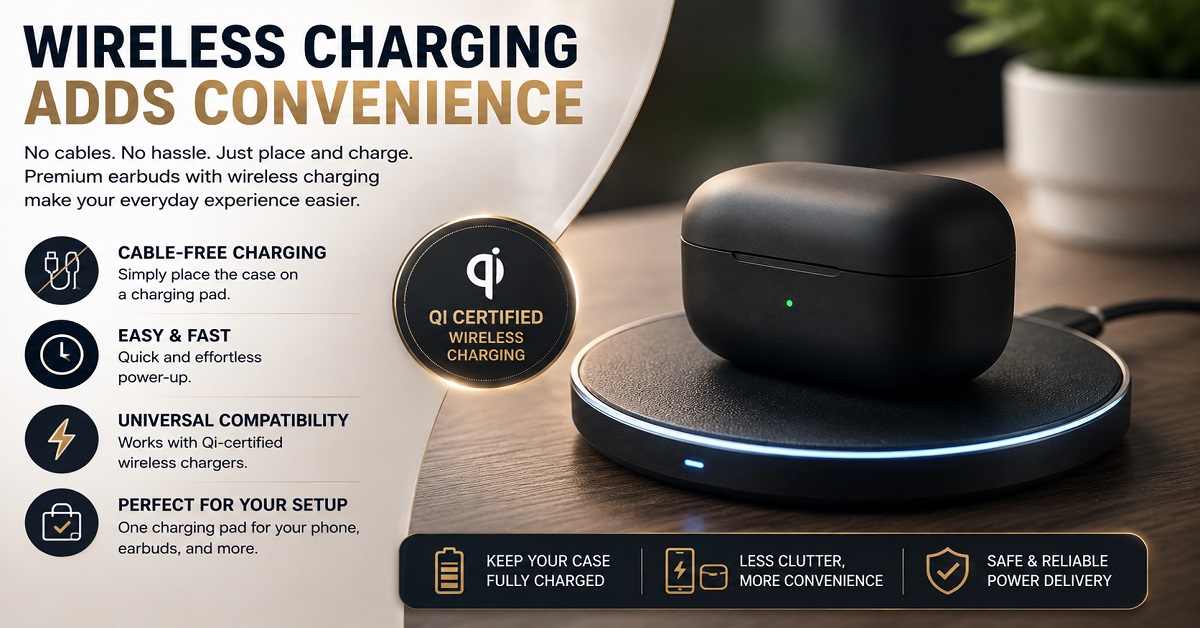
Some premium earbuds include wireless charging cases.
Wireless charging doesn’t improve sound quality.
It simply makes charging easier.
You place the case on a compatible charging pad instead of connecting a cable.
For someone who already uses wireless charging for their smartphone or smartwatch, this can be convenient because several devices can share the same charging setup.
However, it is also a feature you shouldn’t overvalue.
If you don’t mind using a USB-C cable, wireless charging alone is not a good reason to spend thousands of rupees more.
14. Multipoint Connectivity Is More Useful Than It Sounds
Multipoint connectivity is another feature commonly found in better earbuds.
It allows the earbuds to maintain connections with multiple compatible devices, depending on the model.
For example, you might connect your earbuds to:
Laptop + smartphone
You could be listening to music on your laptop when a phone call arrives.
Instead of manually disconnecting from the laptop and connecting to your phone, the earbuds can switch between devices more conveniently.
This can be extremely useful for people who work from home or use earbuds for both work and personal listening.
Consider a typical workday.
You are attending a video meeting on your laptop. After the meeting, you pick up your phone and play music.
With a good multipoint implementation, the transition can be much easier.
For someone who uses only one smartphone, however, multipoint may provide very little additional value.
15. Premium Apps and Software Features
Another part of the price goes into software.
Most major premium earbuds come with a companion smartphone app.
The app may allow you to:
- Adjust EQ
- Change ANC levels
- Customize controls
- Configure listening modes
- Create sound profiles
- Update firmware
- Check battery levels
- Configure spatial audio
- Manage connected devices
The quality of this software experience can have a surprisingly large impact on everyday usability.
Imagine buying expensive earbuds with excellent hardware but an unreliable app that constantly disconnects or makes it difficult to change settings.
That can become frustrating quickly.
Premium brands therefore spend money developing and maintaining software after the product has been launched.
16. Firmware Updates Can Improve the Product
A modern pair of wireless earbuds isn’t necessarily finished when you purchase it.
Manufacturers can release firmware updates that change how the earbuds work.
These updates can potentially improve:
- Connectivity
- Battery management
- ANC performance
- Call quality
- Stability
- Compatibility
- Existing features
Some products can even receive new features through software updates.
This is one of the biggest differences between modern wireless earbuds and traditional wired earphones.
A wired earphone generally does what it did when you bought it.
Wireless earbuds can evolve through software.
That doesn’t mean every manufacturer provides years of major updates, so software support should still be considered when comparing expensive models.
17. Research and Development Costs Money
One of the biggest costs you don’t see on the product box is research and development.
Before a premium earbud reaches the market, manufacturers may spend years working on:
- Acoustic designs
- Driver development
- Noise cancellation algorithms
- Wireless connectivity
- Battery optimization
- Microphone processing
- Comfort and ergonomics
- Software
- Manufacturing processes
- Reliability testing
A company doesn’t simply design one earbud and immediately start selling it.
There can be multiple prototypes and testing stages before the final product is ready.
This is especially important for technologies such as ANC and personalized audio.
The physical hardware is only one part of the problem.
Manufacturers also need algorithms that can process sound quickly and reliably while consuming very little power.
All of this development adds to the final cost of the product.
18. Testing and Quality Control Also Add to the Price
Premium products generally go through extensive testing before they reach customers.
Manufacturers need to make sure that thousands or millions of units behave consistently.
Testing can cover areas such as:
- Battery performance
- Charging
- Bluetooth connectivity
- Microphone performance
- Driver performance
- Temperature
- Physical durability
- Water and dust resistance
- Buttons and touch controls
- Charging contacts
This is important because a premium product is expected to provide a consistent experience.
Of course, no manufacturer can eliminate every defect.
Even expensive earbuds can develop problems.
This is why warranty and after-sales support should be part of your buying decision.
19. Brand Reputation Also Influences the Price
This is where things become more complicated.
When you buy earbuds from a major audio company, you aren’t paying only for components.
Part of the price can reflect the company’s:
- Brand reputation
- Engineering expertise
- Product development
- Customer support
- Distribution network
- Warranty infrastructure
- Marketing
- Retail presence
Some brands have decades of experience developing headphones and audio equipment.
That expertise has value.
But branding can also increase prices beyond what the hardware alone might suggest.
Therefore, don’t assume that a famous logo automatically means better value.
The goal is to determine whether the product’s actual performance and features justify its price.
20. Does a ₹25,000 Earbud Sound Five Times Better Than a ₹5,000 Earbud?
This is one of the most important questions to understand.
No.
Audio quality doesn’t increase proportionally with price.
A ₹20,000 earbud isn’t necessarily four times better than a ₹5,000 earbud.
In fact, the difference can be much smaller than the price difference suggests.
Think of it this way.
A mid-range earbud might already provide:
- Good sound
- Decent ANC
- Good battery life
- Reliable Bluetooth
- Comfortable fit
- Useful app features
A premium model may improve several of those areas.
But you are paying for the combination of improvements, not necessarily one massive improvement.
For example, a premium earbud might offer:
- Better ANC
- Better call quality
- More detailed sound
- Better transparency mode
- More comfortable design
- Better codec support
- Wireless charging
- Personalized audio
- More advanced software
None of these features alone may justify a huge price increase.
But if you regularly use all of them, the premium model can make sense.
This is why the value of premium earbuds depends heavily on how you use them.
21. When Paying More for Premium Earbuds Makes Sense
Premium earbuds can be worth the money if you regularly use the features that make them different.
You may benefit from spending more if you:
Travel frequently
If you spend a lot of time on flights, trains or buses, effective ANC can significantly improve your listening experience.
Listen to music seriously
If you pay attention to vocals, instruments, separation, detail and soundstage, investing in better-tuned earbuds may be worthwhile.
Spend hours on calls
Better microphones and voice-processing technology can make premium earbuds useful for work.
Use multiple devices
Multipoint connectivity can save time if you regularly move between a phone, laptop and tablet.
Wear earbuds for several hours
Comfort becomes extremely important during long listening sessions.
Want advanced customization
If you enjoy adjusting EQ, creating sound profiles or experimenting with different listening modes, premium apps can provide more flexibility.
Want flagship ANC
If reducing background noise is your main priority, premium earbuds can offer some of the most advanced ANC available.
The key is that you should be paying for features you will actually use, not simply paying for a premium label.
When Premium Earbuds Are Not Worth the Extra Money
Premium earbuds can be excellent, but that doesn’t mean everyone should buy the most expensive model available.
In many cases, a mid-range pair can provide everything you actually need.
The important question isn’t simply “Are premium earbuds better?”
They usually are.
The better question is:
“Will I notice and use those improvements enough to justify the extra money?”
22. When You Shouldn’t Spend More on Premium Earbuds
If you mainly use earbuds for YouTube, casual music, phone calls and occasional travel, spending ₹20,000 or ₹30,000 may not be necessary.
A much cheaper pair can already provide a satisfying experience.
You may not need:
- Lossless Bluetooth codecs
- Advanced spatial audio
- Personalized sound profiles
- Multiple ANC modes
- Wireless charging
- Extensive EQ controls
- Premium materials
- Advanced multipoint connectivity
For a casual listener, these features can look impressive on a specification sheet without making a meaningful difference in everyday use.
Example
Suppose you normally listen to music while travelling to work.
You use your earbuds for about 45 minutes each way, mostly at moderate volume.
If a ₹5,000 pair gives you comfortable fit, decent ANC, good battery life and enjoyable sound, moving to a ₹20,000 pair may not transform your daily experience.
You might hear some improvements.
But whether those improvements are worth another ₹15,000 is a personal decision.
23. Don’t Buy Premium Earbuds Just for the Codec
Bluetooth codecs are one of the most confusing parts of wireless audio.
You may see terms such as:
- SBC
- AAC
- aptX
- aptX Adaptive
- aptX Lossless
- LDAC
- LC3
It is tempting to assume that the earbud supporting the most advanced codec will automatically sound the best.
That’s not necessarily true.
The codec is only one part of the audio chain.
Your phone or computer also needs to support the codec.
The earbuds need to support it.
The software needs to use it correctly.
And the rest of the acoustic system still matters.
A well-tuned earbud using a more common codec can sound more enjoyable than a poorly tuned earbud using a technically advanced codec.
So don’t choose an earbud based solely on the longest list of codec names.
24. ANC Quality Can Be More Important Than Maximum Volume
Another common mistake is judging earbuds by how loud they can get.
Louder doesn’t automatically mean better.
In fact, good ANC can make you enjoy music at a lower volume because less background noise is competing with your music.
This can be particularly useful during travel.
Imagine sitting inside a noisy bus.
With weak noise isolation, you may increase the volume to hear vocals clearly.
With better passive isolation and ANC, you may be able to keep the volume lower while still hearing the music properly.
This is one reason premium ANC earbuds can be worthwhile for frequent travellers.
But if you mostly listen at home in a quiet room, paying a large premium for the best possible ANC may not make much sense.
25. Sound Quality Is Personal
This is probably the most important point in the entire article.
There is no single sound signature that every audiophile will prefer.
Some listeners enjoy strong bass.
Others prefer a neutral presentation.
Some like warm vocals.
Others prefer a brighter sound with more emphasis on treble detail.
Some people want a wide soundstage.
Others care more about punch and energy.
This means a ₹25,000 earbud can sound worse to you than a ₹10,000 model simply because its tuning doesn’t match your preference.
That’s why professional reviews, specifications and customer opinions should be treated as guidance rather than absolute truth.
If possible, listen to an earbud before buying it.
If that isn’t possible, look for reviews that describe the sound signature clearly rather than simply saying that the product “sounds amazing.”
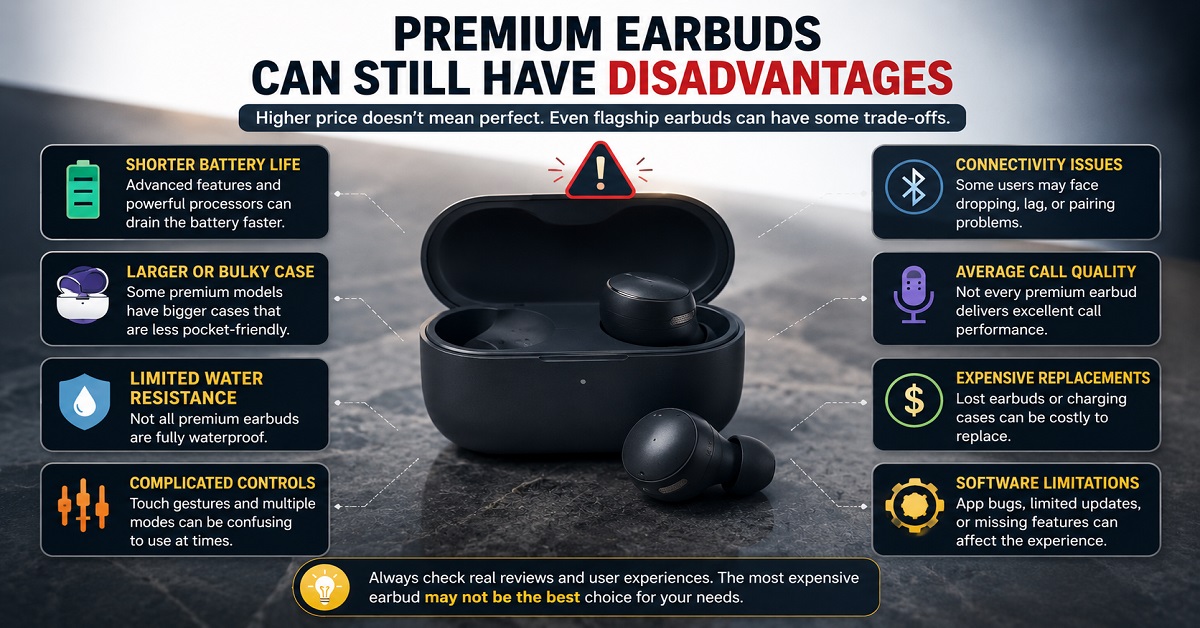
26. Premium Earbuds Can Still Have Disadvantages
A higher price doesn’t eliminate compromises.
Even flagship earbuds can have weaknesses.
For example, a premium model might have:
- Shorter battery life than a cheaper competitor
- A large charging case
- A heavy earbud design
- Limited water resistance
- Complicated controls
- Average call quality
- Expensive replacement accessories
- Software limitations
- Compatibility restrictions
Some premium earbuds also focus heavily on one area.
One model may have outstanding ANC but average battery life.
Another may have exceptional sound but weaker microphone performance.
Another may have excellent comfort but fewer smart features.
This is why comparing the complete package is more useful than looking at the price tag.
27. What Makes a Premium Earbud Actually Worth Buying?
A premium earbud becomes easier to recommend when several important areas are strong at the same time.
1. Excellent sound
The tuning should suit your listening preferences and deliver good detail, separation and clarity.
2. Effective ANC
If the earbuds are marketed as noise-cancelling models, the ANC should provide a noticeable improvement in noisy environments.
3. Comfortable fit
You should be able to wear them for long periods without constant pressure or discomfort.
4. Good call quality
Multiple microphones and voice-processing technology should result in clear communication.
5. Reliable connectivity
Bluetooth should connect quickly and remain stable during everyday use.
6. Useful software
The companion app should make it easy to control and customize the earbuds.
7. Good battery performance
Battery life should be appropriate for your usage rather than simply looking impressive on paper.
8. Strong build quality
The earbuds and case should feel capable of handling normal daily use.
9. Useful long-term features
Multipoint, firmware updates, wireless charging and customizable controls can add value if you actually use them.
When a premium earbud gets most of these things right, its higher price becomes easier to understand.
28. What Should You Check Before Buying Expensive Earbuds?
Before spending a large amount of money, don’t just look at the product’s headline features.
Use this checklist.
Check the sound signature
Ask yourself what type of music you listen to most.
If you enjoy classical, acoustic or vocal-heavy music, you may prioritize clarity, separation and natural tuning.
If you listen mostly to electronic, hip-hop or Bollywood music, you may prefer a more energetic bass response.
There is no universally correct answer.
Check the fit
Look at the earbud shape and the included ear tips.
If possible, try them before buying.
Comfort is particularly important when you are spending a lot of money.
Check the ANC
Don’t simply look for the words “Active Noise Cancellation.”
Look at how well the particular model performs in real-world situations.
Low-frequency sounds such as airplane engines, buses and air conditioners are different from voices and sudden noises.
Check the battery figures carefully
Manufacturers may provide different battery figures depending on whether ANC, spatial audio or other features are enabled.
Don’t assume the maximum advertised number represents your everyday battery life.
Check device compatibility
This is especially important if you use Android, iPhone, Windows and other devices together.
Some features may work differently depending on the connected device.
Check the app
A good app can make an expensive pair of earbuds much easier to live with.
Look for EQ controls, firmware updates, listening modes and customization options.
Check the warranty
A premium purchase deserves proper after-sales support.
Before buying, check the warranty period and how service works in your region.
Check replacement costs
This is something many buyers forget.
Ear tips can wear out.
Charging cases can be lost or damaged.
Batteries eventually degrade.
Replacement parts may be expensive or difficult to find for some models.
The purchase price is not always the complete cost of ownership.
29. Premium Earbuds vs Mid-Range Earbuds
So, what do you generally get when moving from a mid-range pair to a premium model?
| Feature | Mid-range earbuds | Premium earbuds |
|---|---|---|
| Sound quality | Good | Usually more refined |
| ANC | Basic to good | Often more advanced |
| Transparency mode | Available on many models | Usually more natural |
| Microphones | Good | Often more sophisticated |
| Codec support | Basic to advanced | More advanced options |
| EQ | Basic | More customization |
| Multipoint | Model-dependent | More common |
| Build quality | Good | Usually more refined |
| Comfort | Model-dependent | Often more attention to ergonomics |
| Wireless charging | Less common | More common |
| Personalized audio | Limited | More common |
| Spatial audio | Model-dependent | More advanced on some models |
| App features | Basic to good | Usually more comprehensive |
| Price | Lower | Higher |
The table shows why premium earbuds cost more, but it also reveals something important.
You don’t necessarily need every premium feature.
If you only care about sound and comfort, you may be better off buying a product that focuses on those areas instead of paying for features you will never use.
30. The Law of Diminishing Returns in Earbuds
There is a point where spending more produces smaller improvements.
For example, moving from a very cheap pair to a good mid-range pair can produce a major improvement.
You may notice:
- Cleaner vocals
- Better bass control
- Less distortion
- Better comfort
- More reliable connectivity
- Better microphones
Moving from that good mid-range pair to a premium flagship may still improve the experience.
But the difference is usually more subtle.
You might notice better instrument separation, more refined tuning, stronger ANC or a more natural presentation.
The improvement is real, but it may not feel proportional to the increase in price.
This is known as the law of diminishing returns.
It doesn’t mean premium earbuds are overpriced.
It means their value depends increasingly on how much you care about the final improvements.
31. Who Should Buy Premium Earbuds?
Premium earbuds make the most sense for people who spend a lot of time listening.
They are particularly suitable for:
Frequent travellers: Better ANC can make long journeys more comfortable.
Music enthusiasts: Better tuning, drivers and processing can make detailed listening more enjoyable.
Office professionals: Better microphones, multipoint and transparency modes can be genuinely useful.
Heavy daily users: Comfort and battery management become more important when earbuds are worn for several hours every day.
Technology enthusiasts: Advanced codecs, spatial audio, personalized sound and other features may justify the higher cost.
32. Who Should Buy Mid-Range Earbuds Instead?
You probably don’t need premium earbuds if you:
- Mostly listen casually
- Use earbuds for short periods
- Rarely travel
- Don’t care about advanced ANC
- Don’t use multiple devices
- Don’t need wireless charging
- Are satisfied with basic EQ controls
- Have a limited budget
A good mid-range earbud can provide an excellent experience without the premium price.
And that’s something buyers should remember.
You don’t need expensive earbuds to enjoy good music.
Premium earbuds are about getting a more refined overall experience, not gaining access to music that cheaper earbuds cannot play.
33. The Best Way to Decide If Premium Earbuds Are Worth It
Before buying, make a simple list of your top three priorities.
For example:
Priority 1: ANC
Priority 2: Sound quality
Priority 3: Comfort
Now compare products based on those three factors.
Don’t give equal importance to ten different features if you only care deeply about three.
Another buyer might choose:
Priority 1: Sound quality
Priority 2: Battery life
Priority 3: Multipoint
That person may end up choosing a completely different earbud.
This approach helps prevent you from paying extra for features that look impressive but don’t improve your actual listening experience.
34. Premium Doesn’t Always Mean the Most Expensive
There is an important difference between premium and expensive.
A product can be extremely expensive without being the best choice for you.
Likewise, a relatively affordable premium earbud can offer excellent sound and features.
The best purchase is the one that gives you the features and performance you value at a price you are comfortable paying.
For example, if a ₹15,000 pair provides 90% of what you want and a ₹30,000 model adds features you don’t need, buying the cheaper option may be the smarter decision.
On the other hand, if you travel frequently and the more expensive model has significantly better ANC and comfort, the additional cost may be justified.
Value is personal.
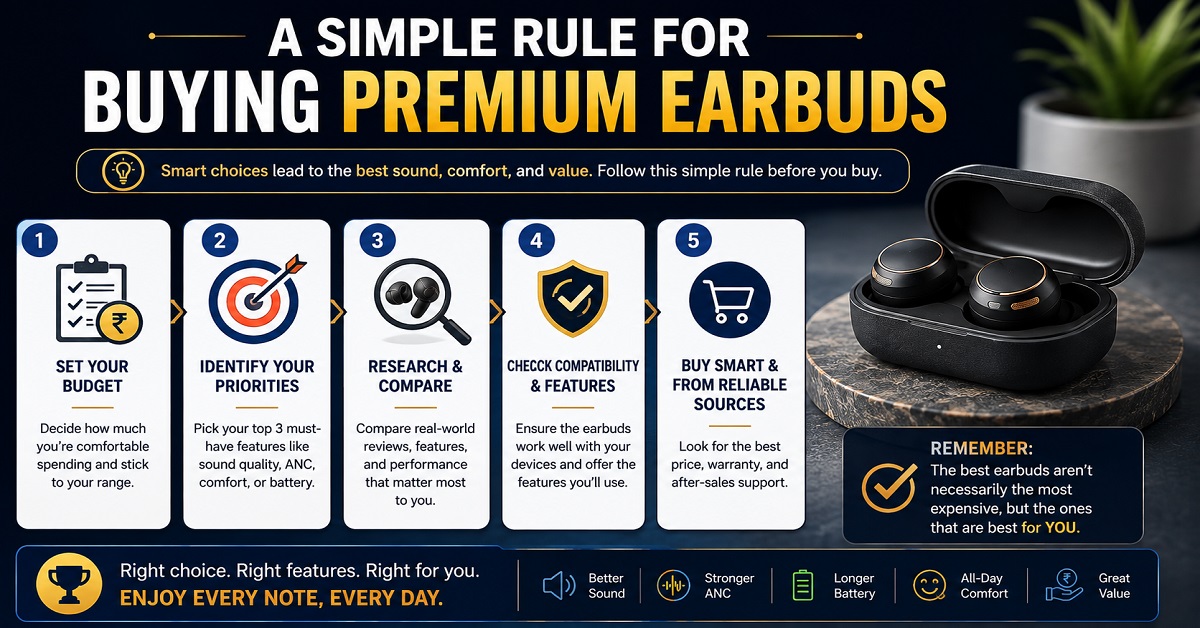
35. A Simple Rule for Buying Premium Earbuds
Before you spend ₹15,000, ₹20,000, ₹30,000 or more on earbuds, ask yourself one question:
“What am I getting for the extra money that I will actually use?”
If you have a clear answer, the purchase is easier to justify.
If your answer is simply “because they are a flagship model,” take another look at your options.
Premium earbuds cost more because manufacturers are combining better hardware, more advanced software, acoustic engineering, ANC, microphones, materials, testing and long-term product development into a very small device.
But you don’t have to pay for all of it.
The smartest buyer identifies the features that genuinely matter to them and chooses accordingly.
Are Premium Earbuds Actually Worth the Money?
36. What Are You Really Paying for When You Buy Premium Earbuds?
After looking at all these features, it becomes easier to understand why premium earbuds can cost so much more than budget models.
You aren’t necessarily paying ₹20,000 or ₹30,000 for a single component.
Instead, you’re paying for the combination of many improvements packed into an extremely small device.
The additional cost can go toward:
- Better drivers
- More advanced acoustic engineering
- Improved ANC
- More microphones
- Better voice processing
- Advanced Bluetooth technology
- Better sound tuning
- Personalized audio
- Improved comfort
- Better materials
- More sophisticated processors
- Wireless charging
- Better apps
- Firmware development
- Research and development
- Testing and quality control
- Warranty and after-sales support
The important thing to understand is that not all of these improvements will matter equally to every buyer.
For one person, better ANC may be worth paying an extra ₹10,000.
For another, improved sound quality may be the main reason to upgrade.
Someone else may care most about comfort and multipoint connectivity.
That’s why there isn’t a universal answer to whether premium earbuds are worth their price.
37. Which Premium Features Are Worth Paying More For?
If you’re working with a limited budget, you don’t have to pay for every premium feature.
Instead, focus on the features that can make a noticeable difference to your daily use.
Better ANC
Worth paying more for if you travel frequently or spend time in noisy environments.
Better sound quality
Worth paying more for if you listen to music regularly and can appreciate differences in tuning, detail and separation.
Better comfort
Worth paying more for if you wear earbuds for several hours every day.
Better microphones
Worth paying more for if you frequently attend calls or online meetings.
Multipoint connectivity
Worth paying more for if you regularly switch between your phone and laptop.
Personalized sound
Worth considering if you enjoy experimenting with EQ or want an audio profile tailored to your hearing and preferences.
Advanced codecs
Worth considering if you have a compatible smartphone and high-quality music sources that can actually take advantage of them.
Wireless charging
A useful convenience, but rarely something that should determine your entire purchase.
The basic rule is simple:
Pay more for features you will use frequently, not features that simply look impressive on the specification sheet.
38. What Features Are Often Overrated?
Not every premium feature deserves equal attention.
Some specifications can sound impressive without making a major difference to your everyday experience.
Extremely large driver sizes
A larger driver doesn’t automatically produce better sound.
The driver design, acoustic system and tuning matter more than the number printed on the box.
Very high volume
You don’t need extremely loud earbuds to get good sound.
In fact, consistently listening at very high volumes can be harmful to your hearing.
Long codec lists
Supporting five different codecs isn’t necessarily better than supporting two well-implemented codecs that work with your devices.
Huge battery numbers
Battery life is important, but you should look at realistic usage with ANC and other features enabled rather than relying only on the maximum advertised figure.
Too many listening modes
Having ten different modes isn’t necessarily useful if you only use two of them.
Premium materials for the sake of appearance
A beautiful metal finish may look impressive, but it doesn’t necessarily improve sound quality or comfort.
This is why specifications should help you narrow down your choices, not make the final decision for you.
39. Premium Earbuds vs Wired Earphones
If sound quality is your absolute top priority, you may also wonder whether premium wireless earbuds are worth buying at all.
A good wired earphone can offer excellent sound without needing a battery, Bluetooth connection, charging case or wireless processor.
It can also avoid some of the limitations associated with wireless audio.
However, wireless earbuds offer something that wired earphones cannot easily match:
convenience.
There is no cable getting caught on your clothes.
You can quickly put them in your ears when leaving home.
ANC can help during travel.
Transparency mode lets you hear your surroundings.
Multipoint can make them useful for work.
And the charging case gives you a compact way to carry and recharge them.
So premium wireless earbuds are not simply competing on sound quality.
They are competing on the complete listening experience.
40. Why Premium Earbuds Can Be a Better Long-Term Purchase
There is another factor worth considering: how often you use them.
Suppose you buy a ₹5,000 pair and use it for one year before replacing it.
Then you purchase another pair because you want better ANC, comfort and call quality.
You may eventually spend more than you expected.
Now imagine buying a ₹15,000 pair that you genuinely enjoy and use for several years.
The initial purchase is much more expensive, but the value can be better if the product meets your needs for longer.
Of course, wireless earbuds contain batteries that naturally degrade over time, so no pair should be expected to last forever.
Still, buying a product that meets your needs from the beginning can sometimes be better than repeatedly upgrading because your cheaper earbuds lack features you actually want.
41. Don’t Ignore Your Smartphone
One mistake buyers often make is choosing premium earbuds without considering the device they will use them with.
Your smartphone can affect which features are available.
For example, certain Bluetooth codecs may only work with compatible phones.
Some advanced features may also be limited depending on the operating system.
Therefore, before buying premium earbuds, check:
- Your phone’s Bluetooth support
- Supported audio codecs
- Companion app compatibility
- Available features on Android and iPhone
- Multipoint compatibility
- Firmware update support
A premium earbud can have excellent technology, but you need a compatible device to take advantage of it.
42. Don’t Forget the Ear Tips
Here’s another surprisingly important point.
The ear tips can affect your experience more than you might expect.
If the ear tips don’t create a good seal, you may experience:
- Weaker bass
- More outside noise
- Poorer ANC
- Less stable fit
- Lower perceived sound quality
This means you could buy a ₹20,000 pair of earbuds and think they don’t sound impressive simply because you’re using the wrong ear tip size.
Try all the included sizes.
Give each one some time.
The best fit isn’t necessarily the one that feels tightest.
You want a secure seal without creating uncomfortable pressure.
43. Don’t Confuse Reviews With Your Personal Experience
Reviews are useful because you can’t always try every earbud before buying it.
But remember that reviewers have different ears, preferences and usage patterns.
One reviewer might describe an earbud as bass-heavy.
Another might call the same earbud balanced.
Neither person necessarily has to be wrong.
Their experience can depend on:
- Ear shape
- Ear tip choice
- Music preference
- Listening volume
- Source device
- Codec
- Previous experience with other headphones
This is particularly important when reading about sound quality.
Instead of looking for a review that says “this is the best sounding earbud”, look for one that explains how it sounds.
Descriptions such as warm, neutral, bright, bass-heavy, detailed or relaxed are more useful because you can compare them with your own preferences.
44. A Practical Premium Earbud Buying Strategy
If you have decided to buy premium earbuds, here’s a simple way to approach the purchase.
Step 1: Decide your budget
Don’t start by looking at the most expensive models.
Decide what you’re comfortable spending first.
For example:
Under ₹10,000: Focus on strong value.
₹10,000 to ₹20,000: Look for a good balance between sound, ANC and features.
₹20,000 to ₹30,000: You can start considering flagship-level sound, ANC and personalization.
Above ₹30,000: Carefully evaluate whether the additional improvements justify the premium.
These aren’t strict categories, and prices change frequently, but they can help you narrow down your options.
Step 2: Choose your top priorities
Pick your three most important features.
For example:
Music lover: Sound quality + comfort + codec support
Frequent traveller: ANC + comfort + battery
Office professional: Microphones + multipoint + comfort
Fitness user: Fit + durability + battery
Step 3: Compare actual performance
Now compare products based on those priorities.
Don’t let an impressive specification sheet distract you from what matters.
Step 4: Check current pricing
Premium earbuds can receive substantial discounts during sales.
A product that costs ₹25,000 at launch might become much more attractive if it drops to ₹18,000 or ₹20,000 later.
Therefore, always check the current price before purchasing.
Step 5: Check the warranty and seller
When spending a significant amount on earbuds, make sure you’re buying from a reliable seller and check the warranty terms.
A lower price isn’t necessarily a bargain if after-sales support becomes difficult.
45. Common Mistakes to Avoid When Buying Premium Earbuds
Mistake 1: Assuming the most expensive model is the best
Price and performance don’t increase at the same rate.
Mistake 2: Buying based only on specifications
A long list of features doesn’t tell you how the product actually sounds or feels.
Mistake 3: Ignoring comfort
Even excellent earbuds become useless if you can’t wear them comfortably.
Mistake 4: Ignoring your phone
Some premium features depend on your smartphone and operating system.
Mistake 5: Choosing ANC when you don’t need it
If you mostly listen at home, spending heavily on the best ANC may not be worthwhile.
Mistake 6: Ignoring the sound signature
A technically excellent earbud may still sound wrong to you.
Mistake 7: Buying immediately at launch price
If you aren’t in a hurry, waiting for discounts can significantly improve the value proposition.
Mistake 8: Forgetting battery replacement limitations
True wireless earbuds have small built-in batteries that eventually lose capacity.
Consider the expected lifespan of the product before spending a very large amount.
46. Are Premium Earbuds Worth It?
Yes, premium earbuds can absolutely be worth the money, but only for the right buyer.
If you care deeply about sound quality, use ANC regularly, travel frequently, spend hours on calls or want advanced features and customization, the improvements offered by premium earbuds can make the higher price worthwhile.
But if you simply want something for casual music, YouTube and occasional calls, you don’t need to spend ₹20,000 or ₹30,000.
Today’s mid-range earbuds can already offer excellent sound, decent ANC, good battery life and reliable connectivity.
The biggest mistake is thinking that expensive automatically means better value.
Instead, think about what you actually use.
If a premium feature improves your experience every single day, paying extra for it can make sense.
If you never use that feature, you’re simply paying for something you don’t need.
FAQs About Premium Earbuds
Premium earbuds can cost more because manufacturers invest in better drivers, acoustic engineering, ANC hardware, microphones, processors, wireless technology, software, comfort, testing and research and development. The price reflects the complete product rather than one individual component.
Are expensive earbuds really better?
Expensive earbuds are often better in areas such as sound refinement, ANC, call quality, comfort and smart features, but they aren’t automatically better for every listener. A cheaper earbud with a sound signature you prefer may be a better choice for you.
There is no fixed amount that everyone should spend. Start with your budget and priorities. If you mainly want good sound and basic features, a mid-range model may be enough. If you want flagship ANC, advanced codecs, personalized audio and premium comfort, spending more may make sense.
Do expensive earbuds have better sound quality?
They often can, thanks to better drivers, acoustic design, tuning and processing. However, sound quality is subjective, and a more expensive earbud may not sound better to you if its tuning doesn’t match your preference.
Usually, you don’t need to spend a large amount if you’re a casual listener. A good mid-range pair can provide excellent sound and useful features without the premium price.
Does a bigger driver mean better sound?
No. Driver size alone doesn’t determine sound quality. Driver design, materials, acoustic structure, tuning and digital processing all influence the final sound.
Is ANC worth paying more for?
If you frequently travel or spend time in noisy environments, high-quality ANC can be worth paying extra for. If you mostly listen at home in quiet surroundings, you may not need the most advanced ANC available.
Not necessarily. Premium earbuds may have better construction and components, but all true wireless earbuds contain batteries that naturally degrade over time. Proper care and a good warranty are important.
Not always. Over-ear headphones can offer larger drivers, a wider physical design and potentially better sound performance. Premium earbuds have the advantage of portability, convenience, ANC and a compact form factor.
Choose premium earbuds if you will genuinely use their advanced sound, ANC, comfort, microphone or connectivity features. Otherwise, a good mid-range pair may offer better value for your money.
Final Verdict
So, why do premium earbuds cost more?
Because there is much more going on inside them than meets the eye.
A premium pair of true wireless earbuds may combine carefully designed drivers, sophisticated ANC, multiple microphones, advanced processors, wireless audio technology, personalized sound, better ergonomics, software features and extensive testing into two tiny devices.
But the higher price doesn’t automatically make them the right choice for everyone.
The best way to decide is to ignore the prestige of the price tag and ask a much simpler question:
What will I actually notice and use?
If you travel frequently, excellent ANC may be worth paying for.
If you’re passionate about music, better tuning and detail may justify the upgrade.
If you work through earbuds every day, comfort, microphones and multipoint connectivity can be more valuable than flashy audio features.
And if you’re a casual listener, a good mid-range pair may give you almost everything you need for much less money.
In the end, the best earbuds aren’t necessarily the most expensive ones. They’re the ones that deliver the features and performance that matter most to you at a price you’re comfortable paying.
That is the real reason premium earbuds cost more, and more importantly, that is how you can decide whether they’re worth it for you.

About the Author
Hari Prasad is the editor of AudioPick.in and a lifelong audio enthusiast. He writes detailed, honest reviews and guides to help everyday users pick the right gear without tech jargon. His personal interest in Bluetooth audio, neckbands, and codecs comes from testing dozens of devices over the past few years.