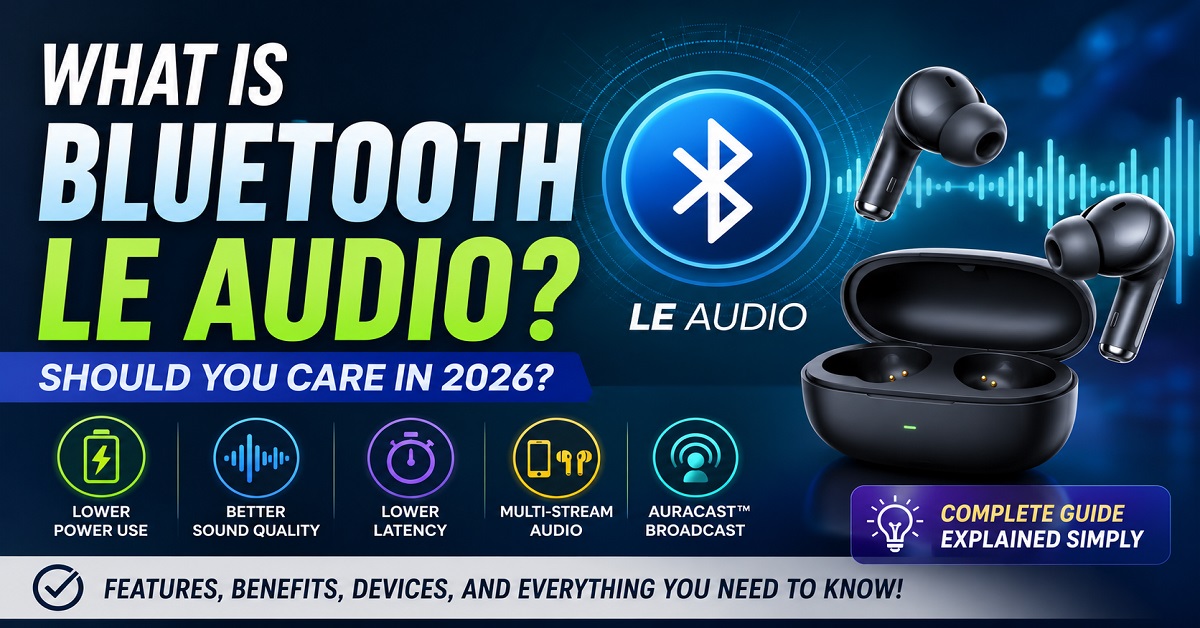
If you’ve been shopping for wireless earbuds recently, you may have noticed a new feature called Bluetooth LE Audio in the specifications. Brands like OnePlus, Samsung, Sony, JBL, and Realme are gradually bringing this technology to their latest earbuds and headphones. But what exactly is Bluetooth LE Audio, and is it something you should actually care about?
The name itself can be confusing. Many people assume it’s simply a newer version of Bluetooth or that it automatically delivers better sound quality. Others think it’s only useful for expensive flagship earbuds. In reality, Bluetooth LE Audio is much more than that. It’s a major upgrade to how wireless audio is transmitted, offering better efficiency, improved sound quality, lower power consumption, and exciting new features that weren’t possible with older Bluetooth audio technology.
In this guide, we’ll explain Bluetooth LE Audio in simple language, without using confusing technical jargon. You’ll learn how it works, what makes it different from traditional Bluetooth audio, its advantages and limitations, which devices support it, and whether it’s worth considering when buying your next pair of earbuds or headphones.
By the end of this article, you’ll know whether Bluetooth LE Audio is just another marketing term or a feature that can genuinely improve your everyday listening experience.
Similar Post: What Is Bluetooth Multipoint Connectivity and How Does It Work?
Quick Answer
Bluetooth LE Audio is a next-generation wireless audio technology built on Bluetooth Low Energy (LE). It is designed to deliver better sound quality while using less battery power than traditional Bluetooth audio.
It also introduces new features like:
- Better audio quality with the LC3 codec
- Lower battery consumption
- Improved connection stability
- Lower latency for gaming and videos
- Auracast™ audio broadcasting (supported devices)
If you’re planning to buy new earbuds or headphones in 2026, Bluetooth LE Audio is definitely a feature worth considering, especially if you want better efficiency and future-ready technology.
What Is Bluetooth LE Audio?
Simply put, Bluetooth LE Audio is a new way of sending audio wirelessly between your smartphone, laptop, TV, or tablet and your earbuds or headphones.
To understand it better, let’s first look at how most wireless earbuds have worked for years.
Traditional Bluetooth audio uses a system called Bluetooth Classic. While it has served us well, it wasn’t designed with today’s audio needs in mind. As wireless earbuds became more advanced, users started expecting better sound quality, longer battery life, lower latency, and smarter connectivity.
Instead of making small improvements to the old system, the Bluetooth Special Interest Group (Bluetooth SIG), the organization behind Bluetooth technology, introduced Bluetooth LE Audio as a completely new audio platform built on Bluetooth Low Energy.
Despite the name, the “LE” in Bluetooth LE Audio doesn’t simply mean “low energy.” It represents a smarter and more efficient way of transmitting audio while consuming significantly less power.
Think of it like upgrading from an older petrol car to a modern hybrid car. Both will get you to your destination, but the newer one uses fuel more efficiently, offers more features, and provides a smoother driving experience.
Bluetooth LE Audio follows the same idea. It allows devices to deliver better wireless audio while using less battery power.
Why Was Bluetooth LE Audio Developed?
Wireless earbuds have improved dramatically over the last few years. Modern earbuds now include features such as:
- Active Noise Cancellation (ANC)
- Transparency Mode
- Spatial Audio
- High-Resolution Audio
- Multipoint Connectivity
- AI-powered call noise reduction
All these features require more efficient communication between your earbuds and the connected device.
Older Bluetooth audio technology wasn’t originally designed to handle all these modern requirements efficiently.
Some common problems with traditional Bluetooth audio include:
- Faster battery drain
- Limited audio efficiency
- Higher latency in certain situations
- Difficulty supporting advanced broadcasting features
- Less efficient use of available bandwidth
Bluetooth LE Audio was created to solve these issues while also preparing wireless audio for the future.
Instead of simply increasing Bluetooth speed, engineers focused on making every bit of transmitted data more efficient.
The result is a technology that can provide better audio quality while consuming less power.
That’s a rare combination because, in most cases, improving quality usually requires more battery. Bluetooth LE Audio manages to improve both at the same time.
How Does Bluetooth LE Audio Work?
Don’t worry, you don’t need an engineering degree to understand this.
Let’s break it down into a simple example.
Imagine you want to send a large photo to your friend.
There are two ways you could do it.
Method 1
You send the original photo without any optimization.
The image looks great, but it’s large, takes longer to transfer, and uses more mobile data.
That’s similar to older Bluetooth audio.
Method 2
You intelligently compress the image.
The photo still looks almost identical, but now:
- It transfers faster.
- It uses less data.
- It finishes sooner.
- It consumes less battery.
That’s the basic idea behind Bluetooth LE Audio.
Instead of sending audio the old way, Bluetooth LE Audio uses a much more efficient method of compressing and transmitting sound.
The biggest reason it can do this is because it introduces a brand-new audio codec called LC3.
We’ll explain the LC3 codec in detail later in this guide, but for now, think of it as a smarter way of packing audio information so that less data needs to be transmitted without sacrificing sound quality.
A Simple Real-Life Example
Imagine you’re watching a movie on your phone while travelling on a train.
With older Bluetooth audio, your earbuds are constantly working harder to receive audio, which can lead to:
- More battery usage
- Slight delays between video and sound
- Less efficient audio transmission
With Bluetooth LE Audio, the communication becomes much more efficient.
Your earbuds receive the same movie audio using less power while maintaining excellent sound quality.
This means you can enjoy your favourite movies, music, or podcasts for longer before needing to recharge your earbuds.
How Bluetooth LE Audio Communicates
Here’s a simplified version of what happens every time you play music:
Step 1
Your smartphone converts the music into digital audio data.
↓
Step 2
The LC3 codec compresses the audio efficiently.
↓
Step 3
Bluetooth LE Audio transmits the compressed audio using Bluetooth Low Energy.
↓
Step 4
Your earbuds receive the data.
↓
Step 5
The earbuds decode the audio and play it through their speakers.
This entire process happens almost instantly, allowing you to enjoy wireless music without noticing the complex technology working behind the scenes.
Does Bluetooth LE Audio Require Special Devices?
Yes.
Both devices must support Bluetooth LE Audio.
For example:
| Device | Bluetooth LE Audio Support Required? |
|---|---|
| Smartphone | ✅ Yes |
| Earbuds/Headphones | ✅ Yes |
If only one device supports Bluetooth LE Audio while the other doesn’t, they’ll usually fall back to traditional Bluetooth audio.
For example:
- A Bluetooth LE Audio-enabled smartphone paired with older earbuds will use traditional Bluetooth audio.
- Likewise, Bluetooth LE Audio earbuds connected to an older phone won’t be able to use Bluetooth LE Audio features.
This is why it’s important to check compatibility before buying new earbuds if you specifically want to take advantage of Bluetooth LE Audio.
Is Bluetooth LE Audio the Same as Bluetooth 5.4?
This is one of the biggest misconceptions among buyers.
The answer is No.
Bluetooth LE Audio and Bluetooth 5.4 are not the same thing.
Bluetooth 5.4 refers to the Bluetooth version, while Bluetooth LE Audio is an audio technology that runs on Bluetooth Low Energy.
In other words:
- Bluetooth 5.4 is like the latest version of a road network.
- Bluetooth LE Audio is the new, more efficient vehicle travelling on that road.
A device can support Bluetooth 5.4 without supporting every Bluetooth LE Audio feature, depending on how the manufacturer has implemented it.
We’ll explain this difference in much more detail in the next section of this guide so you can understand why these terms are often confused and what they actually mean when buying new wireless earbuds.
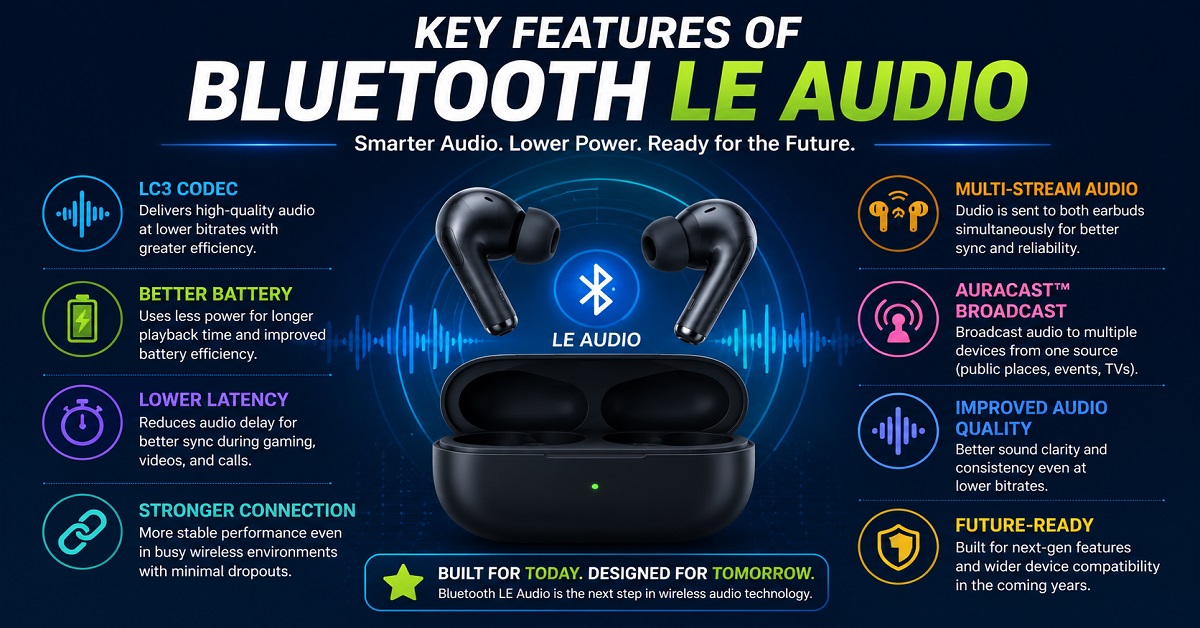
Key Features of Bluetooth LE Audio
Bluetooth LE Audio isn’t just about saving battery. It introduces several improvements that make wireless earbuds smarter, more efficient, and better prepared for future audio experiences.
Let’s look at the most important features one by one.
1. LC3 Codec: The Biggest Upgrade
One of the biggest reasons Bluetooth LE Audio is receiving so much attention is the introduction of a brand-new audio codec called LC3 (Low Complexity Communication Codec).
If you’ve ever read the specifications of wireless earbuds, you’ve probably come across codec names like:
- SBC
- AAC
- aptX
- LDAC
- LHDC
LC3 now joins that list, but it serves a different purpose.
Instead of trying to deliver the highest possible bitrate, LC3 focuses on transmitting audio more efficiently.
Think of it Like This
Imagine you need to pack clothes for a trip.
One person throws everything into a suitcase without organizing it.
Another person folds everything neatly and uses packing cubes.
Both carry the same clothes, but one suitcase takes up less space.
That’s exactly what LC3 does with audio.
It packs the same sound information more efficiently, allowing Bluetooth LE Audio to transmit high-quality audio while using less bandwidth and less battery power.
Why Is LC3 Better?
Compared to the older SBC codec, LC3 offers several advantages.
✔ Better sound quality at lower bitrates
✔ Lower power consumption
✔ More stable wireless transmission
✔ Better performance when the Bluetooth signal is weak
For everyday users, this simply means your earbuds can sound great while lasting longer on a single charge.
Does LC3 Replace LDAC or LHDC?
Not exactly.
This is another common misconception.
Different codecs have different goals.
| Codec | Main Purpose |
|---|---|
| SBC | Basic Bluetooth audio |
| AAC | Optimized for Apple devices |
| LDAC | Very high-resolution audio |
| LHDC | High-resolution wireless audio |
| LC3 | Efficient, low-power, high-quality audio |
If you’re an audiophile listening to lossless music, you may still prefer LDAC or LHDC when available.
However, for everyday music, podcasts, YouTube, Netflix, gaming, and phone calls, LC3 offers an excellent balance between quality and efficiency.
Recommended for you: What Is Hi-Res Audio? Is It Worth It in 2026?
2. Better Battery Efficiency
Battery life is one of the biggest reasons Bluetooth LE Audio was developed.
Since LC3 compresses audio more efficiently, both your earbuds and your smartphone spend less energy transmitting and receiving data.
Real-Life Example
Imagine you’re travelling for an entire day.
With traditional Bluetooth audio, your earbuds might need charging by evening.
With Bluetooth LE Audio, the same earbuds could potentially last longer because they aren’t working as hard to process the audio stream.
Of course, battery life still depends on several other factors, including:
- Active Noise Cancellation
- Volume level
- Codec being used
- Earbud battery size
- Microphone usage
Bluetooth LE Audio doesn’t magically double your battery life, but it helps manufacturers make better use of the available battery.
3. Lower Audio Latency
Latency simply means the delay between your device sending audio and your earbuds playing it.
High latency can cause:
- Lip-sync issues while watching movies
- Delayed footsteps in games
- Audio arriving slightly after the video
Bluetooth LE Audio helps reduce this delay.
Example
Imagine watching a cricket match.
The commentator says “That’s a six!”
With high latency, you might hear the commentary after you’ve already seen the ball cross the boundary.
Bluetooth LE Audio helps keep the sound and picture synchronized much more accurately.
This makes it especially useful for:
- Gaming
- YouTube videos
- Netflix
- Online classes
- Video calls
4. Better Connection Stability
Bluetooth LE Audio is designed to maintain a more reliable wireless connection.
Although Bluetooth technology has improved significantly over the years, people still occasionally experience:
- Audio dropouts
- Short interruptions
- Temporary disconnections
Bluetooth LE Audio helps reduce these issues by transmitting audio more efficiently.
Example
Suppose you’re walking through a crowded shopping mall.
Hundreds of smartphones and wireless devices are operating around you.
Bluetooth LE Audio is better equipped to maintain a stable connection in busy wireless environments.
5. Multi-Stream Audio
This is one of the most exciting improvements.
Older Bluetooth audio often relied on one earbud acting as the “master,” which then forwarded audio to the second earbud.
Bluetooth LE Audio changes this.
Instead, your smartphone can send synchronized audio directly to both earbuds.
Why Is This Better?
It offers several benefits:
- Better synchronization between left and right earbuds
- Lower latency
- Improved reliability
- Reduced chances of one earbud disconnecting
This also improves the experience when using only one earbud at a time.
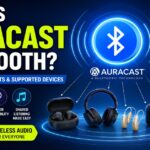
6. Auracast™ Broadcast Audio
Auracast is one of the newest features made possible by Bluetooth LE Audio.
Although it isn’t widely used yet, it has enormous potential.
Instead of pairing your earbuds with just one device, Auracast allows one audio source to broadcast audio to multiple compatible devices simultaneously.
Real-Life Example
Imagine watching a football match at an airport.
Instead of everyone listening through loudspeakers, the airport could broadcast the TV audio directly to passengers wearing compatible Bluetooth LE Audio earbuds.
Each passenger could hear the commentary clearly without increasing the room’s volume.
Other Possible Uses
Auracast could also be useful in:
- Airports
- Railway stations
- Universities
- Museums
- Conference halls
- Gyms
- Public televisions
- Silent entertainment events
As more devices support Bluetooth LE Audio, Auracast is expected to become increasingly common over the next few years.
Bluetooth LE Audio vs Classic Bluetooth Audio
Now that we’ve covered the features, let’s compare Bluetooth LE Audio with the older Bluetooth audio technology most people use today.
| Feature | Bluetooth LE Audio | Classic Bluetooth Audio |
|---|---|---|
| Power Consumption | Lower | Higher |
| Audio Codec | LC3 | SBC, AAC, aptX, etc. |
| Battery Efficiency | Better | Standard |
| Audio Quality | Better at lower bitrates | Depends on codec |
| Multi-Stream Audio | Yes | Limited |
| Auracast Support | Yes | No |
| Latency | Lower | Higher |
| Future Ready | Yes | Older technology |
For most users, Bluetooth LE Audio offers a smarter and more efficient wireless audio experience.
Bluetooth LE Audio vs Bluetooth 5.4
Many buyers confuse these two terms because manufacturers often advertise both together.
Here’s the easiest way to understand the difference.
| Bluetooth LE Audio | Bluetooth 5.4 |
|---|---|
| Audio technology | Bluetooth version |
| Defines how audio is transmitted | Defines overall Bluetooth capabilities |
| Introduces LC3 codec | Introduces protocol improvements |
| Enables Auracast | Doesn’t automatically enable Auracast |
| Focuses on wireless audio | Focuses on Bluetooth communication |
Simple Analogy
Think of Bluetooth 5.4 as a newly built highway.
Bluetooth LE Audio is the modern electric car travelling on that highway.
The highway provides the infrastructure, while the car determines how efficiently you travel.
Both are important, but they serve different purposes.
Advantages of Bluetooth LE Audio
By now, you can probably see why Bluetooth LE Audio is becoming more common in modern earbuds and headphones.
Here are its biggest advantages:
Better Battery Efficiency
Your earbuds can deliver excellent audio while consuming less power.
Improved Sound Quality
Thanks to the LC3 codec, Bluetooth LE Audio delivers better sound than older codecs at similar or even lower bitrates.
Lower Latency
Movies, games, and videos stay more closely synchronized with the audio.
Better Connection Stability
Wireless performance is generally more reliable in crowded environments.
Future-Ready Features
Support for technologies like Auracast makes Bluetooth LE Audio a long-term investment.
Improved Multi-Device Experiences
Multi-stream audio creates a smoother listening experience with true wireless earbuds.
Limitations of Bluetooth LE Audio
Like every technology, Bluetooth LE Audio isn’t perfect.
Here are a few limitations to keep in mind.
Both Devices Must Support It
Your smartphone and earbuds both need Bluetooth LE Audio compatibility.
If only one supports it, the connection will usually fall back to older Bluetooth audio.
Limited Device Support (For Now)
Although adoption is growing quickly, many older smartphones, laptops, and earbuds still don’t support Bluetooth LE Audio.
This will improve over the next few years.
Auracast Isn’t Common Yet
Auracast is one of the most exciting features, but public support is still limited.
Most users won’t encounter it regularly today.
Not Every Manufacturer Enables Every Feature
Some earbuds advertise Bluetooth LE Audio but don’t include every available capability.
Always check the product specifications before buying.
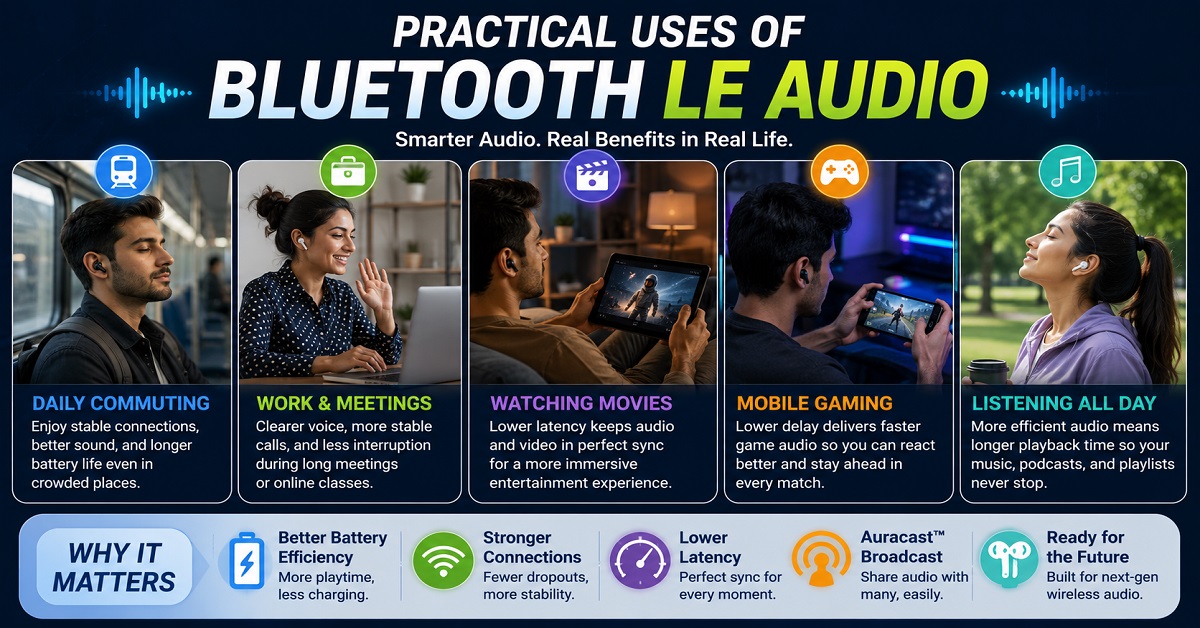
Practical Uses of Bluetooth LE Audio
After learning how Bluetooth LE Audio works, the next question is obvious:
Will you actually notice the difference in everyday use?
For many people, the answer is yes, but it depends on how you use your earbuds or headphones.
Let’s look at some common situations where Bluetooth LE Audio can make a real difference.
1. Daily Commuting
If you spend one or two hours every day travelling by bus, metro, or train, your earbuds are probably one of your most-used gadgets.
Bluetooth LE Audio helps in several ways:
- More efficient battery usage
- Better connection stability in crowded places
- Lower chances of audio dropouts
- Improved sound quality with compatible devices
Example
Imagine you’re travelling on a crowded metro where hundreds of smartphones are using Bluetooth simultaneously.
Traditional Bluetooth usually works well, but Bluetooth LE Audio is designed to communicate more efficiently in these busy wireless environments, helping maintain a smoother listening experience.
2. Office and Work From Home
Many people now wear earbuds for:
- Zoom meetings
- Microsoft Teams
- Google Meet
- Online classes
Bluetooth LE Audio’s lower latency and more efficient communication help deliver a smoother experience during long meetings.
If your earbuds support Bluetooth LE Audio alongside good microphones and ENC, voice calls can feel more reliable throughout the workday.
3. Watching Movies
Nobody likes watching a movie where the actor’s lips move before the dialogue reaches your ears.
Bluetooth LE Audio reduces audio delay, helping movies and TV shows feel more natural.
Although many premium earbuds already minimize latency, Bluetooth LE Audio makes this process even more efficient.
4. Mobile Gaming
If you play games such as:
- BGMI
- Free Fire
- Call of Duty Mobile
lower latency is always beneficial.
Bluetooth LE Audio isn’t a replacement for a dedicated gaming mode, but it provides a stronger foundation for faster wireless audio communication.
Combined with low-latency gaming modes offered by manufacturers, it helps create a more responsive gaming experience.
5. Listening to Music All Day
Battery life is one of the biggest reasons people upgrade their earbuds.
Because Bluetooth LE Audio is designed to use less power, it can help manufacturers deliver longer playback times without increasing battery size.
This is particularly useful if you:
- Listen to music at work
- Study for several hours
- Travel frequently
- Prefer charging your earbuds less often
Who Should Care About Bluetooth LE Audio?
Not everyone needs Bluetooth LE Audio immediately.
Let’s see who benefits the most.
Bluetooth LE Audio Is Worth Considering If You:
You Plan to Buy New Earbuds
If you’re already spending money on new wireless earbuds, choosing a model with Bluetooth LE Audio makes sense.
It gives you better future compatibility without necessarily increasing the price significantly.
You Upgrade Your Smartphone Regularly
Many new Android phones are gradually adding Bluetooth LE Audio support.
If you usually replace your phone every two or three years, you’ll likely benefit from this technology sooner rather than later.
You Care About Battery Life
If you’re always checking your earbud battery percentage, Bluetooth LE Audio is definitely worth considering.
Its improved efficiency helps manufacturers get more listening time from the same battery capacity.
You Use Wireless Audio Every Day
People who wear earbuds for several hours every day will benefit more than occasional users.
Small improvements in battery efficiency, stability, and latency become much more noticeable over time.
Who Doesn’t Need Bluetooth LE Audio Right Now?
Bluetooth LE Audio is exciting, but it shouldn’t be the only reason you buy a pair of earbuds.
You probably don’t need to prioritize it if:
- Your current earbuds already satisfy you.
- You mostly listen at home.
- You rarely use Bluetooth audio.
- Your phone doesn’t support Bluetooth LE Audio.
- You’re shopping on a very tight budget.
In these situations, factors like sound quality, comfort, microphone performance, ANC, and battery life remain more important than Bluetooth LE Audio support.
Which Earbuds Support Bluetooth LE Audio?
Support is growing every year, although availability varies by manufacturer and smartphone compatibility.
Some recent earbuds that support Bluetooth LE Audio (either currently or through firmware support, depending on device compatibility) include:
- OnePlus Buds 4
- Samsung Galaxy Buds3
- Samsung Galaxy Buds3 Pro
- Google Pixel Buds Pro 2
- Sony WF-1000XM5
- Sony LinkBuds series (selected models)
- JBL Tour Pro 2
- Nothing Ear (selected recent models)
As the technology becomes more common, you’ll likely see Bluetooth LE Audio support in many mid-range earbuds over the next few years.
Tip: Before purchasing, always check the official specifications because Bluetooth version alone doesn’t guarantee Bluetooth LE Audio support.
Should You Upgrade Just for Bluetooth LE Audio?
This is probably the most important question in the entire article.
If You Already Own Premium Earbuds
Suppose you already have earbuds like:
You don’t need to upgrade solely because Bluetooth LE Audio exists.
Your current earbuds are already excellent.
The improvements offered by Bluetooth LE Audio are real, but they aren’t dramatic enough to justify replacing perfectly good earbuds.
If You’re Buying New Earbuds
This is where the answer changes.
If you’re purchasing new earbuds today, Bluetooth LE Audio is definitely worth looking for.
Think of it like buying a new laptop with Wi-Fi 7 support.
You may not fully use it today, but it makes your purchase more future-ready.
If You’re Buying Budget Earbuds
Don’t sacrifice essential features just to get Bluetooth LE Audio.
For example, it’s usually better to buy earbuds that offer:
- Better sound quality
- Reliable microphones
- Good comfort
- Longer battery life
rather than choosing another model simply because it advertises Bluetooth LE Audio.
Bluetooth LE Audio should be considered an extra advantage, not the deciding factor.
Common Myths About Bluetooth LE Audio
There are plenty of misconceptions surrounding this technology.
Let’s clear up some of the biggest ones.
Myth 1: Bluetooth LE Audio Automatically Sounds Better
Reality:
Not always.
Sound quality depends on several factors:
- Earbud drivers
- Tuning
- Codec implementation
- DAC
- Source quality
Bluetooth LE Audio improves efficiency, but it can’t magically make poorly tuned earbuds sound amazing.
Myth 2: Bluetooth LE Audio Requires Bluetooth 5.4
Reality:
No.
Bluetooth LE Audio and Bluetooth version numbers are different things.
Manufacturers implement Bluetooth LE Audio support separately.
Myth 3: Older Phones Can Always Use Bluetooth LE Audio
Reality:
Only if the phone supports it.
Both the smartphone and the earbuds need compatible hardware and software.
Myth 4: Bluetooth LE Audio Is Only for Expensive Earbuds
Reality:
Not anymore.
As manufacturers adopt the technology, it’s gradually appearing in more affordable earbuds as well.
Over the next few years, Bluetooth LE Audio is expected to become common even in the mid-range segment.
Buying Tips: Should Bluetooth LE Audio Influence Your Purchase?
Here’s a simple checklist to help you decide.
Prioritize Bluetooth LE Audio if:
✅ You’re buying new premium earbuds.
✅ You plan to keep your earbuds for several years.
✅ You value battery efficiency.
✅ Your smartphone already supports Bluetooth LE Audio.
Don’t Prioritize It Over These Features:
❌ Better sound quality
❌ Comfortable fit
❌ Reliable microphones
❌ Effective ANC
❌ Long battery life
❌ Good after-sales support
Bluetooth LE Audio is a welcome addition, but it should complement these features rather than replace them in your buying decision.
Recommended Bluetooth LE Audio Earbuds
If you’re planning to upgrade to earbuds that support modern Bluetooth technologies, here are a few excellent options worth considering:
Premium Choice
OnePlus Buds 4
Ideal for users who want flagship-level sound quality, Adaptive ANC, Hi-Res Audio, Bluetooth LE Audio support, and an overall premium experience.
OnePlus Buds 4 – 55dB ANC | Dual Drivers | 45H Battery

OnePlus Buds 4 TWS Earbuds with Upto 55dB Real-time ANC, Adaptive Mode, Dual Drivers and DACs, 3D Audio, Upto 45hrs Music Playback, Dual-Device connectivity, 47ms Low Latency, Storm Gray
- [Industry leading ANC up to 55 dB & 5500Hz range]: Powered by the latest OnePlus algorithms, Buds 4 can dynamically adjust ANC in real time—up to 800 times per second—based on ambient noise to ensure optimal noise cancellation. [All-New Adaptive Mode] Dynamically switches between ANC and Transparency Modes for safer and smoother listening.
- [Flagship level near-lossless sound]: Featuring twin tailored DACs (Digital-to-Analog Converter), an 11mm woofer and a 6mm tweeter, precisely engineered to deliver powerful bass and clear treble, creating rich lows and pristine highs across a wide soundstage. Industry leading Hi-res Codec of LHDC 5.0 and upto 1 Mbps 24-bit 192kHz LHDC 5.0 meets studio-grade Hi-Res for silky-smooth sound with reduced latency.
Best Value
Realme Buds Air 7
Offers excellent sound quality, impressive battery life, effective ANC, and modern wireless features at a much more affordable price.
Hi-Res Certified | 52dB ANC | 52H Battery

realme Earbuds Air 7 True Wireless,12.4mm Dynamic Bass Drivers,52Hrs Playtime,52dB Hybrid ANC,6 Mic ENC,45ms Low Latency,360° Spatial Audio,Hi-Res LHDC,IP55 Dust & Water Resistant,BT v5.4(SlateGrey)
- 52dB Smart Active Noise Cancellation (ANC) | Hi-Res Certified with LHDC 5.0
- 12.4mm Deep Bass Driver | Dynamic Bass Boost
- 360° spatial Sound
Frequently Asked Questions (FAQs)
1. Is Bluetooth LE Audio better than regular Bluetooth audio?
Yes, Bluetooth LE Audio is generally better than traditional Bluetooth audio in several ways. It uses the new LC3 codec, which delivers better audio quality while consuming less battery power. It also supports features like Multi-Stream Audio and Auracast™, making it more efficient and future-ready.
However, the actual listening experience still depends on the quality of your earbuds, smartphone, and the music you’re playing.
2. Does Bluetooth LE Audio improve sound quality?
Yes, but not in every situation.
Bluetooth LE Audio uses the LC3 codec, which is more efficient than the older SBC codec. This means it can maintain excellent sound quality while using less data and power.
However, sound quality is also influenced by several other factors, including:
Earbud drivers
Audio tuning
Music quality
Equalizer settings
Ear tip fit
Think of Bluetooth LE Audio as one piece of the puzzle rather than the only factor that determines how good your earbuds sound.
3. Do both my phone and earbuds need Bluetooth LE Audio support?
Yes.
To enjoy all the benefits of Bluetooth LE Audio, both your smartphone (or other source device) and your earbuds/headphones must support it.
If one device doesn’t support Bluetooth LE Audio, they will usually fall back to the older Bluetooth audio standard.
4. Is Bluetooth LE Audio available on iPhones?
Support depends on the iPhone model and Apple’s software implementation.
While newer iPhones support modern Bluetooth standards, Apple has its own approach to wireless audio and doesn’t always adopt every Bluetooth audio feature immediately.
If Bluetooth LE Audio is important to you, it’s a good idea to check Apple’s latest specifications before purchasing compatible earbuds.
5. Does Bluetooth LE Audio reduce battery consumption?
Yes.
One of the biggest advantages of Bluetooth LE Audio is its improved power efficiency.
Thanks to the LC3 codec and Bluetooth Low Energy technology, compatible earbuds can use less battery while maintaining excellent sound quality.
Keep in mind that battery life also depends on features like ANC, volume level, microphone usage, and battery capacity.
6. Is Bluetooth LE Audio good for gaming?
Yes.
Bluetooth LE Audio helps reduce latency compared to older Bluetooth audio technologies, making games feel more responsive.
However, if you’re a competitive gamer, you’ll still benefit from earbuds that include a dedicated Low Latency or Gaming Mode, as these can reduce delay even further.
7. What is Auracast in Bluetooth LE Audio?
Auracast™ is a new feature introduced with Bluetooth LE Audio that allows one compatible device to broadcast audio to multiple compatible receivers simultaneously.
For example, in the future, airports, gyms, museums, or conference halls could broadcast announcements or TV audio directly to compatible earbuds without requiring individual pairing.
Although Auracast is still in its early stages of adoption, it has the potential to transform how public audio is shared.
8. Should I buy earbuds just because they support Bluetooth LE Audio?
Not necessarily.
Bluetooth LE Audio is a valuable feature, but it shouldn’t be the only reason you choose a pair of earbuds.
Before making a purchase, consider these factors first:
Sound quality
Comfort and fit
Active Noise Cancellation (ANC)
Microphone quality
Battery life
Brand reliability
Software support
If two earbuds offer similar features and pricing, choosing the one with Bluetooth LE Audio support is a smart decision because it provides better long-term value.
9. Is Bluetooth LE Audio worth it in 2026?
Yes, for most buyers.
As more smartphones, laptops, tablets, and earbuds begin supporting Bluetooth LE Audio, it’s becoming one of the most useful wireless audio technologies available.
If you’re planning to keep your earbuds for several years, buying a model that supports Bluetooth LE Audio helps ensure you’re ready for future features like Auracast while also benefiting from better battery efficiency and improved wireless performance today.
Final Verdict
Bluetooth technology has come a long way over the past decade, and Bluetooth LE Audio is one of the biggest improvements we’ve seen in wireless listening.
Instead of focusing only on faster speeds or longer range, it addresses the areas that matter most to everyday users:
- Better battery efficiency
- Improved audio quality through the LC3 codec
- Lower latency
- More reliable wireless connections
- Future-ready features like Multi-Stream Audio and Auracast
While these improvements may not feel revolutionary overnight, they make wireless audio smarter, more efficient, and better suited for the way we use earbuds today.
If you’re shopping for new earbuds in 2026, Bluetooth LE Audio is definitely a feature worth looking for. Just remember that it should complement—not replace—other important factors like sound quality, comfort, ANC performance, and battery life.
Conclusion
If you’ve ever wondered whether Bluetooth LE Audio is just another marketing buzzword, the answer is no. It’s a genuine advancement in wireless audio technology that improves efficiency without making things more complicated for users.
For most people, the biggest benefits will be longer battery life, more stable connections, and support for exciting future features like Auracast. As more smartphones and earbuds adopt the technology, Bluetooth LE Audio is likely to become the new standard for wireless listening.
That said, you don’t need to rush out and replace perfectly good earbuds just because they lack Bluetooth LE Audio. If your current pair still meets your needs, there’s no urgent reason to upgrade.
However, if you’re planning to buy new earbuds, choosing a model with Bluetooth LE Audio support is a smart way to make your purchase more future-ready.
Ultimately, the best earbuds are the ones that combine great sound quality, comfortable fit, reliable battery life, and the features you actually use. Bluetooth LE Audio is simply another valuable addition that helps make that experience even better.
Related Articles You May Find Helpful
To learn more about wireless audio technologies and choose the right earbuds, check out these guides on AudioPick:
- What Is Hi-Res Audio? Is It Worth It in 2026?
- What Is Bluetooth Multipoint Connectivity?
- What Are Headphone Drivers? Types, Sizes, and Do They Really Matter?
- What Is ANC in Headphones and How Does It Work?
- Best Earbuds Under ₹5000 in India (2026)
- Best Open-Ear Earbuds (2026): Top Picks You Can Buy
- OnePlus Buds 4 Review
- Realme Buds Air 7 Review

About the Author
Hari Prasad is the editor of AudioPick.in and a lifelong audio enthusiast. He writes detailed, honest reviews and guides to help everyday users pick the right gear without tech jargon. His personal interest in Bluetooth audio, neckbands, and codecs comes from testing dozens of devices over the past few years.