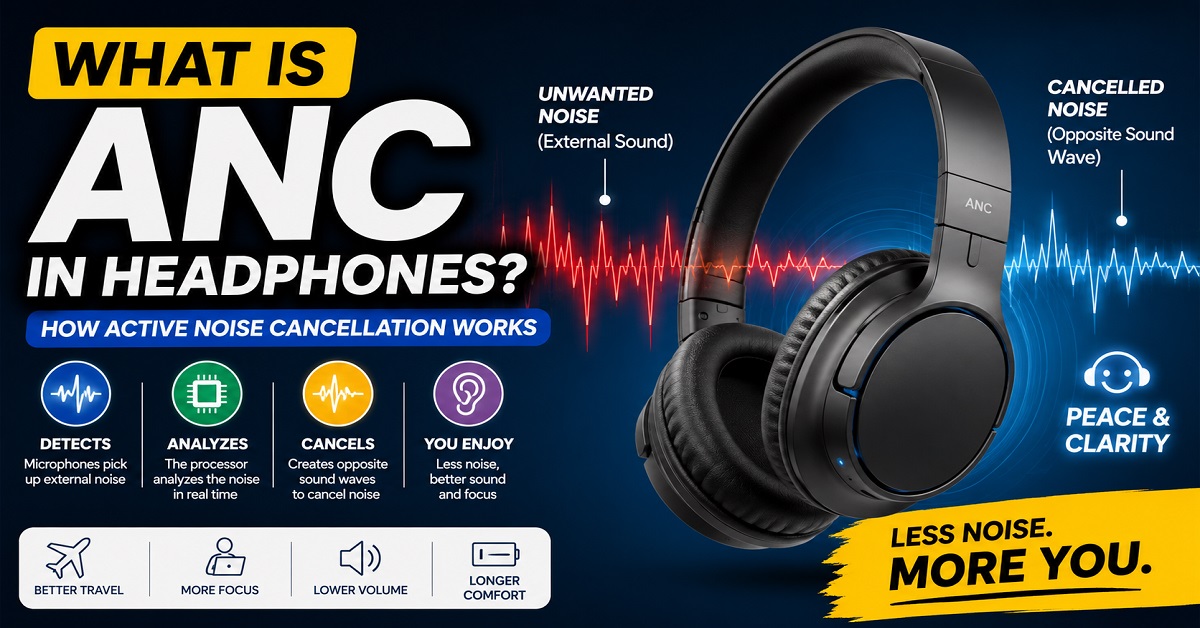
If you’ve ever shopped for headphones recently, you’ve probably come across terms like ANC, Hybrid ANC, Adaptive ANC, or Noise Cancelling Headphones.
Many headphone brands highlight ANC as one of their biggest selling points. You’ll see claims like “50dB ANC,” “Hybrid ANC,” or “Adaptive Noise Cancellation” on product pages and advertisements.
But what exactly does it mean?
More importantly, does ANC really work, or is it just another marketing buzzword?
The truth is that Active Noise Cancellation can make a noticeable difference in the right situations. Whether you’re traveling on a noisy bus, working in a busy office, studying in a crowded environment, or simply trying to enjoy music without distractions, ANC can improve your listening experience.
In this guide, you’ll learn:
- What ANC in headphones actually means
- How ANC works in simple language
- Different types of noise cancellation
- The benefits and limitations of ANC
- Whether ANC headphones are worth buying
- How ANC compares to other noise reduction technologies
Before buying a new pair of wireless headphones, many people ask what is ANC in headphones and whether it actually makes a difference in everyday use. The short answer is yes, but understanding how it works helps you decide whether ANC is worth paying extra for.
By the end of this article, you’ll know exactly whether ANC is a feature you should look for when buying your next pair of headphones.
Quick Answer: What Is ANC in Headphones?
“ANC (Active Noise Cancellation) is a technology that uses microphones and opposite sound waves to reduce unwanted background noise, helping you enjoy music, movies, and calls with fewer distractions.”
This often improves user satisfaction because many visitors get their answer immediately while Google can also pick it up for featured snippets.
What Is ANC in Headphones? A Simple Explanation
Let’s start with the basics.
ANC stands for Active Noise Cancellation.
It is a technology used in headphones to reduce unwanted sounds from your surroundings before those sounds reach your ears.
In simple words, ANC helps make outside noises less noticeable so you can focus more on your music, movies, podcasts, or calls.
Imagine you’re sitting on a bus.
You can hear:
- Engine noise
- Road noise
- People talking
- Air conditioning sounds
Without ANC, all these sounds mix with your music.
With ANC enabled, your headphones actively work to reduce many of these background noises, creating a quieter listening experience.
This is why ANC has become one of the most popular features in modern headphones.
Why Was ANC Created?
Before ANC became common, headphone users mainly relied on volume.
If outside noise increased, people simply increased the volume of their music.
This approach had two problems:
Problem 1: Poor Listening Experience
Background noise could still interfere with music and calls.
Problem 2: Hearing Fatigue
Many people increased volume levels too much, which could become uncomfortable during long listening sessions.
ANC was designed to solve this problem.
Instead of making your music louder, ANC tries to make the outside world quieter.
To fully understand what is ANC in headphones, it helps to know how modern noise-cancelling technology identifies and reduces unwanted sounds around you.
How Does ANC Work?
This is where things sound complicated, but the basic idea is surprisingly simple.
ANC works using three main components:
- Microphones
- Processor
- Opposite Sound Waves
Let’s break each one down.
Step 1: The Headphones Listen to the Environment
ANC headphones contain tiny microphones.
These microphones constantly listen to sounds around you.
For example, they detect:
- Air conditioner hum
- Airplane engine noise
- Bus engine vibration
- Train sounds
The microphones pick up these unwanted noises before they reach your ears.
Step 2: The Processor Analyzes the Noise
Once the microphones detect external sound, a small processor inside the headphones quickly analyzes it.
The processor determines:
- Frequency
- Loudness
- Pattern
This process happens thousands of times every second.
The analysis is nearly instant.
Step 3: The Headphones Create an Opposite Sound Wave
Here’s the interesting part.
The processor creates an opposite version of the detected noise.
This opposite sound wave is sometimes called an “anti-noise” signal.
When the original noise and the opposite sound wave meet, they cancel each other out.
As a result:
Less unwanted noise reaches your ears.
A Simple Real-Life Analogy
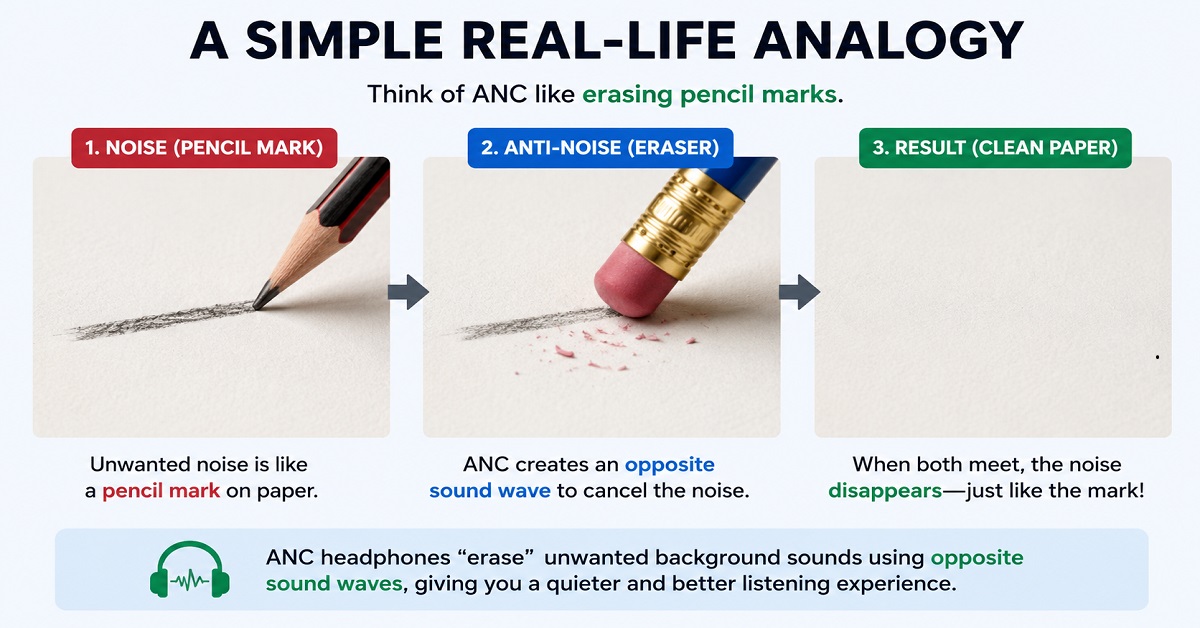
Think of ANC like erasing pencil marks.
Imagine drawing a line on paper.
Now imagine using an eraser to remove that line.
ANC does something similar with sound.
The unwanted noise is the pencil mark.
The anti-noise signal is the eraser.
When they meet, much of the noise disappears.
Of course, sound is more complex than pencil marks, but this analogy helps explain the basic concept.
Why ANC Works Better for Some Sounds Than Others
One common misconception is that ANC completely blocks every sound.
That’s not true.
ANC is most effective against:
Low-Frequency Sounds
Examples:
- Airplane engines
- Air conditioners
- Train noise
- Bus engines
- Ceiling fans
These sounds are predictable and consistent.
ANC systems can easily identify and counter them.
High-Frequency Sounds
Examples:
- People talking
- Children shouting
- Dogs barking
- Sudden loud noises
These sounds change rapidly.
ANC can reduce some of them but usually cannot eliminate them completely.
That’s why you might still hear conversations around you even with ANC turned on.
Different Types of ANC in Headphones
Not all ANC systems are the same.
Modern headphones usually use one of several ANC designs.
Let’s look at them.
Feedforward ANC
In Feedforward ANC systems:
- Microphones are placed outside the earcups.
- They detect noise before it enters the headphones.
Advantages:
- Good at detecting external sounds
- Effective for constant background noise
Limitations:
- Can be affected by wind noise
- Less accurate than advanced systems
Feedback ANC
In Feedback ANC systems:
- Microphones are placed inside the earcups.
- They monitor what you actually hear.
Advantages:
- Better accuracy
- Improved correction of unwanted noise
Limitations:
- Slightly more complex
Hybrid ANC
Many modern headphones now use Hybrid ANC.
Examples include:
- JBL Tune 770NC
- Noise Airwave Max 5
- boAt Rockerz 512 ANC
- Zebronics Silencio 200T
Hybrid ANC combines:
- Feedforward ANC
- Feedback ANC
This gives the system more information about surrounding noise.
Advantages:
- Better overall performance
- More accurate noise reduction
- Improved listening experience
For most buyers, Hybrid ANC is generally considered better than basic ANC implementations.
Adaptive ANC
Adaptive ANC is a newer and smarter version of ANC.
Instead of using fixed settings, Adaptive ANC continuously adjusts itself based on your surroundings.
For example:
If you move from a quiet room to a busy street, Adaptive ANC automatically changes its noise cancellation strength.
Benefits:
- More convenient
- Better performance in changing environments
- Less manual adjustment
Many premium and upper-midrange headphones now offer Adaptive ANC.
Active Noise Cancellation vs Passive Noise Cancellation
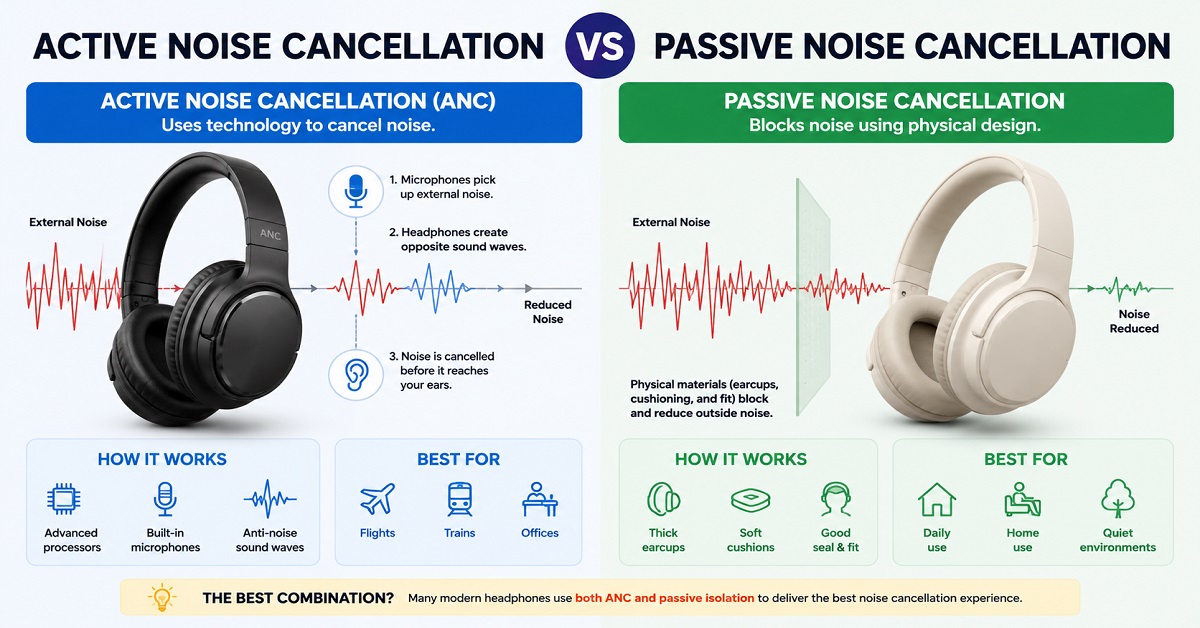
Many people assume every headphone blocks noise because of ANC.
That’s not always true.
There are actually two different ways headphones reduce noise.
Passive Noise Cancellation
Passive Noise Cancellation does not use electronics.
Instead, it relies on physical design.
Examples:
- Thick ear cushions
- Closed-back earcups
- Tight fit around the ears
Think of passive noise cancellation like closing a door.
The door doesn’t remove noise.
It simply blocks some of it from entering.
Good over-ear headphones naturally provide passive noise isolation even without ANC.
Active Noise Cancellation
Active Noise Cancellation uses:
- Microphones
- Processors
- Opposite sound waves
Instead of simply blocking noise, it actively reduces it.
Think of passive isolation as a wall.
Think of ANC as a smart system working behind that wall to further reduce noise.
Do ANC Headphones Use Both Methods?
Yes.
Most ANC headphones combine:
Passive Noise Isolation
Plus
Active Noise Cancellation
This combination creates the best results.
That’s why over-ear ANC headphones usually perform better than open-ear designs when it comes to reducing background noise.
Which Sounds Can ANC Reduce Best?
ANC performs best against:
✅ Airplane engine noise
✅ Air conditioner hum
✅ Train sounds
✅ Bus engine vibration
✅ Office ventilation systems
✅ Fan noise
ANC performs less effectively against:
❌ Human conversations
❌ Babies crying
❌ Dogs barking
❌ Sudden loud sounds
Understanding this helps set realistic expectations before buying ANC headphones.
Now that you understand what is ANC in headphones, let’s look at the practical benefits users experience in real-world situations.
Benefits of ANC in Headphones
Now that you understand what ANC in headphones is and how it works, let’s look at the practical benefits.
This is where ANC becomes more than just a technical feature.
1. Better Focus and Concentration
One of the biggest advantages of ANC is improved focus.
Imagine you’re:
- Studying in a hostel
- Working from a coffee shop
- Sitting in a busy office
Background noises can become distracting very quickly.
ANC helps reduce those distractions so you can focus on what you’re listening to instead of what’s happening around you.
2. More Enjoyable Music Listening
Without ANC, outside sounds often compete with your music.
For example:
You’re listening to your favorite song on a bus.
The engine noise constantly interferes with the music.
With ANC enabled, much of that background noise is reduced, allowing you to hear more details in your music.
This often makes music sound cleaner and more immersive.
3. Lower Volume Levels
Many people increase volume to overcome background noise.
ANC reduces the need for this.
Instead of turning your music to 90% volume, you may only need 50–60%.
This can make long listening sessions more comfortable.
4. Better Travel Experience
Frequent travelers often consider ANC a must-have feature.
Whether you’re on:
- Flights
- Trains
- Buses
ANC can significantly reduce the constant low-frequency noises that make travel tiring.
This is one reason why ANC became popular among business travelers.
5. Improved Call Experience
While ANC primarily benefits listening, many ANC headphones also include good microphones and noise-reduction technologies for calls.
This can make conversations easier in noisy environments.
Limitations of ANC
ANC is useful, but it’s not magic.
Understanding its limitations will help you make a smarter buying decision.
1. ANC Cannot Eliminate Every Sound
Many advertisements make ANC sound like complete silence.
That’s not how it works.
Even excellent ANC headphones cannot completely remove:
- Human voices
- Sudden noises
- High-pitched sounds
You will still hear some sounds around you.
The difference is that they become less distracting.
2. Budget ANC Isn’t the Same as Premium ANC
A ₹3,000 ANC headphone and a ₹25,000 ANC headphone both have ANC.
But the experience can be very different.
Premium ANC systems often provide:
- Better microphones
- Faster processors
- More accurate noise cancellation
Budget ANC still works, but expectations should be realistic.
3. ANC Uses Battery Power
Since ANC requires microphones and processing, it consumes battery.
Most modern headphones compensate with larger batteries, but ANC will generally reduce battery life compared to normal listening mode.
4. Some People Feel Slight Pressure
When using ANC for the first time, some users notice a mild pressure sensation.
It often feels similar to sitting inside an airplane cabin.
Most people get used to it quickly.
Real-Life Situations Where ANC Helps
Many buyers wonder whether ANC is actually useful for them.
Let’s look at some common situations.
During Daily Commutes
If you travel by:
- Metro
- Bus
- Train
ANC can make your journey more comfortable by reducing engine and background noise.
While Working From Home
Many homes have:
- Ceiling fans
- Air conditioners
- Traffic noise
- Family conversations
ANC helps create a quieter environment for work and meetings.
In Offices
Open offices can be noisy.
Colleagues talking nearby can affect concentration.
ANC helps reduce these distractions.
During Flights
Airplane engine noise is one of the best examples of noise that ANC can reduce effectively.
This is why frequent travelers often prefer ANC headphones.
While Studying
Students studying in libraries, hostels, or shared rooms often find ANC useful for maintaining focus.
ANC vs ENC: What’s the Difference?
This is one of the most common questions among buyers.
Many people confuse ANC and ENC because both involve noise reduction.
However, they serve different purposes.
| Feature | ANC | ENC |
|---|---|---|
| Full Form | Active Noise Cancellation | Environmental Noise Cancellation |
| Purpose | Improves what you hear | Improves what others hear |
| Used During | Music, videos, movies | Voice calls |
| Works On | Background sounds around you | Background sounds around your microphone |
| Main Benefit | Better listening experience | Better call quality |
Simple Example
Imagine you’re on a busy street.
ANC helps reduce traffic noise reaching your ears.
ENC helps reduce traffic noise reaching the person you’re talking to.
Both are useful, but they solve different problems.
Is ANC Harmful for Ears?
This is probably the biggest concern people have when learning about ANC.
The short answer is:
No, ANC is generally considered safe for ears.
ANC does not damage hearing.
In fact, some people argue that ANC may indirectly help because it reduces the need to listen at very high volume levels.
However:
Listening to music at extremely high volumes can still damage hearing regardless of whether ANC is enabled.
A good habit is to keep volume levels comfortable and take regular listening breaks.
Does ANC Drain Battery Faster?
Yes.
ANC requires:
- Microphones
- Audio processing
- Continuous operation
As a result, battery consumption increases.
For example:
A headphone rated for:
- 80 hours without ANC
might deliver:
- 50–65 hours with ANC enabled
The exact difference varies between products.
Fortunately, modern headphones now offer excellent battery life, so this is rarely a major issue.
Are ANC Headphones Good for Calls?
ANC itself mainly improves listening.
However, many ANC headphones also include:
- ENC microphones
- AI noise reduction
- Multiple microphone systems
This combination often results in better overall calling performance.
For office users and work-from-home professionals, ANC headphones can be a practical choice.
Is ANC Worth It in Budget Headphones?
In many cases, yes.
Budget ANC has improved significantly over the last few years.
Headphones such as:
- JBL Tune 770NC
- Noise Airwave Max 5
- boAt Rockerz 512 ANC
- Zebronics Silencio 200T
- boAt Nirvana 751 ANC
offer ANC at prices that would have been impossible a few years ago.
The ANC may not match flagship headphones from Sony or Bose, but it can still noticeably reduce background noise.
For many buyers, that improvement is worth the extra cost.
Frequently Asked Questions
What is ANC in headphones?
ANC stands for Active Noise Cancellation. It uses microphones and sound processing technology to reduce unwanted background noise before it reaches your ears.
How does ANC work in headphones?
ANC microphones detect outside noise. The headphones then create opposite sound waves that help cancel much of that noise before you hear it.
Is ANC safe for ears?
Yes. ANC is generally safe. It does not damage hearing. Safe listening habits are still important regardless of whether ANC is enabled.
Does ANC completely block noise?
No. ANC reduces many background sounds but cannot completely eliminate every noise, especially conversations and sudden sounds.
Is ANC useful for travel?
Yes. ANC is particularly effective against airplane engines, train noise, bus engines, and other low-frequency sounds commonly experienced during travel.
Does ANC reduce sound quality?
Good ANC systems usually do not significantly affect sound quality. In many situations, music may actually sound clearer because background noise is reduced.
Are ANC headphones worth buying?
If you travel frequently, work in noisy environments, commute daily, or value a quieter listening experience, ANC is often worth the extra cost.
Which is better: ANC or Passive Noise Isolation?
Neither is universally better.
The best results usually come from combining both. Most modern ANC headphones use passive isolation and active noise cancellation together.
Can ANC help during online meetings?
ANC mainly helps you hear better. For meetings, headphones with ENC microphones provide additional benefits by improving voice clarity.
Why are ANC headphones more expensive?
ANC requires extra hardware, including microphones, processors, and specialized software, which increases manufacturing costs.
If you were searching for what is ANC in headphones, hopefully this guide has given you a clear understanding of how the technology works and when it is useful.
Final Thoughts: Should You Buy ANC Headphones?
Now that you know what ANC in headphones is and how it works, the answer depends on how you use your headphones.
If you:
- Travel regularly
- Commute daily
- Work in noisy environments
- Study in shared spaces
- Want a more immersive listening experience
ANC can make a noticeable difference.
On the other hand, if you mostly listen at home in a quiet room, ANC may not be essential.
The good news is that ANC is no longer limited to expensive premium models. Many affordable headphones now offer effective Active Noise Cancellation at budget-friendly prices.
The key is having realistic expectations.
ANC won’t create complete silence, but it can significantly reduce everyday background noise and make music, movies, podcasts, and calls more enjoyable.
For many users, that’s enough to make ANC one of the most valuable features available in modern headphones.
Related Articles You May Find Helpful
- Best ANC Headphones Under ₹5000 in India (2026): Top 7 Picks Tested and Compared
- ANC vs ENC in Neckbands: What’s the Difference?
- Noise Two vs Noise Airwave Max 4
- Noise Two Review: Worth It at ₹1,499?
- Bluetooth Multipoint Connectivity Explained

About the Author
Hari Prasad is the editor of AudioPick.in and a lifelong audio enthusiast. He writes detailed, honest reviews and guides to help everyday users pick the right gear without tech jargon. His personal interest in Bluetooth audio, neckbands, and codecs comes from testing dozens of devices over the past few years.