
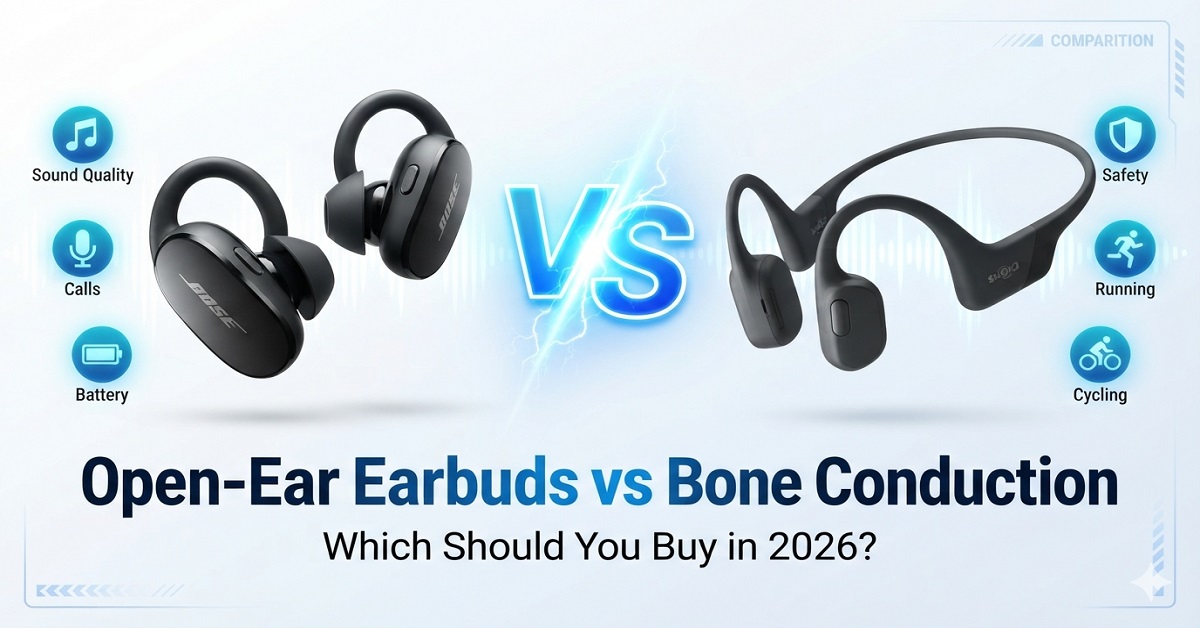
Have you noticed that more people are choosing headphones that let them enjoy music without completely blocking the outside world?
Whether you’re running, cycling, walking, working from home, or simply commuting, staying aware of your surroundings has become just as important as enjoying great sound. That’s why open-ear earbuds and bone conduction headphones have become increasingly popular in recent years.
At first glance, these two types of headphones seem very similar. Both leave your ears open, both allow you to hear what’s happening around you, and both are designed for people who want a safer and more comfortable listening experience.
However, they work in completely different ways.
Open-ear earbuds direct sound toward your ears without sealing the ear canal, while bone conduction headphones send sound through vibrations on your cheekbones, leaving your ears completely free.
So, which one should you buy?
The answer depends on how you plan to use them.
If you’re a runner, cyclist, office worker, frequent traveler, or someone who simply wants a more comfortable way to listen to music, choosing the right type can make a big difference in your daily experience.
In this guide, we’ll explain the differences between open-ear earbuds and bone conduction headphones, compare them across the features that matter most, and help you decide which one is the better choice for your lifestyle.
Quick Answer
If you’re short on time, here’s the simple answer.
Choose Open-Ear Earbuds if you:
- Want better sound quality.
- Prefer stronger bass.
- Take lots of phone calls.
- Listen to music for long hours.
- Work from home or in an office.
- Want a listening experience closer to traditional earbuds.
Choose Bone Conduction Headphones if you:
- Run or cycle outdoors regularly.
- Need maximum awareness of traffic.
- Swim or train in wet conditions.
- Wear helmets frequently.
- Prioritize safety over powerful bass.
- Want nothing inside or directly over your ears.
For most music lovers, open-ear earbuds provide the better listening experience.
For runners, cyclists, and outdoor fitness enthusiasts, bone conduction headphones remain the safer choice.
Open-Ear Earbuds vs Bone Conduction Headphones: At a Glance
| Feature | Open-Ear Earbuds | Bone Conduction Headphones |
|---|---|---|
| Sound Quality | ⭐⭐⭐⭐⭐ | ⭐⭐⭐☆☆ |
| Bass Performance | ⭐⭐⭐⭐⭐ | ⭐⭐☆☆☆ |
| Comfort | ⭐⭐⭐⭐⭐ | ⭐⭐⭐⭐⭐ |
| Outdoor Awareness | ⭐⭐⭐⭐☆ | ⭐⭐⭐⭐⭐ |
| Running | ⭐⭐⭐⭐☆ | ⭐⭐⭐⭐⭐ |
| Cycling | ⭐⭐⭐⭐☆ | ⭐⭐⭐⭐⭐ |
| Swimming | ⭐⭐☆☆☆ | ⭐⭐⭐⭐⭐ |
| Office Calls | ⭐⭐⭐⭐⭐ | ⭐⭐⭐⭐☆ |
| Long Listening Sessions | ⭐⭐⭐⭐⭐ | ⭐⭐⭐⭐⭐ |
| Overall Safety | ⭐⭐⭐⭐☆ | ⭐⭐⭐⭐⭐ |
Winner for Music: Open-Ear Earbuds
Winner for Outdoor Sports: Bone Conduction Headphones
What Are Open-Ear Earbuds?
Open-ear earbuds are a new type of wireless earbuds designed to let you enjoy music without blocking your ear canal.
Unlike traditional earbuds that sit inside your ears, open-ear earbuds rest just outside them and direct sound toward your ears using precision speakers.
This design allows you to hear music while remaining aware of conversations, traffic, or other important sounds around you.
Popular examples include:
- Bose Ultra Open Earbuds
- SHOKZ OpenFit
- Huawei FreeClip
- Soundcore AeroFit Series
Advantages of Open-Ear Earbuds
- Better sound quality than bone conduction headphones.
- Stronger bass and clearer vocals.
- Comfortable for extended listening sessions.
- Excellent for music, podcasts, and calls.
- Natural transparency without completely isolating you from your surroundings.
Limitations
- Less awareness than bone conduction headphones in very noisy environments.
- Generally not suitable for swimming.
- Premium models can be expensive.
What Are Bone Conduction Headphones?
Bone conduction headphones take a completely different approach to delivering sound.
Instead of using speakers that direct audio into your ears, they use small transducers that rest on your cheekbones.
These transducers create gentle vibrations that travel through your facial bones directly to your inner ear, allowing you to hear audio while leaving your ears completely open.
This unique technology has made bone conduction headphones particularly popular among runners, cyclists, and outdoor athletes who need to remain aware of traffic and surrounding sounds.
Popular examples include:
Advantages of Bone Conduction Headphones
- Maximum awareness of surrounding sounds.
- Excellent for running and cycling.
- Comfortable for users who dislike in-ear earbuds.
- Suitable for long outdoor workouts.
- Swimming models are available with built-in MP3 storage.
Limitations
- Bass is lighter than open-ear earbuds.
- Audio quality isn’t as rich for music lovers.
- Slight vibration may be noticeable at high volumes.
- Premium models can be expensive.
How Do They Work?
Although both products keep your ears open, the technology behind them is completely different.
Open-Ear Earbuds
Open-ear earbuds use small directional speakers that send sound toward your ear canal without sealing it.
Think of it like placing a small speaker just outside your ear. You hear your music clearly while still being able to hear the environment around you.
This approach provides a listening experience that’s much closer to traditional earbuds, with better bass and overall sound quality.
Bone Conduction Headphones
Bone conduction headphones skip your ear canal entirely.
Instead, they place small transducers against your cheekbones. These transducers create tiny vibrations that travel through your bones directly to your inner ear.
Because your ears remain completely open, you continue hearing traffic, conversations, warning signals, and other environmental sounds naturally.
This makes bone conduction technology especially useful for outdoor sports and situations where awareness is essential.
Why Are More People Choosing Open-Ear Audio?
Open-ear listening has become increasingly popular because many people no longer want to completely isolate themselves from the world around them.
Whether you’re exercising outdoors, commuting, working in an office, or simply walking your dog, staying aware of your surroundings can improve both convenience and safety.
Instead of forcing users to choose between listening to music and hearing the environment, open-ear audio offers a balance between both.
That’s why we’re now seeing more brands investing in both open-ear earbuds and bone conduction headphones, giving buyers more options than ever before.
Design and Build Quality
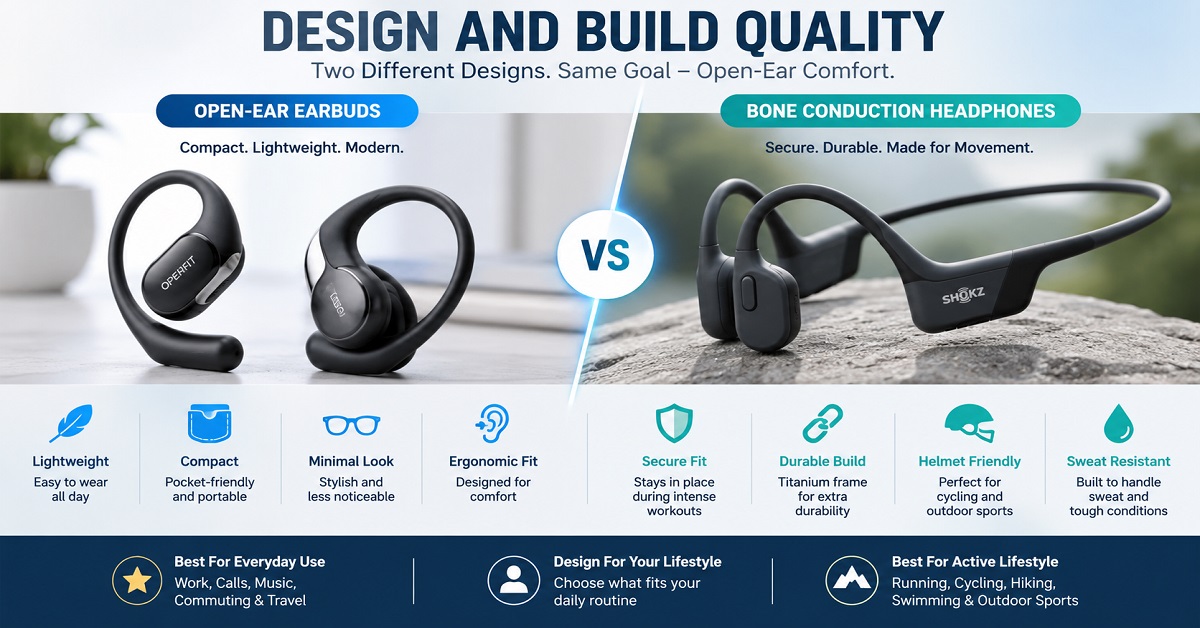
When it comes to design, both open-ear earbuds and bone conduction headphones are built to keep your ears open, but they achieve this in very different ways.
Open-ear earbuds are compact and modern. Most models rest just outside your ears using ear hooks, clips, or an ergonomic frame. They look similar to traditional wireless earbuds but don’t sit inside your ear canal.
Bone conduction headphones, on the other hand, use a wraparound headband that sits behind your head. Small transducers rest against your cheekbones to transmit sound through vibrations.
Open-Ear Earbuds
Bone Conduction Headphones
Winner: Open-Ear Earbuds ⭐
For everyday portability and appearance, open-ear earbuds take the lead. Their compact size and discreet design make them more convenient for daily use, while bone conduction headphones prioritize stability over style.
Comfort and Fit
Comfort is one of the biggest reasons people choose open-ear audio products.
Since neither option sits inside your ear canal, both eliminate the pressure and fatigue that many people experience with traditional earbuds.
However, the overall wearing experience is slightly different.
Open-Ear Earbuds
Open-ear earbuds rest gently outside your ears and are barely noticeable once you get used to them.
They’re an excellent choice for:
- Office work
- Online meetings
- Watching videos
- Long music sessions
- Everyday commuting
Many users can wear them for several hours without discomfort.
Bone Conduction Headphones
Bone conduction headphones distribute their weight across your head using a flexible frame.
This makes them particularly comfortable for:
- Running
- Cycling
- Hiking
- Outdoor workouts
- Long walks
Because nothing touches your ear canal, they remain comfortable even during extended exercise.
Winner: Tie ⭐⭐⭐⭐⭐
Both products are exceptionally comfortable.
If your day mainly involves work, commuting, and entertainment, open-ear earbuds feel more natural.
If you’re constantly moving during workouts or outdoor activities, bone conduction headphones provide a more secure fit.
Sound Quality
This is where the biggest difference appears.
Although both products keep your ears open, they deliver sound using completely different technologies.
Open-Ear Earbuds
Open-ear earbuds direct sound toward your ears using small speakers.
Because they still use air to deliver audio, the sound is much closer to what you’d expect from traditional wireless earbuds.
You can expect:
- Clear vocals
- Rich mids
- Better treble
- Wider soundstage
- More detailed music
Many premium models now deliver surprisingly immersive audio despite their open-ear design.
Bone Conduction Headphones
Bone conduction headphones send sound through vibrations on your cheekbones.
While speech and podcasts sound clear, music isn’t quite as detailed.
The focus is on:
- Safety
- Awareness
- Comfort
rather than maximum audio quality.
Winner: Open-Ear Earbuds ⭐⭐⭐⭐⭐
If music quality is your top priority, open-ear earbuds are the clear winner.
They produce richer, more natural audio with better overall balance than bone conduction headphones.
Bass Performance
Bass is often the deciding factor for music lovers.
Open-Ear Earbuds
Thanks to directional speakers and advanced audio processing, premium open-ear earbuds produce noticeably stronger bass than bone conduction headphones.
Although they don’t match fully sealed in-ear earbuds, the difference is significant.
Genres like:
- Pop
- Rock
- EDM
- Hip-Hop
sound much more energetic.
Bone Conduction Headphones
Bone conduction technology isn’t designed to deliver powerful bass.
While premium models have improved over the years, low-frequency performance remains limited.
At higher volumes, you may also notice slight vibrations against your cheekbones.
Winner: Open-Ear Earbuds ⭐⭐⭐⭐⭐
For anyone who enjoys music, open-ear earbuds provide a far more satisfying listening experience.
Situational Awareness
One of the biggest reasons people buy open-ear audio products is to remain aware of their surroundings.
However, there’s still a difference between the two.
Open-Ear Earbuds
Open-ear earbuds allow outside sounds to enter naturally while directing music toward your ears.
You’ll hear:
- Conversations
- Traffic
- Announcements
- Doorbells
However, loud music can reduce how much of your surroundings you notice.
Bone Conduction Headphones
Since your ears remain completely unobstructed, environmental sounds stay more natural.
This makes it easier to hear:
- Approaching vehicles
- Cyclists
- Emergency sirens
- Other runners
- Public announcements
without lowering your music volume as much.
Winner: Bone Conduction Headphones ⭐⭐⭐⭐⭐
For maximum awareness, bone conduction headphones remain the safest choice.
Safety
If you regularly exercise outdoors, safety is just as important as sound quality.
Open-Ear Earbuds
Open-ear earbuds are considerably safer than traditional earbuds because they don’t completely block outside sounds.
They’re suitable for:
- Walking
- Light jogging
- Daily commuting
- Office use
Bone Conduction Headphones
Bone conduction headphones were practically built with outdoor safety in mind.
Because your ears remain completely open, they’re widely used by:
- Marathon runners
- Cyclists
- Trail runners
- Outdoor fitness enthusiasts
Many sports organizations and experienced athletes recommend open-ear listening for this very reason.
Winner: Bone Conduction Headphones ⭐⭐⭐⭐⭐
If your priority is staying aware of traffic and your surroundings during outdoor activities, bone conduction headphones are the better option.
At a Glance: Who Wins Each Category?
| Category | Winner | Why? |
|---|---|---|
| Design | Open-Ear Earbuds | Smaller, more stylish, and easier to carry. |
| Comfort | Tie | Both are comfortable, but excel in different situations. |
| Sound Quality | Open-Ear Earbuds | Richer, clearer, and more detailed audio. |
| Bass Performance | Open-Ear Earbuds | Stronger low-end response for music lovers. |
| Situational Awareness | Bone Conduction Headphones | Keeps your ears completely open for maximum awareness. |
| Outdoor Safety | Bone Conduction Headphones | Better suited for running, cycling, and busy roads. |
Current Score
- Open-Ear Earbuds: ⭐⭐⭐ (3 wins)
- Bone Conduction Headphones: ⭐⭐ (2 wins)
- Tie: ⭐ (1 category)
At this stage, the comparison shows that open-ear earbuds excel in entertainment and everyday listening, while bone conduction headphones stand out for safety and outdoor sports. Neither technology is universally better, which is why the remaining sections will focus on practical use cases to help readers choose the one that fits their lifestyle best.
Call Quality
If you frequently take calls while working, commuting, or exercising, microphone performance is an important factor to consider.
Open-Ear Earbuds
Most premium open-ear earbuds are equipped with multiple microphones and AI-powered noise reduction technology to improve voice clarity during calls.
They generally perform well in:
- Indoor meetings
- Video conferences
- Quiet offices
- Cafés
- Moderate outdoor environments
Since the microphones are positioned closer to your mouth, your voice usually sounds clearer to the person on the other end.
Bone Conduction Headphones
Bone conduction headphones have improved significantly in recent years, and many premium models now include dual microphones with noise reduction.
They’re perfectly suitable for casual phone calls during walks, runs, or workouts. However, voice clarity can decrease more noticeably in windy or very noisy environments compared to premium open-ear earbuds.
Winner: Open-Ear Earbuds ⭐⭐⭐⭐⭐
If you spend a lot of time on phone calls or virtual meetings, open-ear earbuds generally offer clearer voice quality and better microphone performance.
Battery Life
Battery life varies between models, but there are some general differences.
Open-Ear Earbuds
Most open-ear earbuds provide:
- 6–10 hours of playback on a single charge.
- Up to 25–40 hours with the charging case.
The charging case also makes it easy to recharge while traveling.
Bone Conduction Headphones
Since they don’t require a charging case, bone conduction headphones usually offer:
- 8–12 hours of playback on a single charge.
Some premium models also support quick charging, providing around 1–2 hours of playback from a short charging session.
Winner: Tie ⭐⭐⭐⭐⭐
Open-ear earbuds offer a longer total listening time thanks to their charging cases, while bone conduction headphones often last longer on a single charge. Which is better depends on how you use them.
Water Resistance
Whether you’re exercising outdoors or caught in unexpected rain, water resistance can make a big difference.
Open-Ear Earbuds
Most models come with IP54 or IP55 ratings, making them suitable for:
- Sweat
- Light rain
- Daily workouts
However, they aren’t designed for swimming.
Bone Conduction Headphones
Many bone conduction headphones also feature strong water resistance.
Some premium models even offer IP68 protection and include built-in MP3 storage, allowing you to listen to music while swimming without a Bluetooth connection.
Winner: Bone Conduction Headphones ⭐⭐⭐⭐⭐
If you need headphones for swimming or water sports, bone conduction headphones are the clear winner.
Best for Sports and Fitness
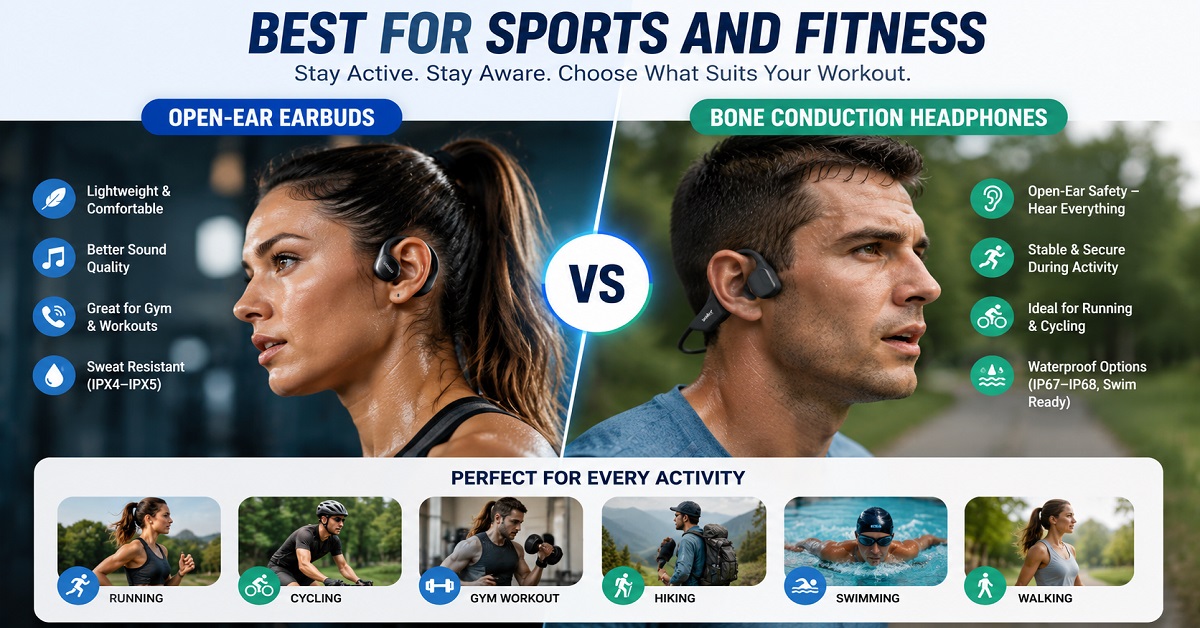
Both options are excellent for exercise, but they’re designed with different priorities.
Running
Both perform well, but bone conduction headphones provide greater awareness of traffic and other runners.
Winner: Bone Conduction Headphones
Cycling
Cyclists benefit from hearing approaching vehicles, horns, and other important sounds while riding.
Winner: Bone Conduction Headphones
Gym Workouts
In a gym environment, situational awareness is less critical than sound quality.
Open-ear earbuds deliver richer music while remaining comfortable during workouts.
Winner: Open-Ear Earbuds
Walking
Both are comfortable for walking and daily exercise.
If you prioritize music quality, choose open-ear earbuds. If safety is your main concern, bone conduction headphones are a better fit.
Winner: Tie
Swimming
Bluetooth signals don’t travel well underwater, so standard wireless earbuds aren’t practical for swimming.
Several bone conduction headphones solve this by including built-in music storage, letting you listen without a phone.
Winner: Bone Conduction Headphones
Best for Office Work and Online Meetings
Open-ear audio has become increasingly popular among professionals who want to stay aware of colleagues while listening to music or attending meetings.
Open-Ear Earbuds
Ideal for:
- Remote work
- Online meetings
- Customer calls
- Multitasking
- Listening to music while working
They offer better sound quality and clearer microphones, making them a great choice for office use.
Bone Conduction Headphones
They’re still suitable for office environments but are primarily designed for active outdoor use.
The wraparound design may also feel less discreet during professional meetings.
Winner: Open-Ear Earbuds ⭐⭐⭐⭐⭐
For productivity and everyday office use, open-ear earbuds are generally the better choice.
Best for Travel and Daily Commuting
Travelers often need a balance between comfort, portability, and awareness.
Open-Ear Earbuds
Their compact charging case makes them easy to carry in a pocket or bag.
They’re ideal for:
- Airports
- Public transport
- Daily commuting
- Walking around cities
Bone Conduction Headphones
While still portable, their wraparound frame takes up more space and isn’t as convenient to store.
However, they remain an excellent option for travelers who frequently walk or jog outdoors.
Winner: Open-Ear Earbuds ⭐⭐⭐⭐⭐
For portability and everyday convenience, open-ear earbuds have the advantage.
Price and Value for Money
The price of both technologies has become more competitive, with options available across different budgets.
Open-Ear Earbuds
Entry-level models are becoming more affordable, while premium options from brands like Bose and SHOKZ offer advanced features such as spatial audio, multipoint connectivity, and app customization.
They generally provide excellent value for users who prioritize music quality and everyday versatility.
Bone Conduction Headphones
Premium bone conduction headphones are often priced similarly to premium open-ear earbuds, but they cater to a more specialized audience.
If your main activities include running, cycling, hiking, or swimming, the additional investment can be well worth it.
Winner: Tie ⭐⭐⭐⭐⭐
Both offer good value, but the better choice depends on how you plan to use them rather than the price alone.
Comparison Scorecard
| Category | Winner |
|---|---|
| Design & Build | Open-Ear Earbuds |
| Comfort & Fit | Tie |
| Sound Quality | Open-Ear Earbuds |
| Bass Performance | Open-Ear Earbuds |
| Situational Awareness | Bone Conduction Headphones |
| Outdoor Safety | Bone Conduction Headphones |
| Call Quality | Open-Ear Earbuds |
| Battery Life | Tie |
| Water Resistance | Bone Conduction Headphones |
| Running | Bone Conduction Headphones |
| Cycling | Bone Conduction Headphones |
| Gym Workouts | Open-Ear Earbuds |
| Walking | Tie |
| Swimming | Bone Conduction Headphones |
| Office Work | Open-Ear Earbuds |
| Travel & Commuting | Open-Ear Earbuds |
| Price & Value | Tie |
Overall Score
- Open-Ear Earbuds: 6 Wins
- Bone Conduction Headphones: 5 Wins
- Tie: 4 Categories
At this stage, it’s clear that open-ear earbuds excel in sound quality, portability, and everyday productivity, making them an excellent choice for music lovers and office users. Bone conduction headphones, on the other hand, stand out for outdoor safety, sports, and swimming, making them ideal for active users who need maximum environmental awareness.
Who Should Buy Open-Ear Earbuds?
Open-ear earbuds are the better choice if your priority is enjoying music without completely shutting yourself off from the world around you.
You should consider buying open-ear earbuds if you:
- Love listening to music with better sound quality and stronger bass.
- Spend long hours working from home or in an office.
- Frequently attend online meetings or make phone calls.
- Want a compact and portable pair of earbuds for everyday use.
- Commute regularly and want to stay aware of your surroundings.
- Prefer a more traditional listening experience without inserting earbuds into your ears.
For most users, open-ear earbuds strike an excellent balance between comfort, convenience, and audio performance.
Who Should Buy Bone Conduction Headphones?
Bone conduction headphones are designed for people who prioritize safety and environmental awareness over immersive sound quality.
You should consider buying bone conduction headphones if you:
- Run or cycle outdoors regularly.
- Need to hear traffic, conversations, or warning signals while exercising.
- Swim and want headphones with built-in MP3 storage.
- Wear helmets frequently while cycling.
- Dislike anything sitting inside your ears.
- Spend a lot of time hiking, walking, or participating in outdoor sports.
If staying aware of your surroundings is your top priority, bone conduction headphones remain one of the safest options available.
Frequently Asked Questions (FAQs)
1. Which is better: open-ear earbuds or bone conduction headphones?
Neither is universally better. Open-ear earbuds generally offer superior sound quality and stronger bass, while bone conduction headphones provide better environmental awareness and are better suited for outdoor sports.
2. Are bone conduction headphones safer than open-ear earbuds?
Yes. Because bone conduction headphones leave your ears completely open, they usually provide better awareness of traffic, pedestrians, and other surrounding sounds, making them a safer option for outdoor activities.
3. Which offers better sound quality?
Open-ear earbuds generally deliver richer sound with clearer vocals, stronger bass, and better overall detail than bone conduction headphones.
4. Are open-ear earbuds good for running?
Yes. Many open-ear earbuds are comfortable and secure enough for running. However, if you frequently run near busy roads, bone conduction headphones may provide greater environmental awareness.
5. Can I use bone conduction headphones for swimming?
Yes, but only certain models designed for swimming. These typically include built-in MP3 storage because Bluetooth signals do not work reliably underwater.
6. Which is better for office work?
Open-ear earbuds are generally the better choice for office work thanks to their improved sound quality, clearer microphones, and compact design.
7. Which is more comfortable for long listening sessions?
Both are very comfortable because neither blocks your ear canal. The better choice depends on your activities and personal preference.
8. Do open-ear earbuds leak sound?
Most modern open-ear earbuds use directional audio technology to minimize sound leakage. However, at higher volumes, people nearby may still hear some of your audio.
9. Can I wear either option with glasses?
Yes. Most open-ear earbuds and bone conduction headphones are compatible with glasses. Comfort may vary depending on the design and fit of the specific model.
10. Which is better for phone calls?
Premium open-ear earbuds generally provide better microphone performance and clearer voice quality, making them a better option for calls and virtual meetings.
11. Are open-ear earbuds worth buying in 2026?
Yes. Open-ear earbuds have improved significantly in recent years, offering better sound quality, improved comfort, and useful smart features while allowing you to stay aware of your surroundings.
12. Should I buy open-ear earbuds or bone conduction headphones?
Choose open-ear earbuds if you prioritize music, calls, and everyday use. Choose bone conduction headphones if your focus is running, cycling, swimming, or outdoor safety.
Final Verdict
Both open-ear earbuds and bone conduction headphones offer a unique listening experience by keeping your ears open, but they’re designed for different users.
If you value better sound quality, richer bass, clearer phone calls, and everyday convenience, open-ear earbuds are the better choice. They’re ideal for commuting, office work, casual listening, and anyone who wants a comfortable alternative to traditional earbuds.
On the other hand, if your priority is staying aware of your surroundings during outdoor activities, bone conduction headphones are hard to beat. Their open-ear design makes them especially suitable for runners, cyclists, hikers, and swimmers who need maximum awareness without giving up music or podcasts.
Ultimately, the right choice comes down to how and where you’ll use them most.
Our Recommendation Based on Your Needs
| If You Want… | Choose… |
|---|---|
| Best Sound Quality | Open-Ear Earbuds |
| Stronger Bass | Open-Ear Earbuds |
| Better Call Quality | Open-Ear Earbuds |
| Office Work & Meetings | Open-Ear Earbuds |
| Everyday Commuting | Open-Ear Earbuds |
| Running | Bone Conduction Headphones |
| Cycling | Bone Conduction Headphones |
| Swimming | Bone Conduction Headphones |
| Maximum Safety Outdoors | Bone Conduction Headphones |
| Best Overall for Most Users | Open-Ear Earbuds |
| Best for Outdoor Athletes | Bone Conduction Headphones |
No matter which option you choose, both technologies provide a comfortable way to enjoy audio while staying connected to the world around you.
Recommended Articles
If you’re still deciding, check out these detailed guides on AudioPick:
- Best Open-Ear Earbuds in India (2026): Top Picks
- Best Bone Conduction Headphones in India (2026)
- What Is Bluetooth LE Audio? Should You Care in 2026?
- What Is Hi-Res Audio? Is It Worth It in 2026?
- What Are Headphone Drivers? Types, Sizes, and Do They Really Matter?

About the Author
Hari Prasad is the editor of AudioPick.in and a lifelong audio enthusiast. He writes detailed, honest reviews and guides to help everyday users pick the right gear without tech jargon. His personal interest in Bluetooth audio, neckbands, and codecs comes from testing dozens of devices over the past few years.