If you’ve been shopping for new headphones or earbuds recently, you’ve probably noticed the words Dolby Atmos on product pages, advertisements, or smartphone settings. Many brands claim it delivers a more immersive listening experience, making movies feel cinematic, games more realistic, and music richer than regular stereo audio.
But what does Dolby Atmos actually do? More importantly, does it make a noticeable difference, or is it just another marketing feature?
If you’re wondering whether Dolby Atmos headphones are worth buying, you’re in the right place.
Before deciding, it also helps to understand other important audio technologies, such as Active Noise Cancellation (ANC) and Bluetooth LE Audio, which can also improve your overall listening experience.
In this guide, you’ll learn what Dolby Atmos is, how it works with headphones, whether you need special hardware, its advantages and limitations, and whether it’s worth using for music, movies, and gaming. By the end, you’ll know exactly when Dolby Atmos can improve your listening experience and when regular stereo audio is more than enough.
Quick Answer
Dolby Atmos creates a more immersive, three-dimensional sound experience by making audio seem as if it’s coming from different directions, including above and around you. Most headphones don’t need special hardware to use Dolby Atmos because the effect is created through software on compatible devices. While Dolby Atmos can significantly improve movies, games, and supported music, the difference depends on the content you’re listening to and whether your device supports the technology.
What Is Dolby Atmos?
Dolby Atmos is an advanced audio technology developed by Dolby Laboratories that creates a more realistic and immersive listening experience than traditional surround sound.
Unlike standard stereo audio, which sends sound through only the left and right channels, Dolby Atmos treats individual sounds as separate audio objects. This allows sounds to move freely around you, making them appear to come from different directions instead of being limited to two speakers.
If you’re also curious about what actually produces the sound inside headphones, you may want to learn how headphone drivers work and why they play a major role in overall audio quality.
For example, imagine you’re watching an action movie.
With regular stereo headphones, you’ll hear a helicopter flying from left to right.
With Dolby Atmos, it can feel like the helicopter is flying above your head, while rain falls around you and voices remain clearly positioned in front of you. The sound feels more natural because it creates a sense of space rather than simply increasing the volume.
This is why Dolby Atmos has become popular not only in movie theaters but also on smartphones, TVs, gaming consoles, streaming platforms, and Dolby Atmos headphones.
A Simple Example
Think of regular stereo audio like standing in front of a stage where all the performers are lined up in a straight row.
Now imagine standing in the middle of a live concert where instruments, vocals, and audience sounds surround you from every direction. That’s the kind of experience Dolby Atmos tries to recreate through compatible headphones.
While headphones only have two speakers, Dolby Atmos uses advanced audio processing to make your brain perceive sounds as coming from different positions around you. This creates a much more spacious and immersive listening experience than traditional stereo audio.
How Does Dolby Atmos Work in Headphones?
One question many people ask is:
“How can headphones create surround sound if they only have two speakers?”
The answer lies in software rather than additional hardware.
Dolby Atmos uses advanced digital signal processing to simulate how sound naturally reaches your ears. Instead of simply playing audio through the left and right drivers, it adjusts timing, volume, and frequency so your brain perceives sounds as coming from different directions.
This technology is often referred to as virtual surround sound.
For example:
- A bird chirping may sound like it’s above you.
- Footsteps in a game may seem to come from behind you.
- A car passing by in a movie can feel like it’s moves naturally from one side to the other.
- Crowd noise during a live concert can make you feel like you’re sitting among the audience.
Your headphones aren’t producing extra speakers. Instead, Dolby Atmos creates the illusion of three-dimensional sound, making the listening experience feel more realistic and immersive.
This is one of the biggest reasons why many people notice the greatest improvement when watching movies or playing games, where accurate sound positioning adds to the overall experience.
Do You Need Special Dolby Atmos Headphones?
The short answer is no.
This is one of the biggest misconceptions about Dolby Atmos. Many people assume they need headphones with special speakers or extra hardware to enjoy Dolby Atmos, but that’s usually not the case.
Most wired and wireless stereo headphones can play Dolby Atmos content as long as your device and the content support the technology.
If you’re planning to buy a new pair, check out our recommendations for some of the best wireless headphones available across different budgets.
For example, if you have a compatible smartphone, laptop, gaming console, or streaming service, the Dolby Atmos processing is done by the software. Your headphones simply reproduce the processed audio.
However, some manufacturers advertise their products as Dolby Atmos headphones because they are certified, optimized, or bundled with devices that support Dolby Atmos. This doesn’t necessarily mean they contain unique hardware that other headphones lack.
What Do You Actually Need?
To experience Dolby Atmos, you’ll typically need the following:
- A compatible device such as a smartphone, tablet, laptop, smart TV, or gaming console that supports Dolby Atmos.
- Dolby Atmos-enabled content, such as movies, TV shows, games, or music mixed in Dolby Atmos.
- A supported app or streaming service that delivers Dolby Atmos audio.
- A pair of headphones, either wired or wireless.
If any one of these pieces is missing, you may only hear standard stereo audio instead of Dolby Atmos.
Which Devices Commonly Support Dolby Atmos?
Many modern devices already support Dolby Atmos, including:
- Premium Android smartphones from brands like Samsung, Motorola, OnePlus, and Xiaomi.
- Apple devices that support Dolby Atmos playback through Apple Music and compatible apps.
- Windows PCs using Dolby Access.
- Xbox Series X and Series S consoles.
- Many smart TVs and streaming devices.
Support varies by model, so it’s always worth checking your device’s specifications.
Dolby Atmos vs Stereo Audio
To understand whether Dolby Atmos is worth using, it helps to compare it with traditional stereo audio.
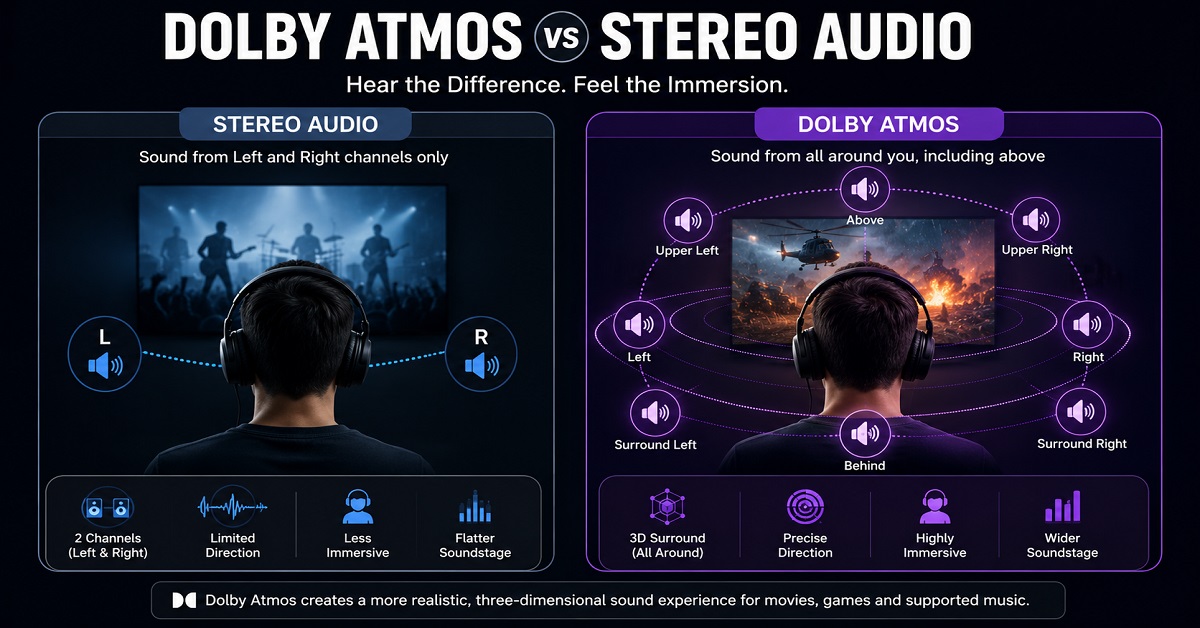
Stereo has been the standard for decades. It uses two audio channels, one for the left ear and one for the right. While stereo can produce excellent sound quality, it doesn’t accurately place sounds around the listener.
Dolby Atmos goes a step further by creating a virtual three-dimensional soundstage. Instead of hearing everything from just the left and right, sounds can appear to come from in front of you, behind you, above you, or somewhere in between.
| Feature | Stereo Audio | Dolby Atmos |
|---|---|---|
| Audio Channels | Left and Right | Object-based 3D audio |
| Sense of Space | Limited | Much wider and more immersive |
| Movie Experience | Good | More cinematic |
| Gaming | Basic directional sound | Better positional awareness |
| Music | Traditional stereo mix | Supported songs can sound more spacious |
| Hardware Requirement | Any headphones | Any compatible headphones with supported devices and content |
For everyday listening, stereo still delivers excellent audio quality. However, when you’re watching action movies, playing competitive games, or listening to Dolby Atmos music, the extra sense of depth and direction can make the experience feel much more engaging.
Dolby Atmos vs Spatial Audio
Many people use the terms Dolby Atmos and Spatial Audio interchangeably, but they are not exactly the same.
Dolby Atmos is an audio format and technology that stores sound as individual audio objects. It tells compatible devices where each sound should be placed in a three-dimensional space.
Spatial Audio, on the other hand, is a playback feature that creates an immersive listening experience using technologies such as Dolby Atmos or other surround sound formats.
Think of it this way:
- Dolby Atmos is the content and audio technology.
- Spatial Audio is how some devices reproduce that content for the listener.
For example, Apple’s Spatial Audio can play Dolby Atmos tracks while also using features like dynamic head tracking on supported AirPods. As you turn your head, the sound adjusts to make it feel like it’s coming from a fixed position in front of you.
Similarly, some Android manufacturers offer their own versions of spatial audio that enhance Dolby Atmos-compatible content.
Although the names are different, the goal is the same: to create a more realistic and immersive listening experience than standard stereo audio.
Does Dolby Atmos Make a Difference?
The answer is yes, but only in the right situations.
Dolby Atmos isn’t designed to make every song or video sound dramatically better. Instead, it enhances audio that has been specifically created or mixed for Dolby Atmos. When paired with compatible devices and content, it can deliver a more immersive listening experience than standard stereo audio.
Let’s see how it performs in different scenarios.
Watching Movies and TV Shows
This is where Dolby Atmos makes the biggest difference.
Movies often contain sounds coming from multiple directions, such as dialogue, background music, explosions, rain, footsteps, or vehicles moving across the screen. Dolby Atmos places these sounds more accurately around you, making scenes feel more lifelike.
For example, imagine you’re watching an action movie. A helicopter flies overhead while people are talking in front of you, and explosions happen in the distance. With standard stereo audio, these sounds mainly come from the left and right channels.
With Dolby Atmos, the helicopter can seem to fly above you, dialogue stays centered, and surrounding effects feel more natural. This creates a cinematic experience, even when you’re using headphones.
If you frequently watch movies or TV series on streaming platforms that support Dolby Atmos, you’ll likely notice the improvement.
Listening to Music
The impact of Dolby Atmos on music depends largely on the song.
Traditional songs are mixed in stereo, meaning instruments and vocals are distributed between the left and right channels. Dolby Atmos music allows producers to place each instrument, vocal, or sound effect in a three-dimensional space.
For instance, vocals may sound centered while guitars, drums, and backing vocals appear to surround you, creating a wider and more spacious soundstage.
Some listeners love this immersive presentation because it reveals details that are less noticeable in stereo. Others prefer the original stereo mix, especially for older songs.
Whether Dolby Atmos sounds better for music is often a matter of personal preference.
Playing Games
Gamers can benefit significantly from Dolby Atmos, especially in games where sound direction matters.
In first-person shooters, racing games, or adventure titles, knowing where sounds are coming from can improve both immersion and awareness.
For example:
- You may hear footsteps approaching from behind.
- Vehicle engines can sound like they’re passing beside you.
- Aircraft may appear to fly overhead.
- Environmental sounds can make virtual worlds feel more realistic.
While Dolby Atmos won’t improve your gaming skills on its own, it can make gameplay more engaging and help you better understand your surroundings in supported games.
Everyday Listening
If you’re mainly listening to podcasts, YouTube videos, voice calls, or standard stereo music, you may not notice a major difference.
These types of content are often produced in stereo, so Dolby Atmos has less audio information to work with. In some cases, enabling Dolby Atmos may create a slightly wider soundstage, but the improvement is usually subtle.
For casual daily use, standard stereo audio is often sufficient.
Advantages of Dolby Atmos Headphones
Whether you’re using premium over-ear headphones or wireless earbuds, Dolby Atmos offers several benefits when everything is compatible.
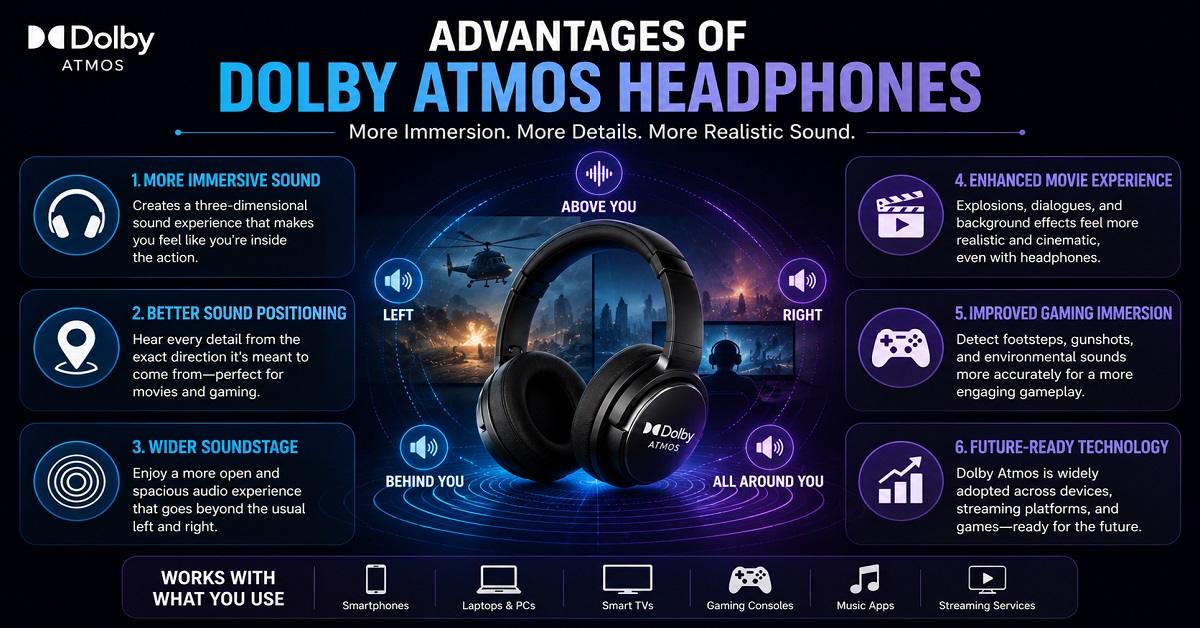
1. More Immersive Sound
Instead of hearing audio from just the left and right, sounds feel like they surround you. This creates a more realistic listening experience for movies, games, and supported music.
2. Better Sound Positioning
Dolby Atmos improves the perception of where sounds originate.
For example, you’ll have an easier time identifying whether footsteps are behind you or whether a vehicle is approaching from the left or right in supported games and movies.
3. Wider Soundstage
Many listeners describe Dolby Atmos as making the sound feel more open and spacious.
Rather than everything feeling compressed between your ears, audio appears to extend beyond the headphones, creating a greater sense of depth.
4. Enhanced Movie Experience
Movie lovers are among the biggest beneficiaries of Dolby Atmos.
Action scenes, background effects, and environmental sounds become more engaging, helping recreate the feeling of watching a film in a cinema.
Premium headphones generally offer a better Dolby Atmos experience because they combine high-quality drivers with excellent comfort for long listening sessions.
5. Improved Gaming Immersion
Games with Dolby Atmos support can feel more realistic because environmental sounds are positioned more accurately around the player.
Whether you’re exploring open-world environments or competing in multiplayer matches, the added spatial awareness can make gameplay more enjoyable.
6. Future-Ready Audio Technology
More streaming services, smartphones, gaming consoles, and music platforms continue to support Dolby Atmos every year.
Choosing devices that support Dolby Atmos helps ensure you’re ready to enjoy compatible content as it becomes increasingly common.
Limitations of Dolby Atmos
While Dolby Atmos can significantly improve your listening experience, it’s important to understand that it isn’t perfect. Knowing its limitations will help you set realistic expectations before choosing Dolby Atmos headphones or enabling the feature on your device.
1. Not All Content Supports Dolby Atmos
Dolby Atmos only works as intended when the movie, song, or game has been created or mixed in the Dolby Atmos format.
If you’re listening to standard stereo music or watching videos that don’t support Dolby Atmos, you may notice little to no improvement.
2. Device Compatibility Matters
Even if you own excellent headphones, you’ll still need a compatible device and app to experience Dolby Atmos.
For example, some smartphones, laptops, streaming services, and gaming consoles support Dolby Atmos, while others don’t. Without compatibility, your audio will simply play in standard stereo.
3. The Difference Isn’t Always Dramatic
Many people expect Dolby Atmos to completely transform the sound of every song or movie.
In reality, the improvement varies depending on the content.
For action movies and supported games, the difference can be quite noticeable. For podcasts, YouTube videos, or regular stereo songs, the change is often much smaller.
4. Personal Preference Plays a Role
Not everyone prefers the Dolby Atmos sound profile.
Some listeners enjoy the wider and more spacious presentation, while others feel that certain songs sound more natural in their original stereo mix.
There’s no right or wrong choice. It ultimately comes down to your listening preferences.
Is Dolby Atmos Worth It?
For most people, yes. However, the value depends on how you use your headphones.
Here’s a quick recommendation based on different types of users.
| User Type | Is Dolby Atmos Worth It? |
|---|---|
| Movie lovers | ✅ Yes. One of the best upgrades for a more cinematic experience. |
| Gamers | ✅ Yes. Better positional audio and improved immersion in supported games. |
| Music listeners | ✅ Usually. Worth trying if you use Dolby Atmos-supported music services. |
| Casual users | ⚠️ Maybe. The difference may be small for everyday listening. |
| Podcast listeners | ❌ Not necessary. Stereo audio is generally sufficient. |
If your smartphone or computer already includes Dolby Atmos support, it’s worth enabling the feature and comparing it with standard stereo audio. Since everyone’s hearing preferences are different, the best way to decide is by listening to the same content with Dolby Atmos turned on and off.
Best Dolby Atmos Headphones in 2026 (Quick Recommendations)
Frequently Asked Questions
Can any headphones use Dolby Atmos?
Yes. Most wired and wireless stereo headphones can play Dolby Atmos audio, provided your device, app, and content support the technology.
Do I need expensive headphones for Dolby Atmos?
No. Dolby Atmos is primarily processed through software, so even affordable headphones can benefit. However, higher-quality headphones may reproduce the effects more clearly because of their better overall sound quality.
Is Dolby Atmos better than stereo?
For supported movies, games, and music, Dolby Atmos usually provides a more immersive listening experience than stereo. For regular content, the difference may be minimal.
Does Dolby Atmos improve music quality?
Dolby Atmos doesn’t increase the audio quality itself. Instead, it changes how sounds are positioned around you, making supported songs feel more spacious and immersive.
Can wired headphones use Dolby Atmos?
Yes. Wired headphones work just as well as wireless headphones, as long as the connected device supports Dolby Atmos.
Does Dolby Atmos work with Bluetooth headphones?
Yes. Most Bluetooth headphones can play Dolby Atmos content if your smartphone, computer, or streaming service supports it.
Does Dolby Atmos consume more battery?
Enabling Dolby Atmos may use slightly more battery because your device performs additional audio processing. However, for most users, the impact is relatively small.
Is Dolby Atmos good for gaming?
Yes. Many gamers appreciate Dolby Atmos because it improves directional audio, making footsteps, vehicles, and environmental sounds easier to identify in supported games.
Key Takeaways
- Dolby Atmos creates a virtual three-dimensional sound experience that feels more immersive than traditional stereo audio.
- Most headphones can use Dolby Atmos because the processing happens on compatible devices rather than inside the headphones themselves.
- Dolby Atmos provides the biggest improvements when watching movies, playing games, and listening to content specifically mixed in Dolby Atmos.
- Standard stereo content may show little or no noticeable improvement.
- Whether Dolby Atmos is worth using depends on the type of content you enjoy and your personal listening preferences.
Conclusion
Dolby Atmos has changed the way many people experience audio by making movies, games, and supported music feel more immersive and realistic. Instead of limiting sound to the left and right channels, it creates the impression that audio is coming from different directions, adding depth and dimension to your listening experience.
The good news is that you don’t necessarily need specialized Dolby Atmos headphones to enjoy these benefits. Most standard headphones can reproduce Dolby Atmos audio when paired with a compatible device and supported content.
That said, Dolby Atmos isn’t a magic upgrade for everything you listen to. If your favorite songs, videos, or apps don’t support the format, standard stereo audio will still provide an excellent experience.
If you regularly watch movies, play games, or stream Dolby Atmos-supported music, enabling the feature is definitely worth trying. For many users, it adds an extra layer of immersion that makes entertainment more enjoyable. The best approach is to test it yourself using compatible content and decide which listening experience you prefer.

About the Author
Hari Prasad is the editor of AudioPick.in and a lifelong audio enthusiast. He writes detailed, honest reviews and guides to help everyday users pick the right gear without tech jargon. His personal interest in Bluetooth audio, neckbands, and codecs comes from testing dozens of devices over the past few years.