
If you’ve ever listened to music late at night and suddenly felt your earbuds sounded clearer, deeper, or more immersive, you’re not alone.
Many people notice that their earbuds sound better at night compared to daytime listening. Songs may feel more emotional, bass may seem stronger, and tiny audio details become easier to notice.
At first, this might feel like imagination.
But surprisingly, there are real scientific and psychological reasons behind why earbuds sound better at night.
In this article, we’ll break down:
- why nighttime listening feels different,
- how your brain affects sound perception,
- whether earbuds actually perform better at night,
- and what makes music feel more immersive after dark.
Let’s understand the real science in simple words.
What Does “Earbuds Sound Better at Night” Actually Mean?
When people say earbuds sound better at night, they usually mean:
- music feels clearer,
- bass sounds richer,
- vocals feel more emotional,
- and the overall listening experience becomes more immersive.
The earbuds themselves usually do not change.
Instead, the environment around you changes.
Your ears, brain, surroundings, and even your mood all affect how audio feels.
That is why the same earbuds can feel completely different at different times of the day.
Why Earbuds Sound Better at Night
There isn’t just one reason why earbuds sound better at night.
Several small factors work together to improve the listening experience.
Let’s understand them one by one.
1. The Environment Becomes Much Quieter
This is the biggest reason why earbuds sound better at night.
During the day, your brain constantly processes background noise like:
- traffic,
- ceiling fans,
- conversations,
- TV sounds,
- construction,
- vehicle horns,
- and notifications.
Even if you are not actively paying attention to these sounds, your brain still hears them.
At night, most of these noises reduce significantly.
As a result:
- vocals become clearer,
- instruments become easier to separate,
- and small audio details become more noticeable.
Recent Article: Best Low-Profile Earbuds Under ₹2000 in 2026
Simple Example
Imagine trying to hear someone speaking in a crowded market.
Now imagine listening to the same person in a quiet room.
The voice itself did not change. The environment changed.
That is exactly what happens with earbuds at night.
2. Your Brain Becomes More Relaxed
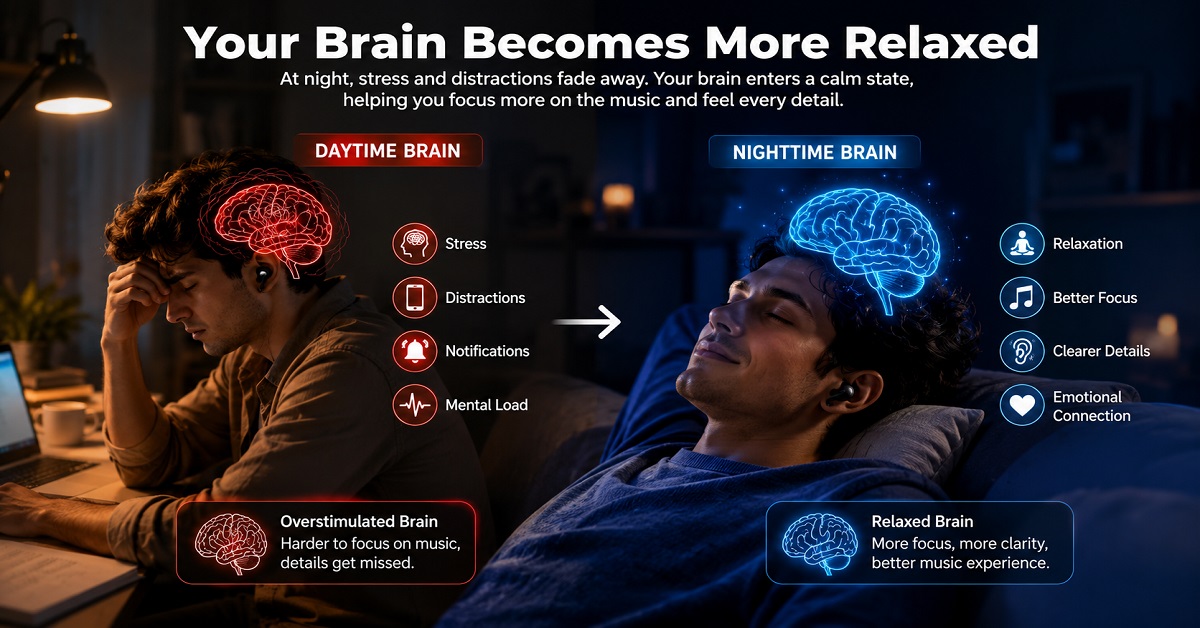
Another major reason why earbuds sound better at night is your mental state.
Sound is not only processed by the ears. Your brain plays a huge role.
During daytime, your brain handles:
- work stress,
- studies,
- phone usage,
- multitasking,
- and constant distractions.
Because of this, you may not fully focus on music.
At night, your brain usually becomes calmer.
You are:
- less distracted,
- more emotionally connected,
- and more focused on what you’re hearing.
This improves audio immersion naturally.
That is why emotional songs often feel even more powerful late at night.
3. Bass Feels Stronger at Night
Many people say bass sounds deeper during nighttime listening.
This also has a scientific reason.
Low-frequency sounds like bass are often masked by environmental noise during the day.
For example:
- AC hum,
- fan sounds,
- road traffic,
- and city noise
can interfere with low-frequency perception.
At night, quieter surroundings allow your ears to notice bass more clearly.
This creates the feeling that your earbuds suddenly became more powerful.
But in reality, your environment simply stopped interfering with the sound.
4. Your Hearing Perception Changes Throughout the Day
Human hearing is not exactly constant all day long.
Factors like:
- stress,
- tiredness,
- loud environments,
- and mental fatigue
can affect how you perceive sound.
For example, after spending hours in noisy places, your ears may temporarily become less sensitive.
Later at night, when things become quieter, your hearing may feel more balanced again.
That is another reason why earbuds sound better at night for many people.
5. Nighttime Improves Focused Listening
During daytime listening, music often becomes background noise.
People usually:
- scroll social media,
- work,
- travel,
- or multitask while listening.
At night, people are more likely to:
- lie down,
- close their eyes,
- relax,
- and focus only on the music.
This deeper attention improves the listening experience naturally.
You start noticing:
- hidden instruments,
- background vocals,
- soundstage,
- and stereo separation more clearly.
Similar Post: Why Earbuds Sound Different Even with Similar Specs
How Sound Perception Works in Simple Terms
To understand why earbuds sound better at night, it helps to know how hearing works.
Your ears capture sound waves.
Then your brain processes those signals and decides:
- how loud the sound feels,
- how emotional it feels,
- and how immersive it feels.
So hearing is actually a combination of:
- Your earbuds
- Your ears
- Your brain
- Your surroundings
If even one of these changes, your listening experience changes too.
Are Earbuds Actually Performing Better at Night?
No. Your earbuds themselves are usually performing exactly the same.
The drivers, tuning, and hardware do not suddenly improve after sunset.
What changes is:
- your environment,
- your focus,
- and your hearing perception.
This creates the illusion that the earbuds sound better at night.
In simple words:
Your ears are hearing more because your surroundings are interfering less.
Why Slow and Emotional Songs Feel Better at Night
Have you noticed this too?
Songs with:
- soft vocals,
- lo-fi beats,
- acoustic instruments,
- piano,
- or emotional lyrics
often feel more powerful at night.
This happens because nighttime naturally creates a calmer atmosphere.
Your brain becomes more emotionally connected to slower music during relaxed situations.
That is why many people prefer:
- lo-fi playlists,
- romantic songs,
- soft pop,
- and chill music at night.
Meanwhile, energetic songs are often preferred during workouts or daytime activities.
Does Volume Feel Louder at Night?
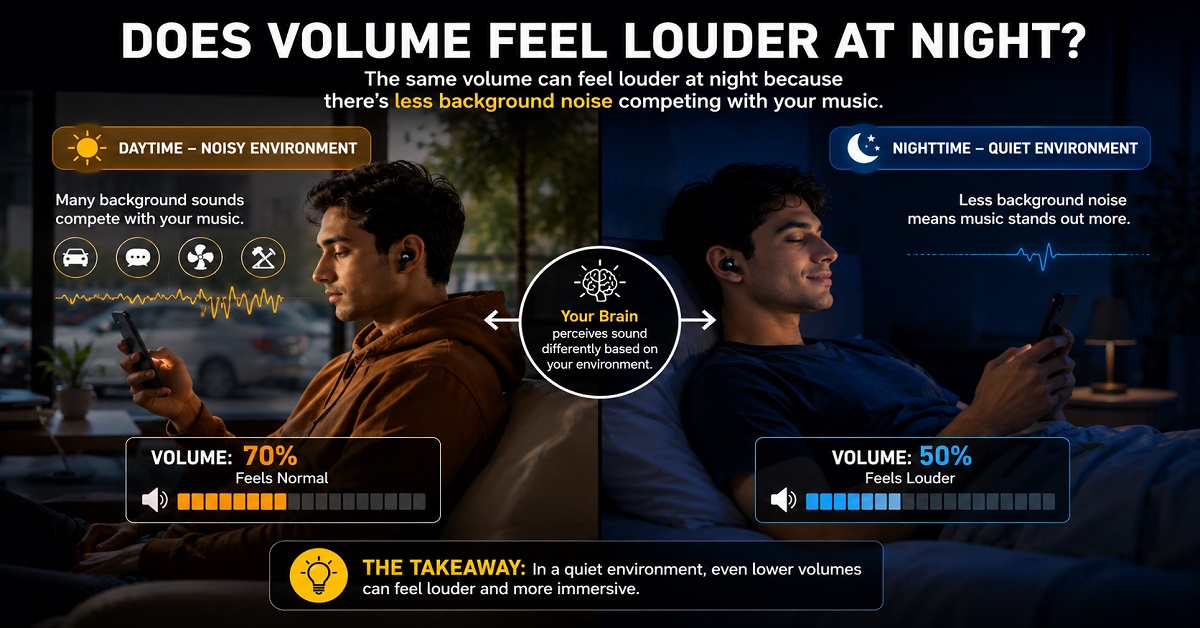
Yes, sometimes.
Even moderate volume levels can feel louder at night because there is less background noise competing with your music.
For example:
- 50% volume in a quiet room may feel louder than 70% volume in a noisy street.
This is also why some people accidentally play music too loudly at night without realizing it.
Advantages of Nighttime Listening
There are several benefits when earbuds sound better at night.
Better Audio Detail
You can hear:
- instruments,
- vocals,
- and sound effects more clearly.
More Relaxing Experience
Music feels calmer and more immersive.
Improved Focus
Nighttime listening is often distraction-free.
Better Emotional Connection
Songs may feel more meaningful and personal.
Limitations of Nighttime Listening
Even though earbuds sound better at night, there are also some drawbacks.
Higher Risk of Listening Too Loudly
People may increase volume too much in silent environments.
This can damage hearing over time.
Sleep Disruption
Listening to loud music before sleeping can affect sleep quality.
Ear Fatigue
Long listening sessions without breaks may cause discomfort.
Best Situations for Nighttime Earbud Listening
Nighttime listening works especially well for:
- relaxing after work,
- studying quietly,
- late-night walks,
- meditation music,
- podcasts,
- and emotional playlists.
People who enjoy detailed sound usually prefer listening at night because the environment helps them notice more audio details.
Keep Reading: Open-Ear Earbuds Explained: Are They Better Than Normal Earbuds?
Night Listening vs Day Listening
| Feature | Daytime Listening | Nighttime Listening |
|---|---|---|
| Background Noise | High | Low |
| Focus Level | Lower | Higher |
| Bass Perception | Moderate | Stronger |
| Emotional Immersion | Lower | Higher |
| Detail Clarity | Reduced | Better |
This table explains why earbuds sound better at night for many listeners.
FAQs
1. Why do earbuds sound better at night?
Earbuds sound better at night mainly because the environment becomes quieter, your brain becomes calmer, and background noise reduces.
2. Do earbuds actually improve at night?
No. The earbuds themselves do not change. Your listening conditions improve, which makes the sound feel better.
3. Why does bass feel stronger at night?
Bass becomes easier to notice because nighttime environments usually have less outside noise interfering with low frequencies.
4. Is it safe to listen to earbuds at night?
Yes, but avoid listening at very high volumes for long periods.
A safer volume range is around 50–60%.
5. Why do emotional songs feel more powerful at night?
Your brain is usually more relaxed and emotionally focused at night, which improves immersion and emotional connection with music.
Final Verdict
The reason why earbuds sound better at night is actually a combination of science, psychology, and environment.
At night:
- surroundings become quieter,
- distractions reduce,
- bass becomes clearer,
- and your brain focuses more deeply on the music.
Your earbuds are not magically improving.
Instead, your listening conditions become much better.
That is why nighttime music often feels more immersive, emotional, and enjoyable.
If you truly want to experience the full capability of your earbuds, try listening in a quiet environment at moderate volume levels.
You may start noticing audio details that you never heard before.
If you’ve ever noticed your earbuds sound better at night, chances are many other people around you have experienced the same thing without understanding why. Sharing this article can help your friends, family, or fellow music lovers discover the real science behind nighttime listening and improve their own audio experience too.
Whether someone enjoys late-night music sessions, relaxing with podcasts before sleep, or simply loves learning interesting audio facts, this guide can be genuinely useful. If this article helped you understand your earbuds better, consider sharing it on WhatsApp, Reddit, Facebook, X, or any music community you’re part of. You might help someone experience their favorite songs in a completely new way.

About the Author
Hari Prasad is the editor of AudioPick.in and a lifelong audio enthusiast. He writes detailed, honest reviews and guides to help everyday users pick the right gear without tech jargon. His personal interest in Bluetooth audio, neckbands, and codecs comes from testing dozens of devices over the past few years.